Timeline
-
1831
Frederick Richards Leyland born in Liverpool on September 30
Darwin begins voyage on the Beagle
-
1834
Slavery abolished throughout British Empire
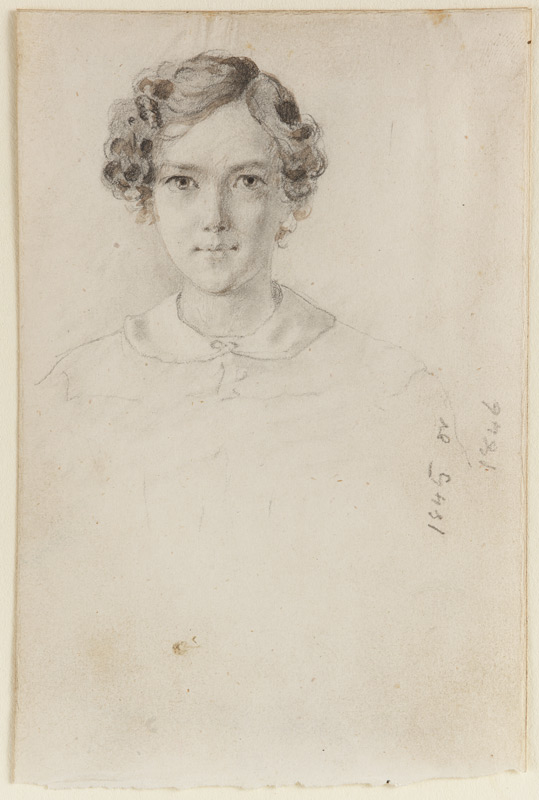
Portrait of Whistler, 1845 or 1846, pencil touched with watercolor on paper (F1898.144)
James Abbott McNeill Whistler born to Major George Washington Whistler and Anna Matilda McNeill Whistler on July 11 in Lowell, Massachusetts
-
1837
Euston Station, London's first railway station, opens
-
1838
First Canadian railway begins operation
-
1839
First Opium War between England and China (ends 1842 with Treaty of Nanking)
-
1840
World Anti-Slavery Convention held in London
-
1842
Treaty of Nanking signed; Hong Kong ceded to Great Britain
-
1843
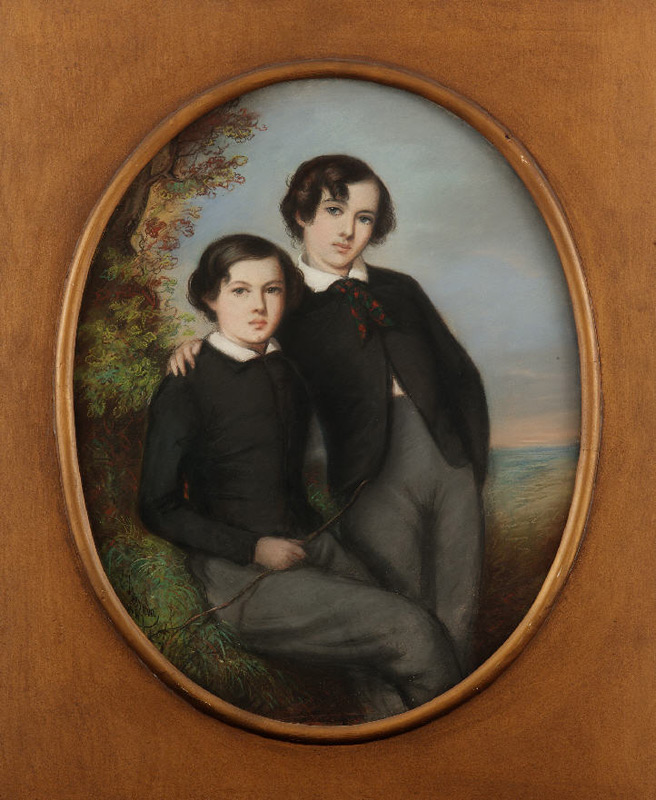
Portrait of J. McNeill Whistler and his brother William (Dr. Whistler), Emile Francois Dessain, 1847, pastel on paper (F1904.412)
Whistler family moves to St. Petersburg, Russia, where Major Whistler, a civil engineer, works on the St. Petersburg-to-Moscow railway
-
1844
Leyland begins work as an office boy at Messrs. Bibby, Sons, & Co., a Liverpool shipping company
-
1846
Mexican-American War
-
1848
Treaty of Guadalupe Hidalgo ends U.S. war with Mexico
-
1851
Whistler enrolls at U.S. Military Academy at West Point, N.Y.
Crystal Palace/Great Exhibition of the Industry of All Nations opens in Hyde Park, London
-
1853
Railways introduced in India; Commodore Matthew C. Perry and four U.S. naval ships steam into Edo Bay
-
1854

Sketches on the Coast Survey Plate, James McNeill Whistler, 1854-1855, etching on paper (F1897.17)
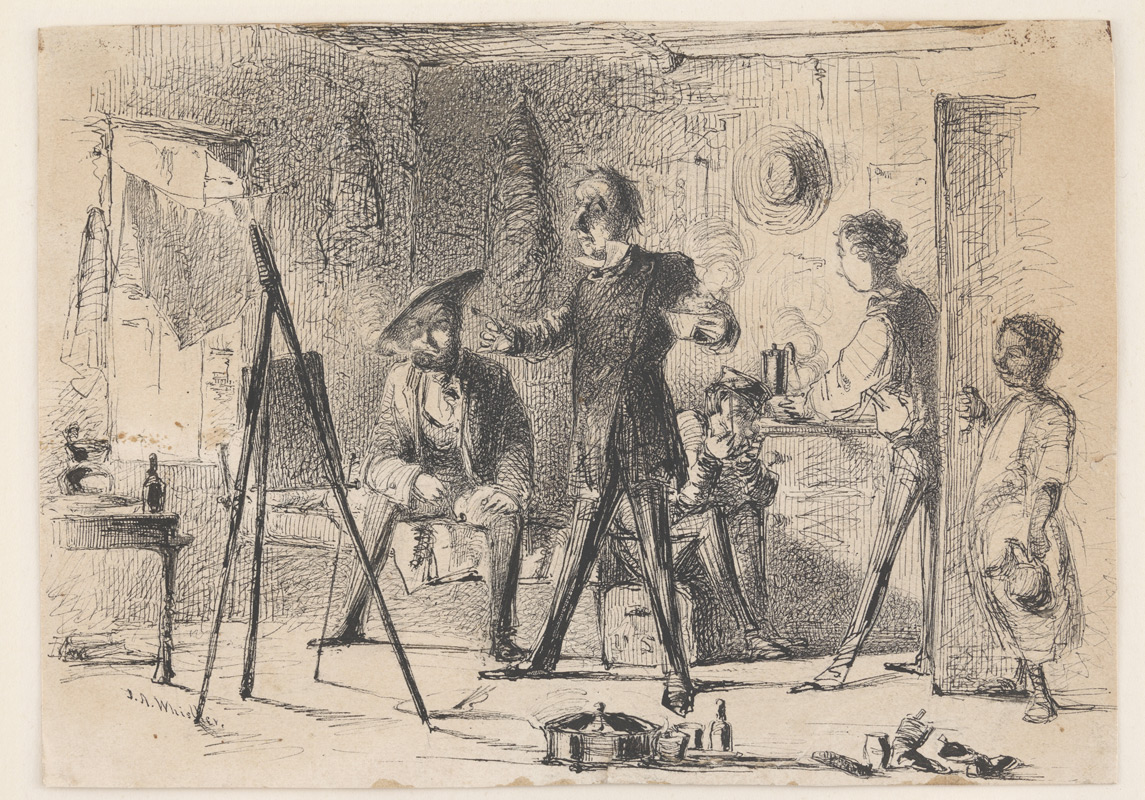
Connoisseurs in a Studio, James McNeill Whistler, 1854-1855, pen and ink drawing on paper (fsc-gr-778)
Expelled from West Point, Whistler is appointed to U.S. Coast and Geodetic Survey in Washington, D.C.
Charles Lang Freer born in Kingston, N.Y.
Commodore Perry's treaty 'opens' Japan to western trade
-
1855
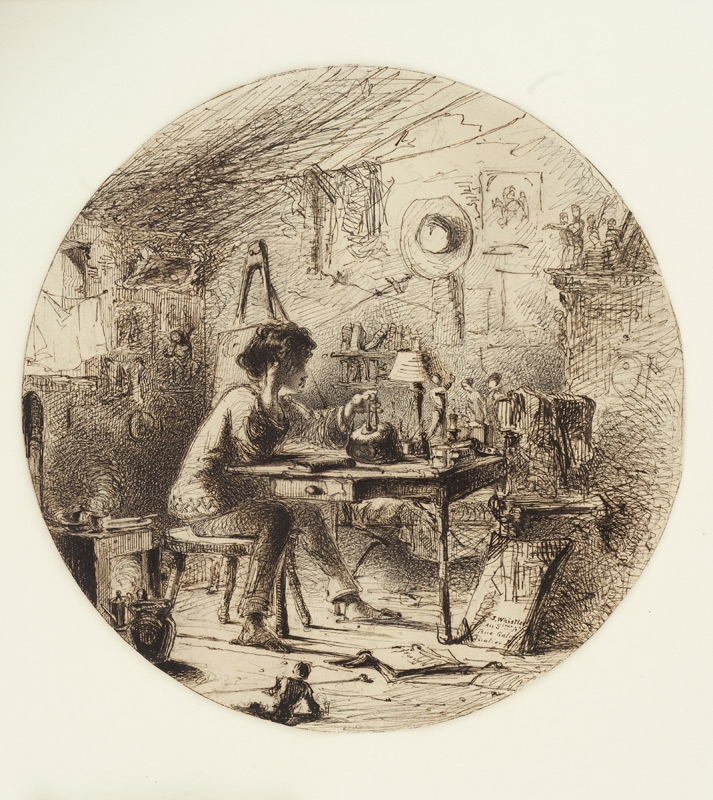
An Artist in His Studio, Seated before a Table, James McNeill Whistler, ca. 1856, pen, ink, and pencil on paper (F1906.104)
Whistler arrives in Paris and enters studio of Charles Gleyre
15,000 Chinese immigrants arrive in California to work on the transcontinental railroad
First land grant railroad in the U.S. completed; first railroad bridge across Mississippi River is completed
Leyland promoted to bookkeeper at Messrs. Bibby, Sons, & Co.
-
1856
Second Opium War between western nations and China (ends 1860 with Convention of Peking)
-
1858
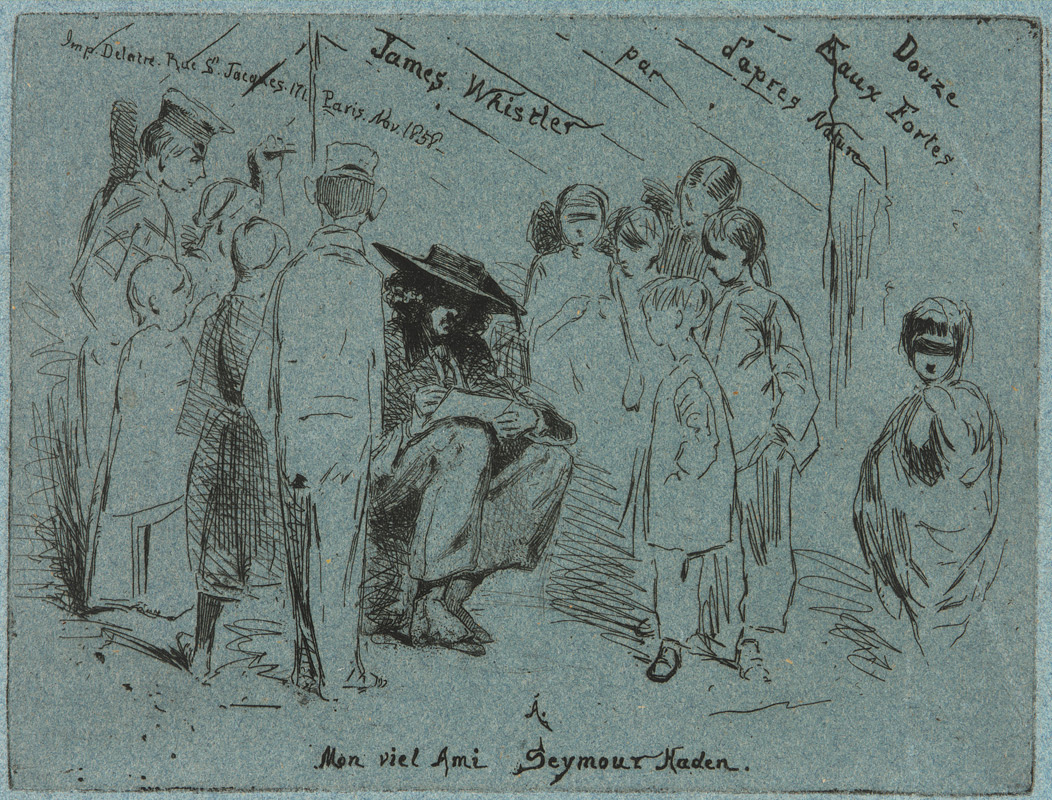
Title page of the "French Set," James McNeill Whistler, 1858, etching on paper (F1898.241)
Whistler embarks on sketching tour of Rhineland. Upon return to Paris, begins to print Twelve Etchings from Nature (the 'French Set'), which will be marketed in Paris and London, with the help of his brother-in-law Francis Seymour Haden
-
1859
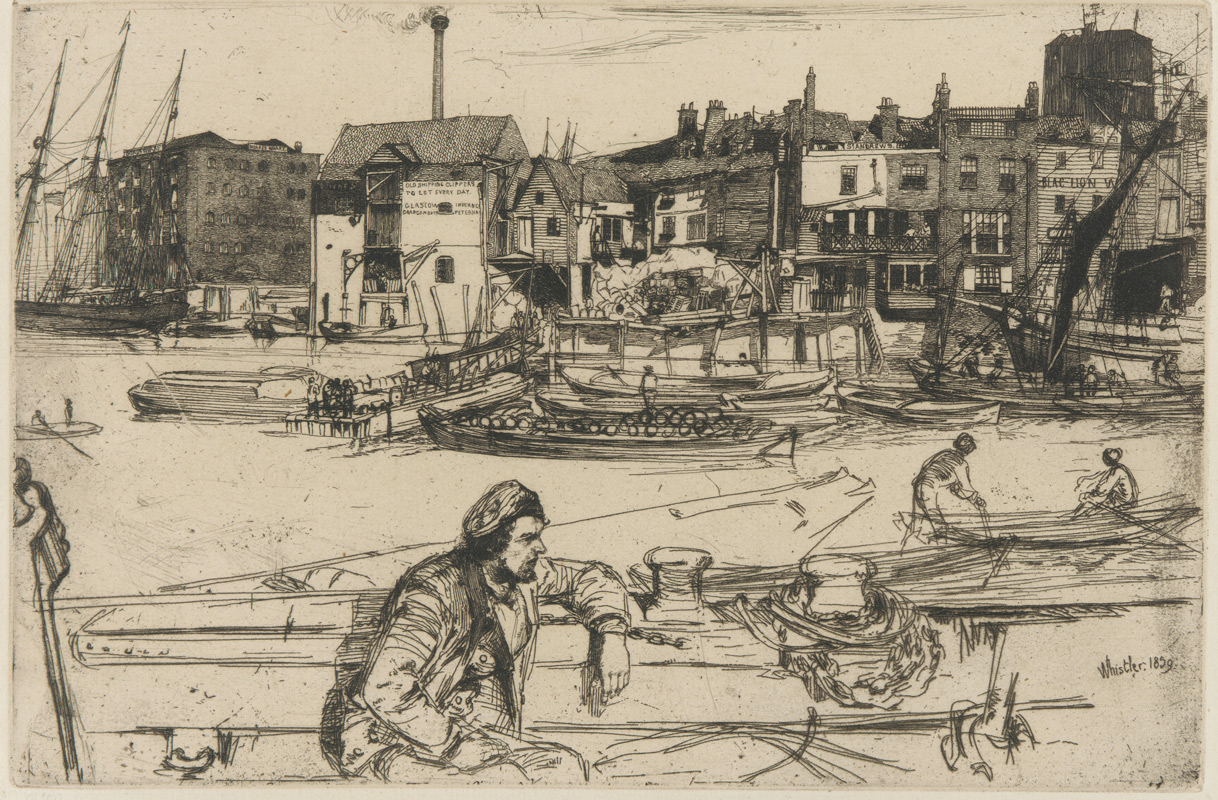
Black Lion Wharf, James McNeill Whistler, 1859, etching (F1906.105)
Whistler moves to London, staying with his half-sister Deborah and her husband, Francis Seymour Haden in their home in Sloane Street and in the seedier environs of Wapping, near London Docks, where he begins the 'Thames Set' etchings
Abolitionist John Brown leads a raid on Harper's Ferry, Virginia
Darwin publishes On the Origin of Species
-
1860
Whistler exhibits his first painting, At the Piano, at the Royal Academy in May
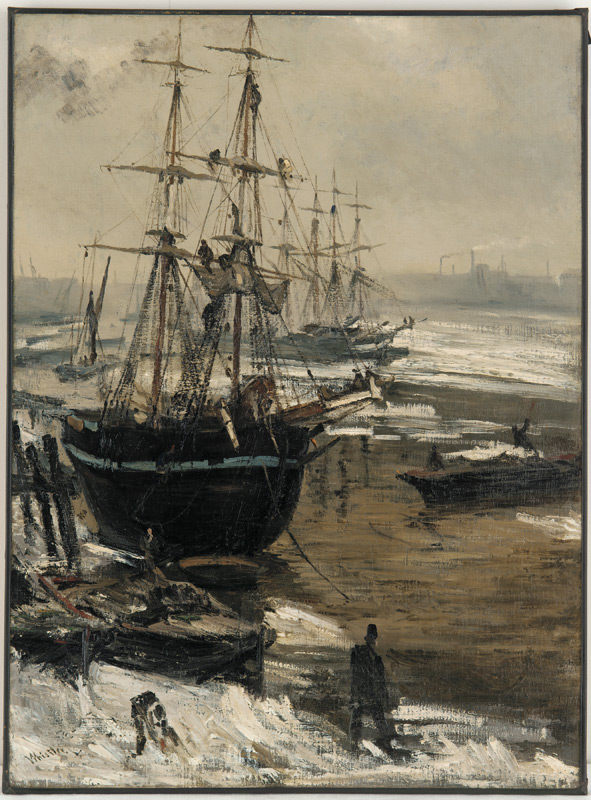
The Thames in Ice, James McNeill Whistler, 1860, oil on canvas (F1901.107ab)
Whistler paints The Thames in Ice in December
Abraham Lincoln elected U.S. president
-
1861
Whistler in Paris, painting The White Girl
Leyland becomes a partner in Messrs. Bibby, Sons, & Co.
U.S. Civil War Begins
-
1862
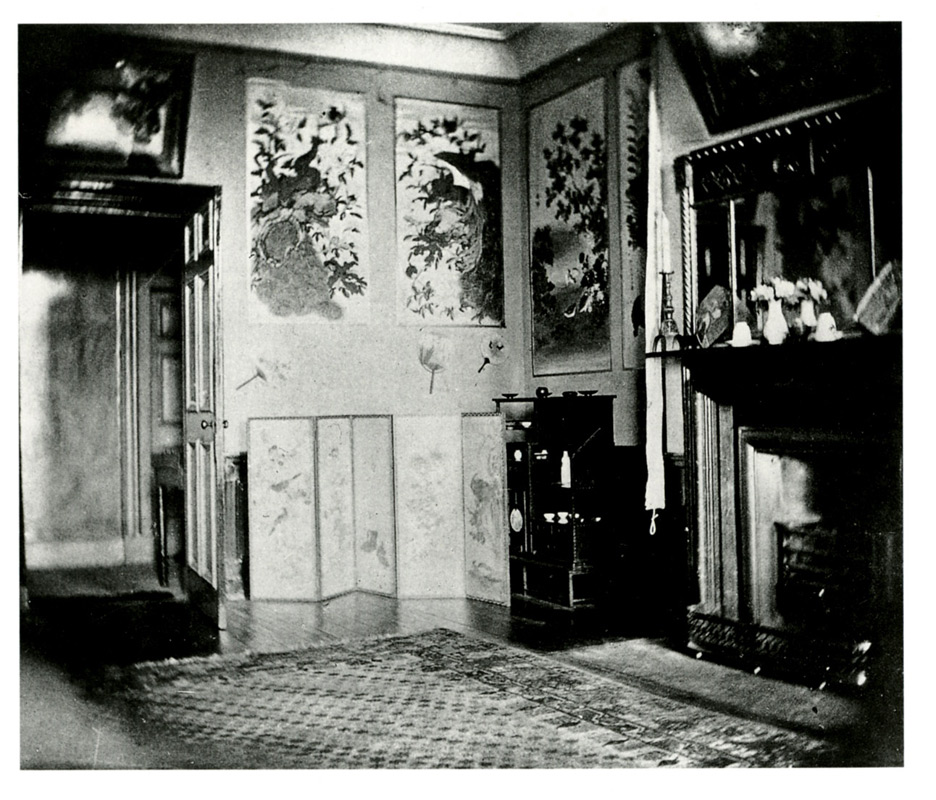
Whistler's drawing room at Cheyne Walk, London
Whistler moves to Chelsea and meets Pre-Raphaelites Dante Gabriel Rossetti and Charles Algernon Swinburne
Pacific Railway Act by U.S. Congress authorizes construction of first transcontinental railroad.
-
1863
Whistler exhibits The White Girl at the Salon des Refusés in Paris
Lincoln issues Emancipation Proclaimation; Congress passes Homestead Act
Whistler's mother moves into his Chelsea residence at 7 Lindsey Row; he begins to collect Chinese blue and white porcelain
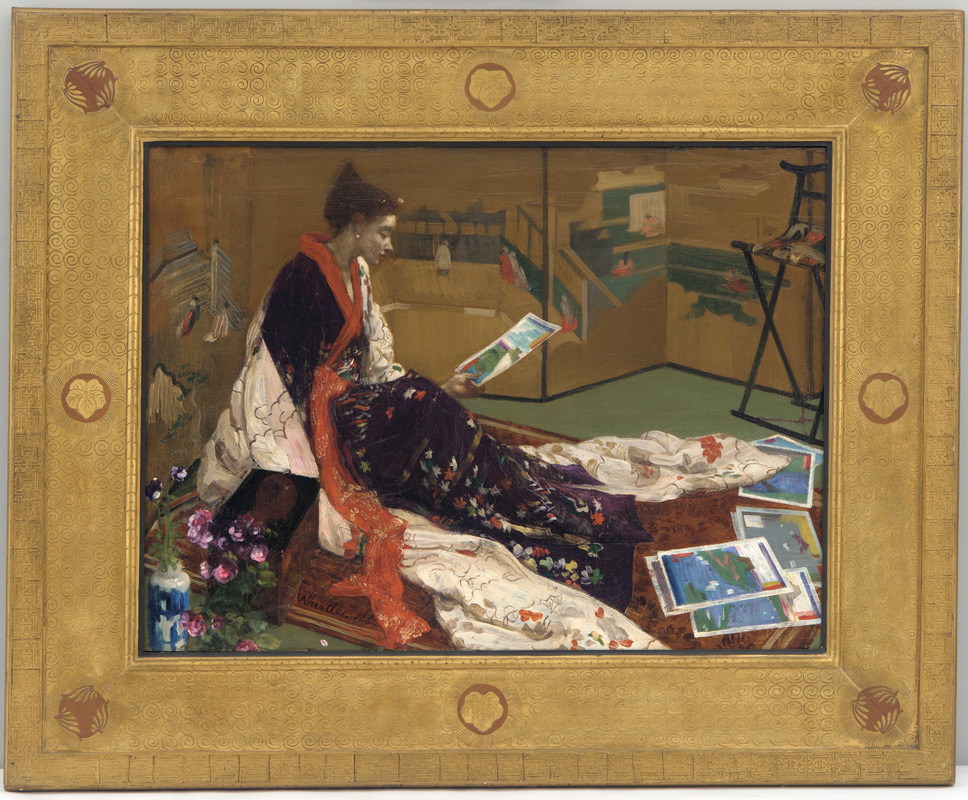
Caprice in Purple and Gold: The Golden Screen, James McNeill Whistler, 1864, oil on wood panel (F1904.75)
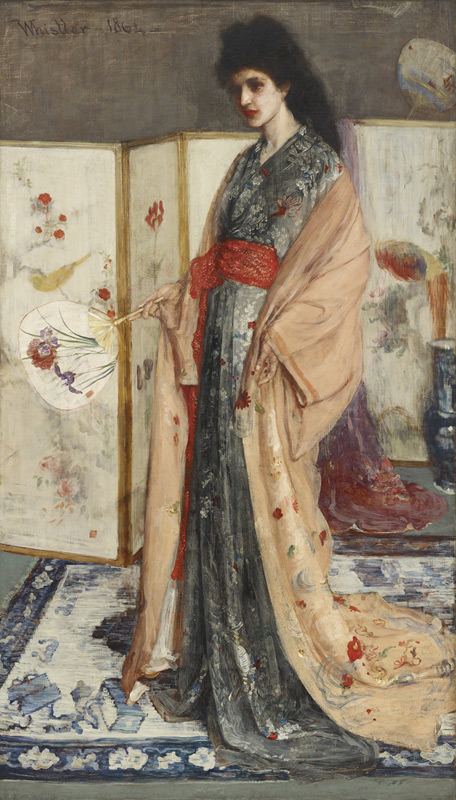
La Princesse du pays de la porcelaine, James McNeill Whistler, 1863-1865, oil on canvas (F1903.91a-b)
Whistler begins a series of oriental costume pictures featuring porcelains from his own collection
-
1865
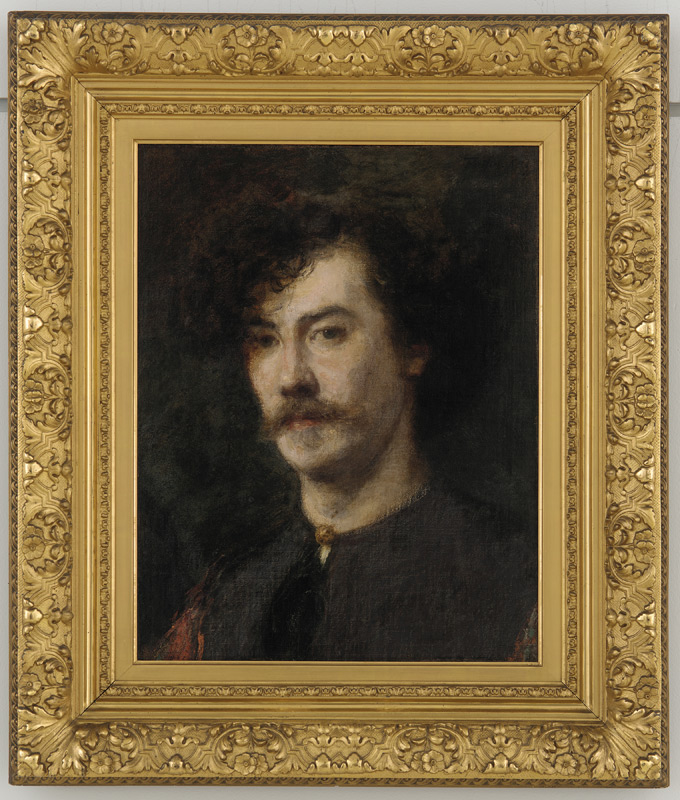
Portrait of Whistler, Henri Fantin-Latour, 1865, oil on canvas (F1906.276)
La Princesse is exhibited at the Paris Salon, along with Fantin-Latour's Le Toast:! (Homage a la Verité)
-
1866
La Princesse purchased by Frederick Huth
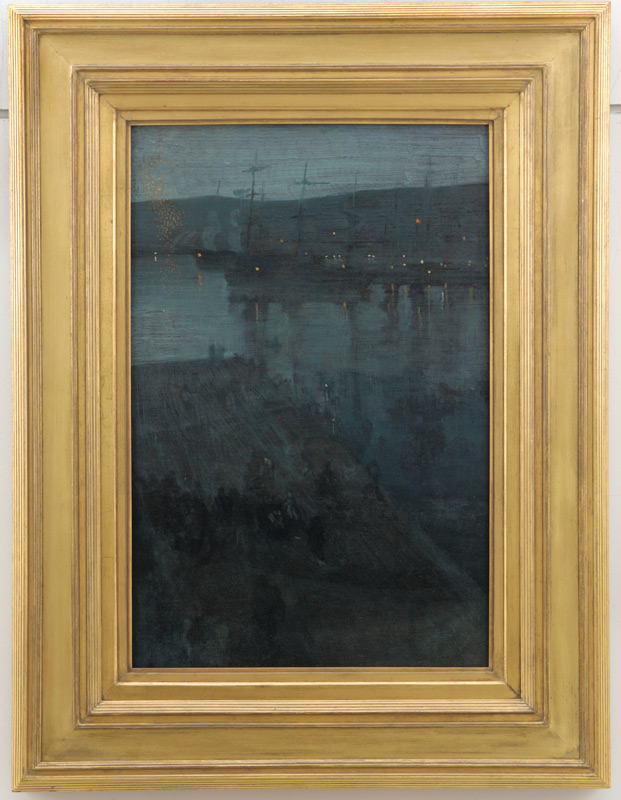
Nocturne in Blue and Gold: Valparaiso, James McNeill Whistler, 1866/ca. 1874, oil on canvas (F1909.127a-b)
Whistler travels to Valparaiso, Chile
-
1867
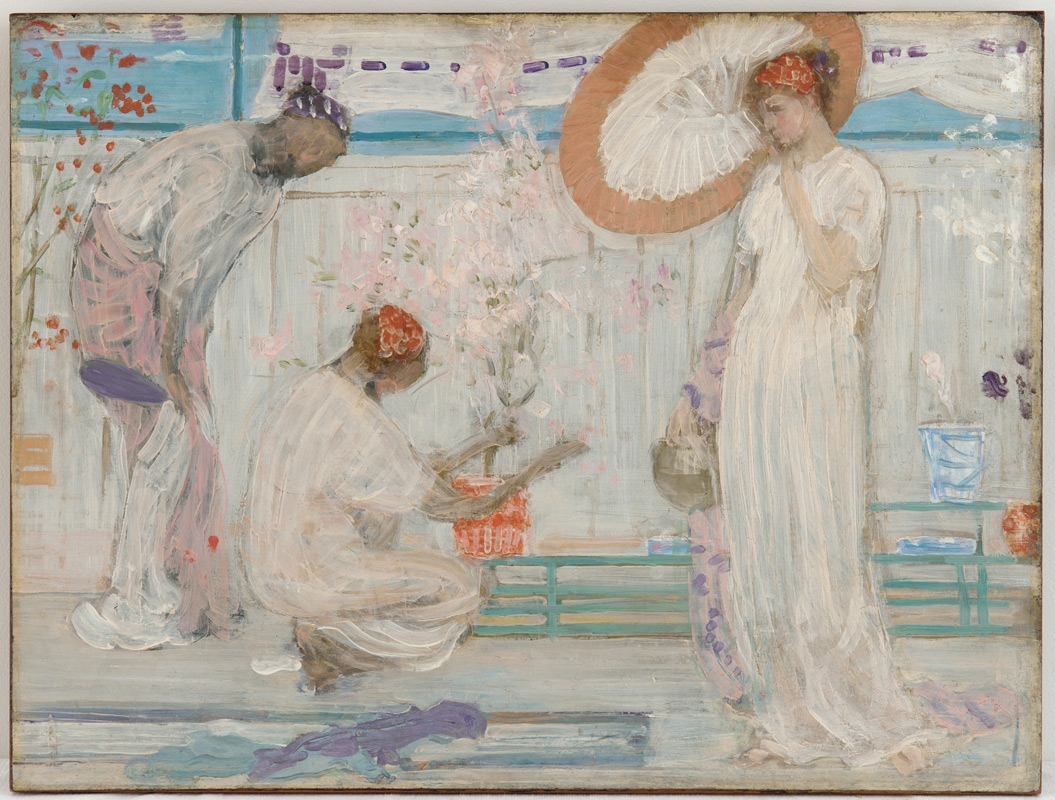
The White Symphony: Three Girls, James McNeill Whistler, ca. 1868, oil on millboard mounted on wood panel (F1902.138)
Leyland takes a lease on Speke Hall, a manor house outside Liverpool, and commissions Whistler to paint The Three Girls
Whistler renounces realism in letter to Fantin
Japanese art exhibited in Paris at the Exposition Universelle
Second Reform Act passed by British Parliament
-
1869
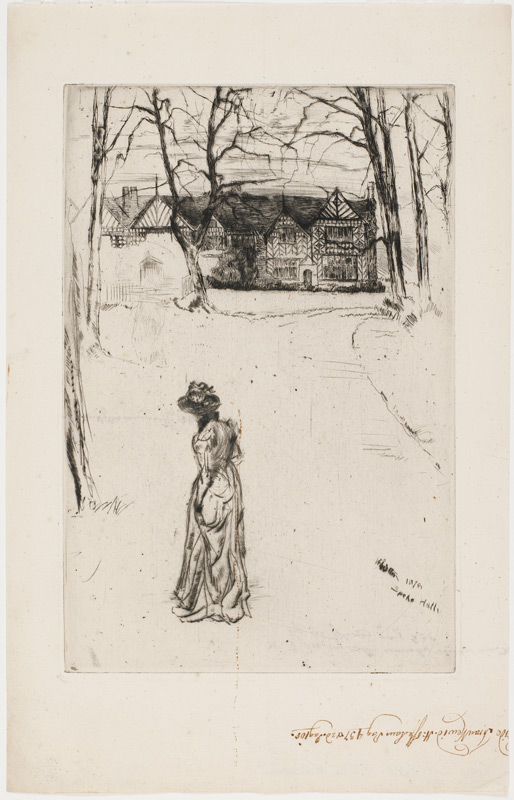
Speke Hall, No. 1, James McNeill Whistler, 1870, etching and drypoint on paper (F1898.332)
Leyland commissions Whistler to paint portraits of his family, and the artist makes first visit to Leyland's home at Speke Hall
Suez Canal opens
Central Pacific and Union Pacific Railroads joined at Promontory, Utah
-
1870

Arrangement in Black: Portrait of F.R. Leyland, James McNeill Whistler, 1870-1873, oil on canvas (F1905.100)
Whistler paints full-length portrait of Leyland
First train engine steams into Ulster County, N.Y., near Freer's home
-
1871
Whistler begins to paint Nocturnes - images of London after dark
Whistler publishes Sixteen Etchings of Scenes on the Thames
Whistler paints Arrangement in Grey and Black: Portrait of the Painter's Mother
-
1872
La Princesse exhibited in London at the International Exposition
Leyland sells his first art collection (mostly romantic landscapes) for £15,5001
Leyland acquires Bibby & Sons and launches Leyland Line
Leyland acquires La Princesse for his London home at 23 Queen's Gate
Freer becomes office clerk at Kingston & Syracuse Railway and is soon promoted to paymaster
-
1874
Whistler stages first one-man exhibition at Flemish Gallery in London
First Impressionist exhibition in Paris
-
1876
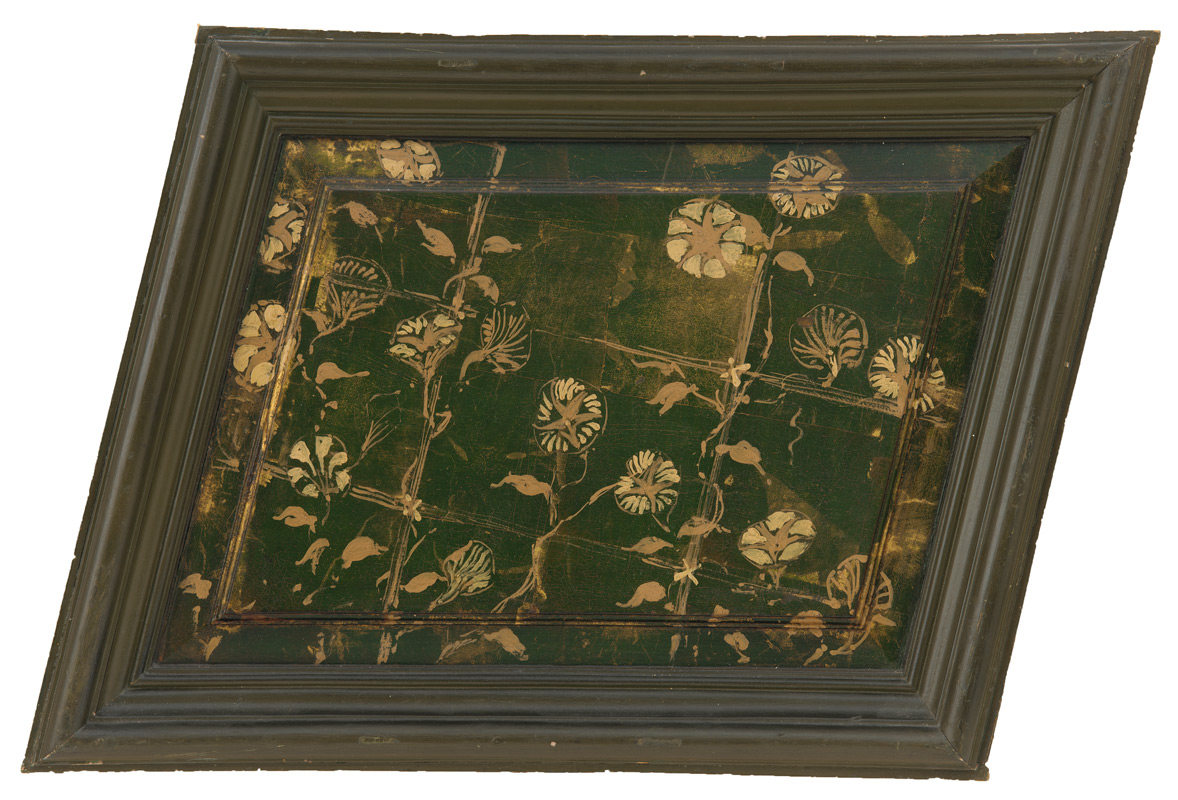
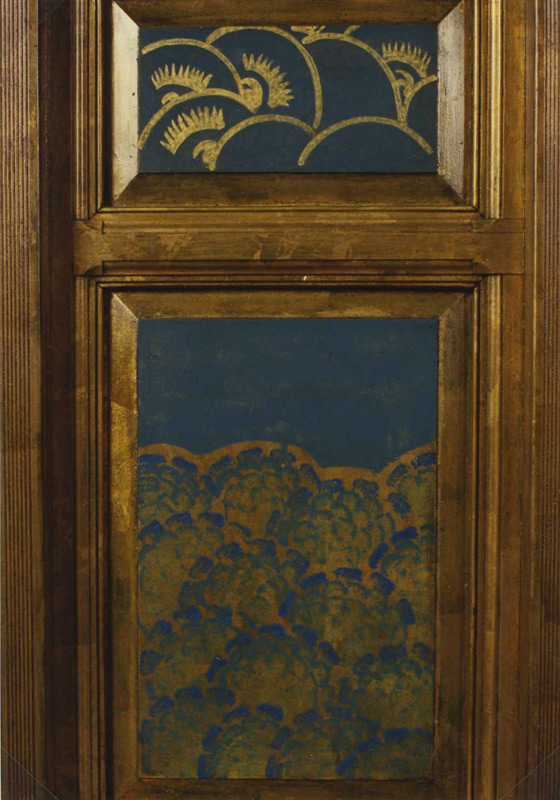
Staircase dado panel for entrance hall, 49 Prince's Gate, London, James McNeill Whistler, 1876, oil paint and metal leaf on wood (F1904.464)
Whistler works on stairway decoration at Leyland's London mansion at 49 Prince's Gate in Kensington in March
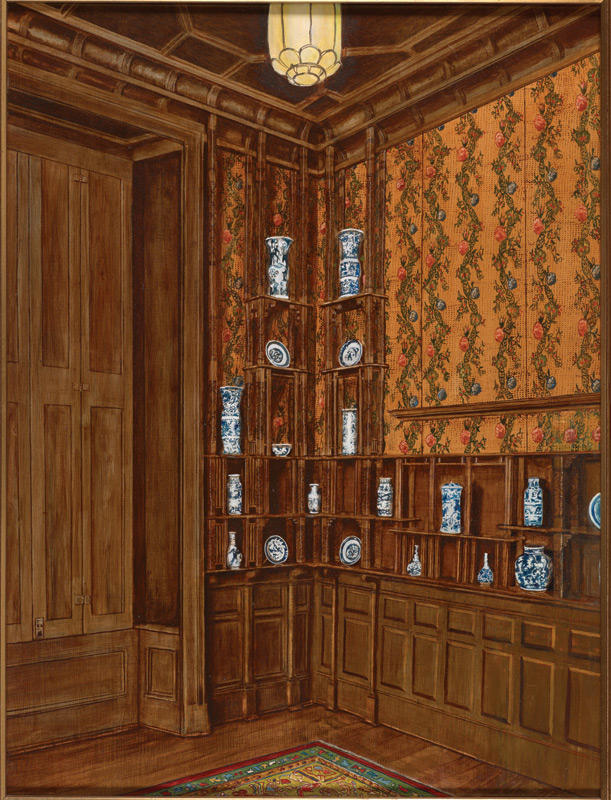
Southeast corner of the Peacock Room in April 1876. Rendering by Peter Nelsen.
Thomas Jeckyll remodels Leyland's dining room at Prince's Gate as a 'Chinese garden pavilion' and showcase for Leyland's porcelain collection in April
Centennial International Exhibition in Philadelphia opens
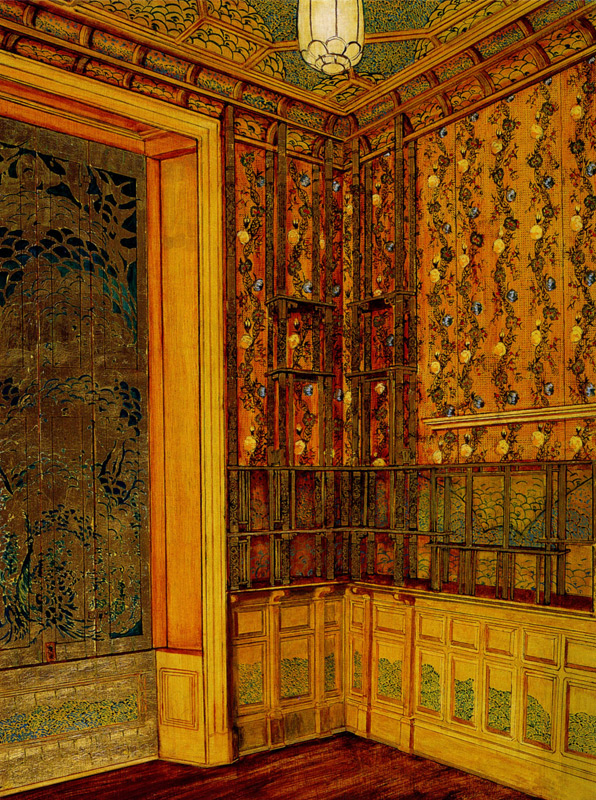
Peacock Room in October 1876. Rendering by Peter Nelsen
Whistler begins redecoration of Leyland's dining room at Prince's Gate in August
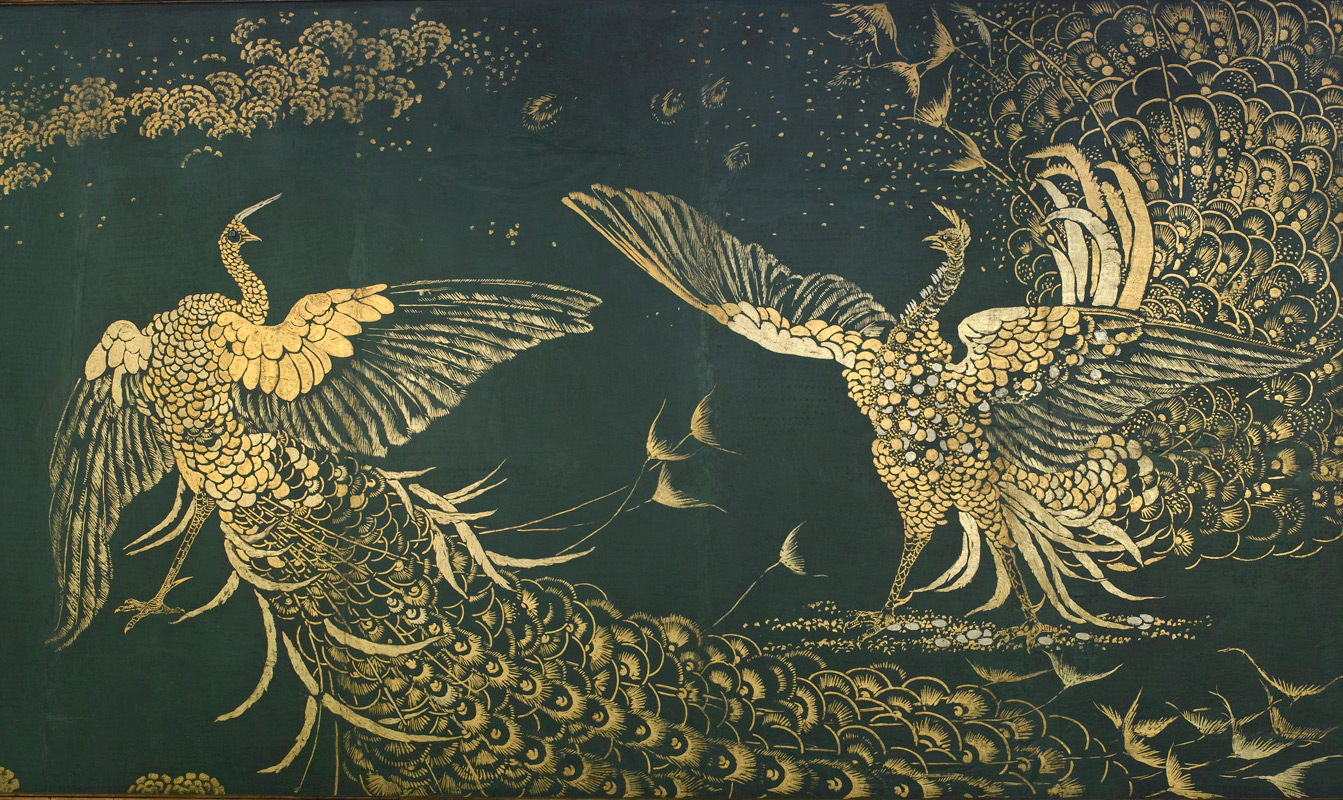
South wall mural of Harmony in Blue and Gold: The Peacock Room, James McNeill Whistler, 1876-77, oil paint and metal leaf on leather, canvas, and wood
Leyland and Whistler quarrel over payment for the Peacock Room, and Whistler paints allegorical mural Art and Money; or, the Story of the Room
Freer and Hecker move to Logansport, Indiana to work for the Detroit, Eel River and Illinois Railroad
-
1877
Press visit the Peacock Room in February
Grosvenor Gallery exhibition of Whistler nocturnes prompts critical diatribe from John Ruskin in May
Whistler commissions architect E. W. Godwin to build him the White House, a studio residence, in Tite Street
Jeckyll, in a manic state, is committed to Bethel Hospital
Thomas Edison presents prototype of the phonograph in December
-
1878
Images from A Catalogue of Blue and White Nankin Porcelain, Forming the Collection of Sir Henry Thompson, with illustrations by Whistler, published by art dealer Murray Marks
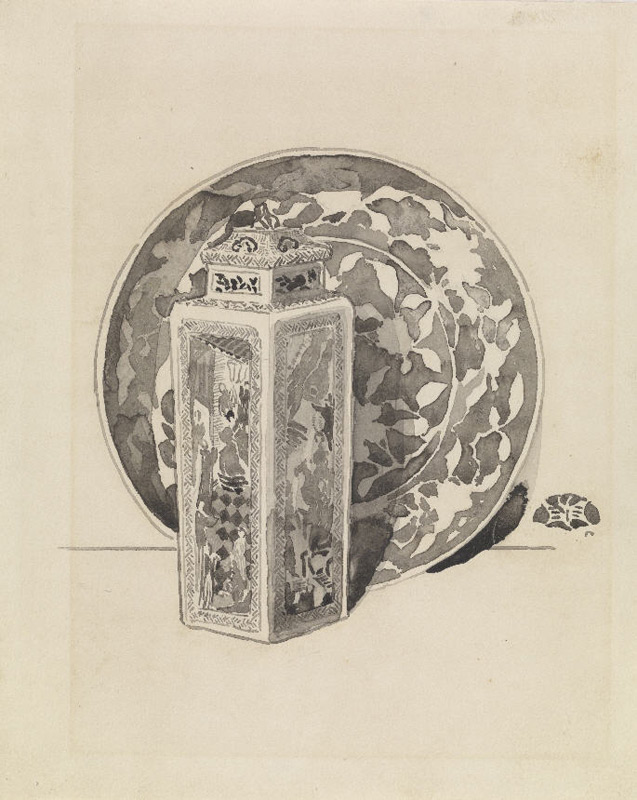
A Chinese porcelain covered square canister and saucer dish, James McNeill Whistler, 1876, drawing (F1898.415)
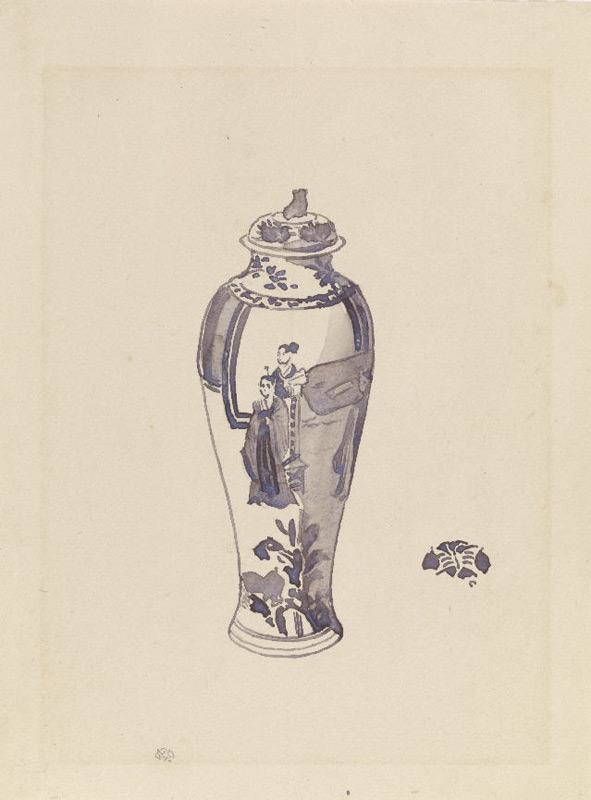
Vase with slightly bulging body, James McNeill Whistler, 1876-1878, drawing (F1893.18)
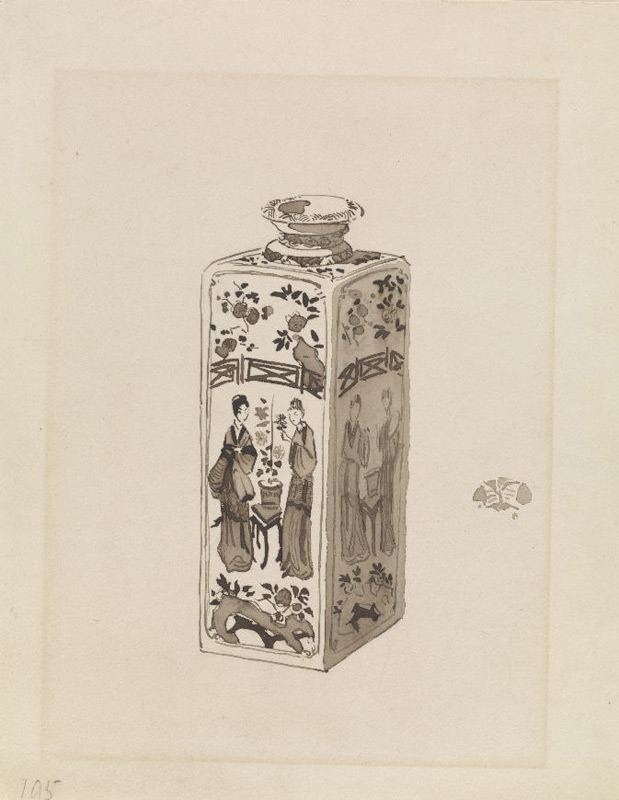
A Chinese porcelain square canister, James McNeill Whistler, 1878, drawing (F1907.175)
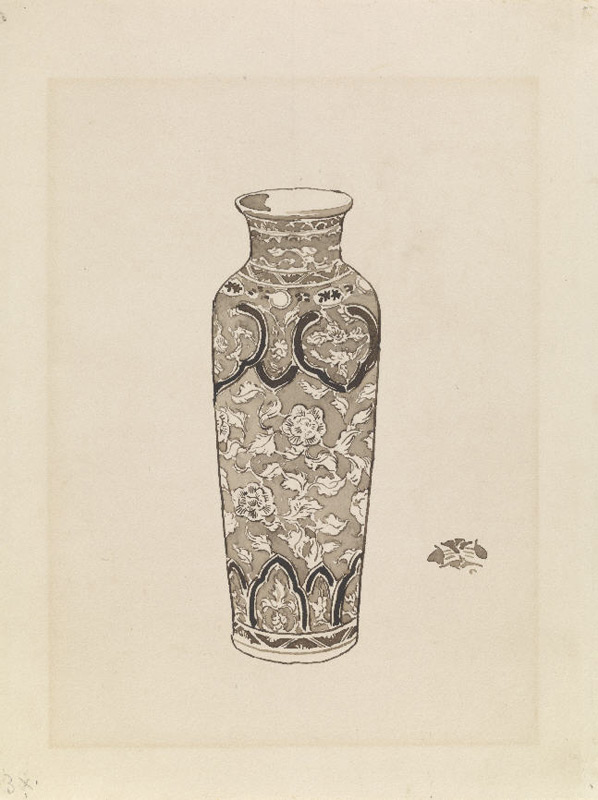
A Chinese porcelain cylindrical jar, James McNeill Whistler, 1876-1878, drawing (F1907.176)

A Chinese porcelain square canister, James McNeill Whistler, 1878, drawing (F1907.177)
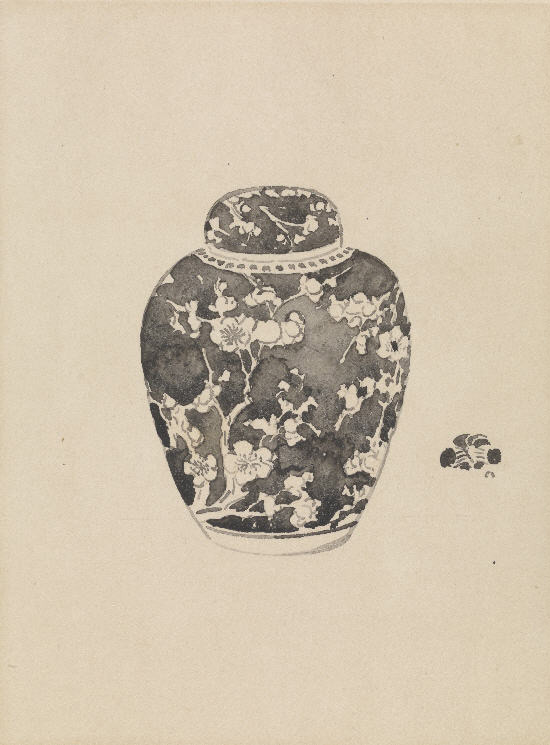
An Oviform Ginger Jar with Bell-shaped cover, James McNeill Whistler, 1878, drawing (F1907.178)
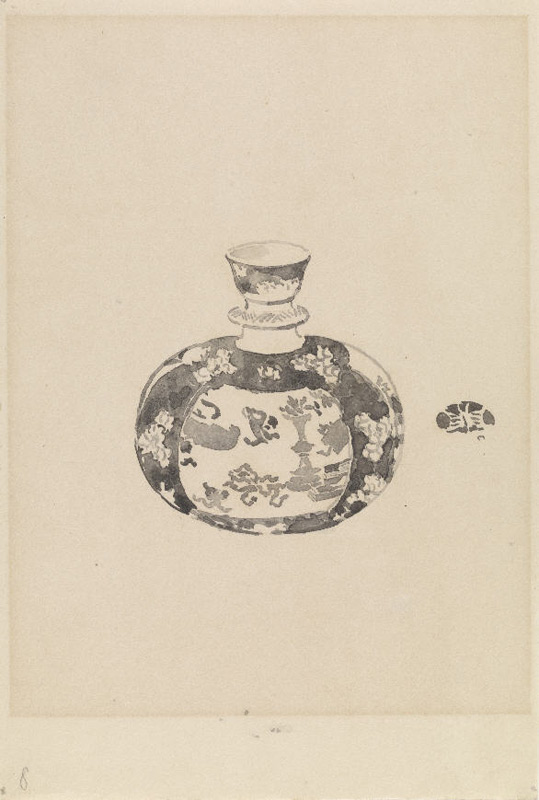
A Chinese porcelain bottle, James McNeill Whistler, 1878, drawing (F1907.179)

A Chinese porcelain cylindrical vase with hawthorn decoration, James McNeill Whistler, 1876, drawing (F1907.174)
Whistler brings a libel suit against Ruskin
-
1879
Whistler files for bankruptcy; bailiffs take possession of his studio-residence, the White House, in May
Whistler leaves for Venice, commissioned by the Fine Art Society to produce twelve etchings
-
1880
Whistler returns to London and exhibits Venice, a Series of Twelve Etchings (the 'First Venice Set') at the Fine Arts Society
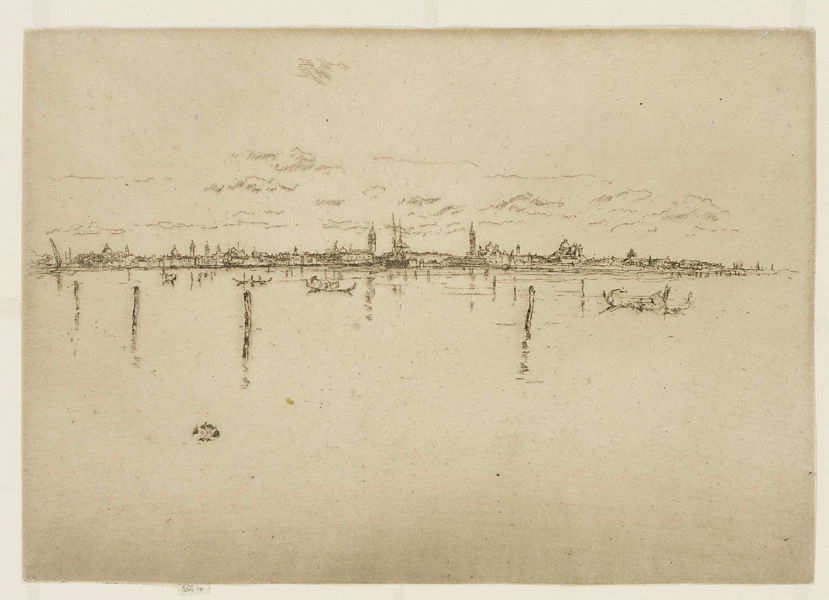
1. Little Venice (F1893.22), James McNeill Whistler, 1879-1880, etching and drypoint on paper
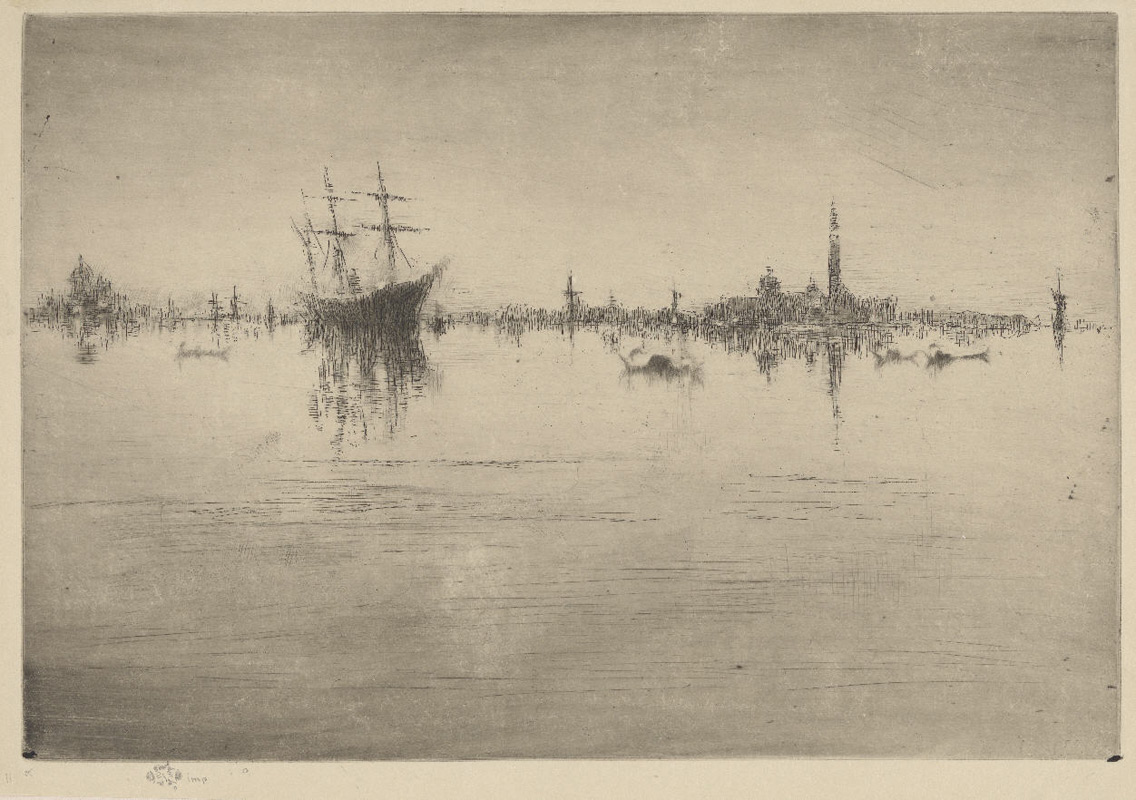
2. Nocturne (F1898.379), James McNeill Whistler, 1879-1880, etching and drypoint on paper
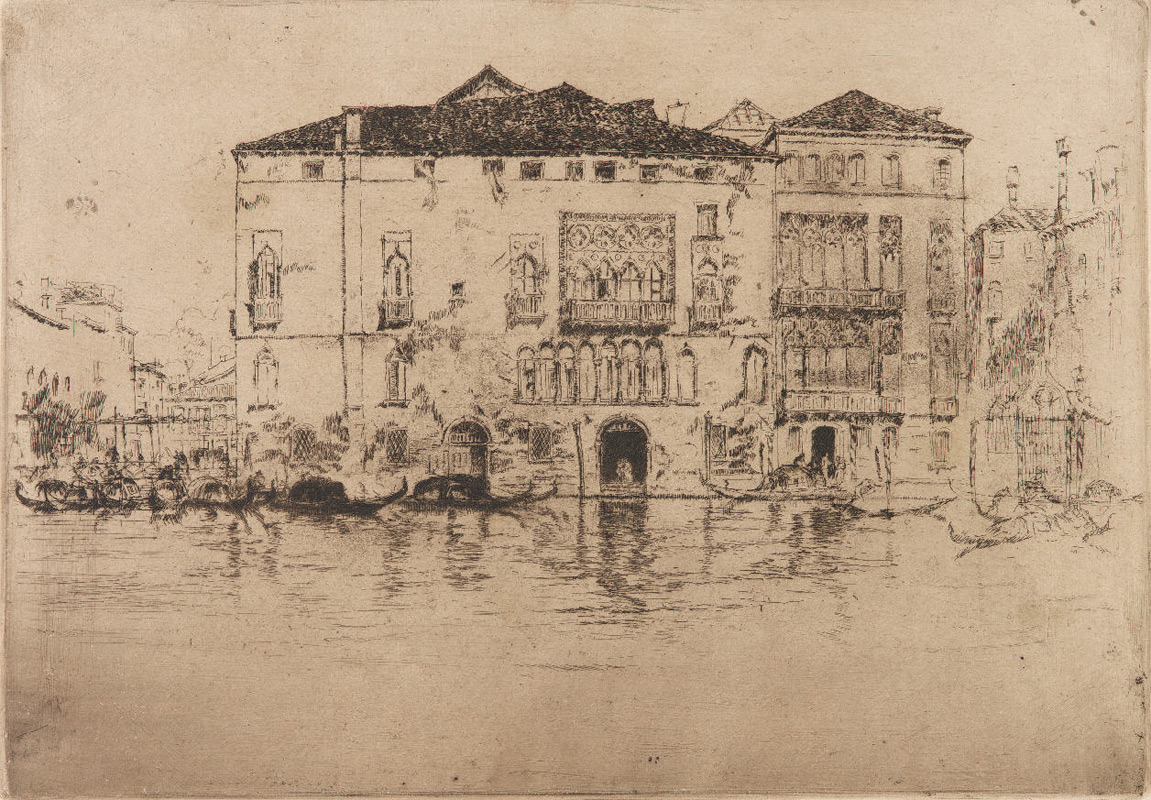
3. The Palaces (F1898.383), James McNeill Whistler, 1879-1880, etching and drypoint on paper
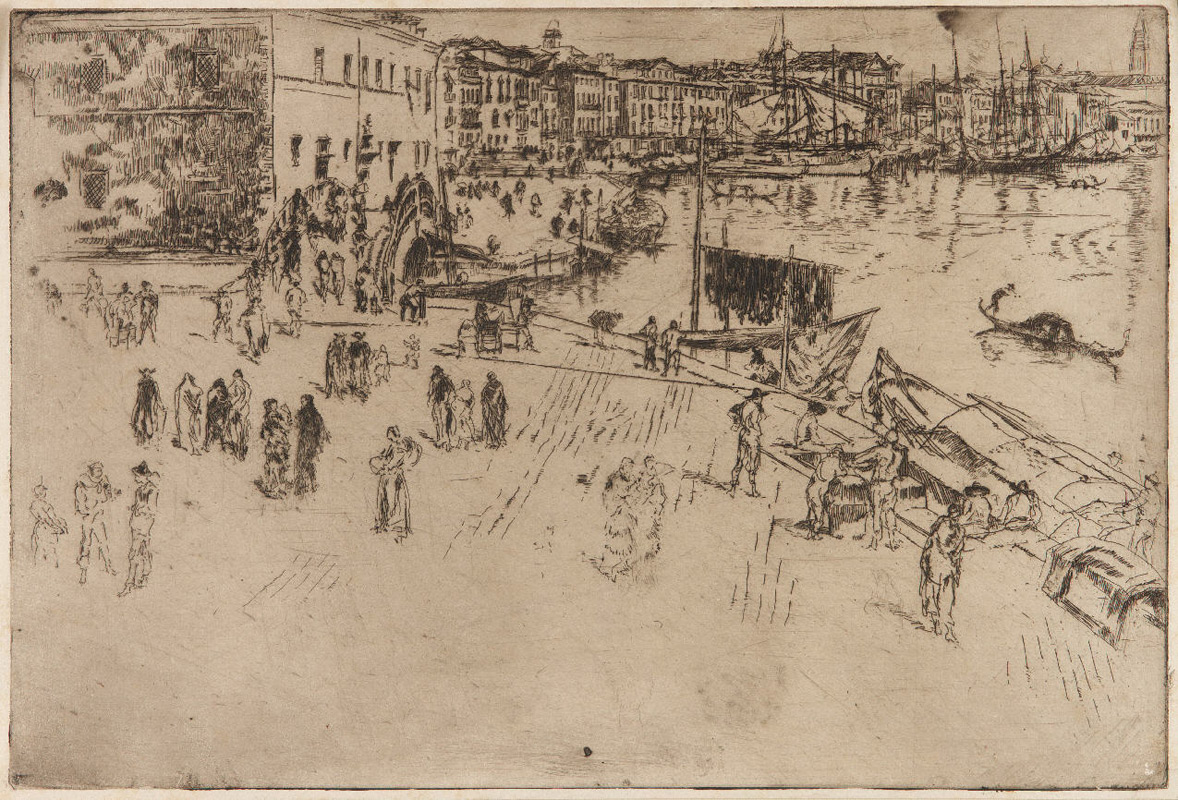
4. The Riva (F1901.170), James McNeill Whistler, 1879-1880, etching and drypoint on paper
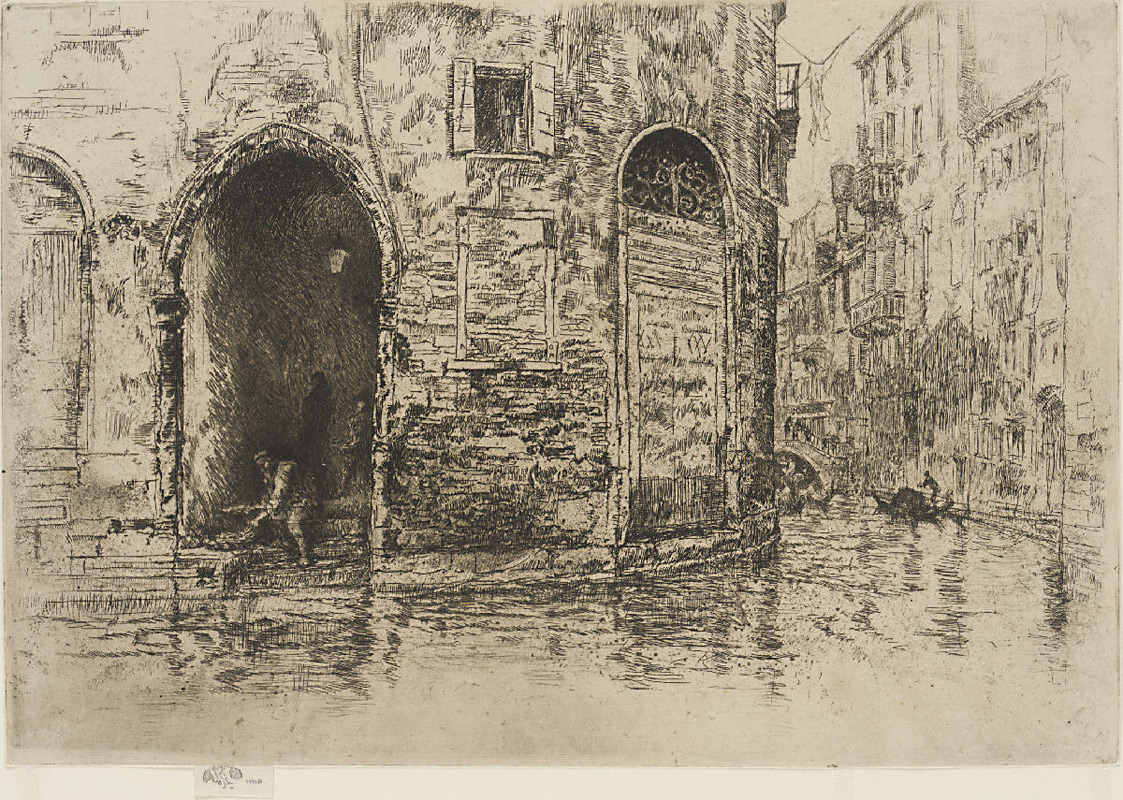
5. Two Doorways (F1891.1), James McNeill Whistler, 1879-1880, etching and drypoint on paper
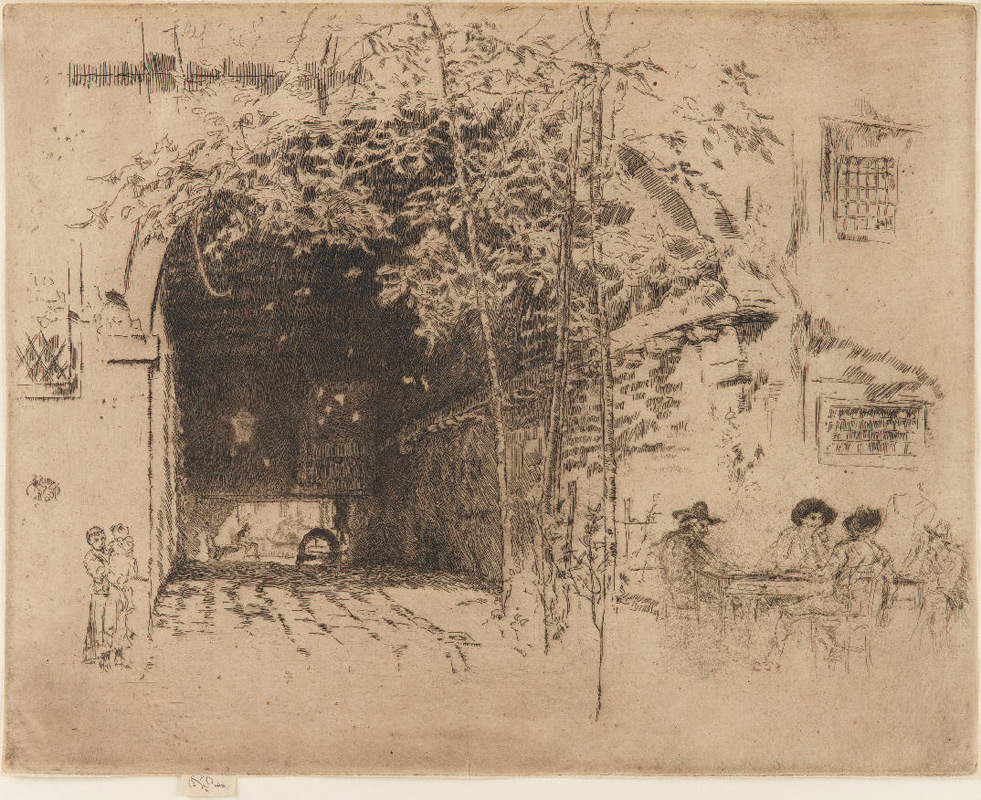
6. The Traghetto (F1905.183), James McNeill Whistler, 1879-1880, etching and drypoint on paper

7. The Little Mast (F1894.24), James McNeill Whistler, 1879-1880, etching (and drypoint, 7 & 9) on paper
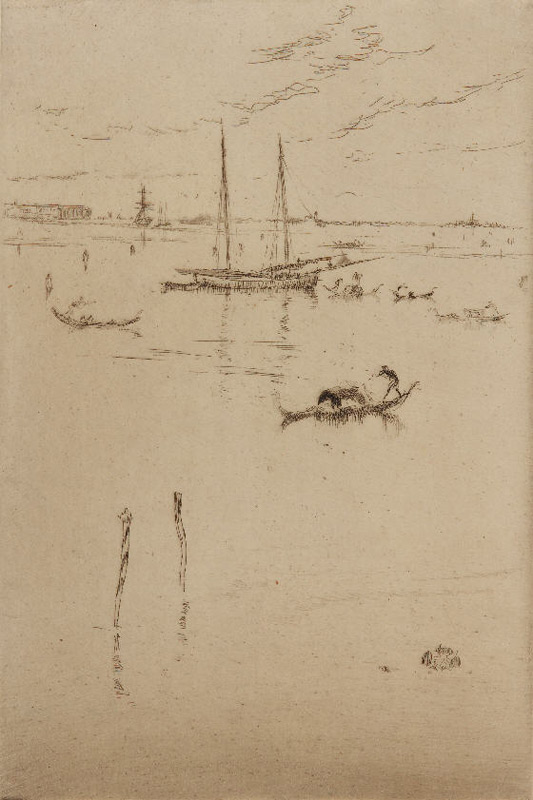
8. The Little Lagoon (F1894.41), James McNeill Whistler, 1879-1880, etching (and drypoint, 7 & 9) on paper

9. The Doorway (F1905.181), James McNeill Whistler, 1879-1880, etching (and drypoint, 7 & 9) on paper
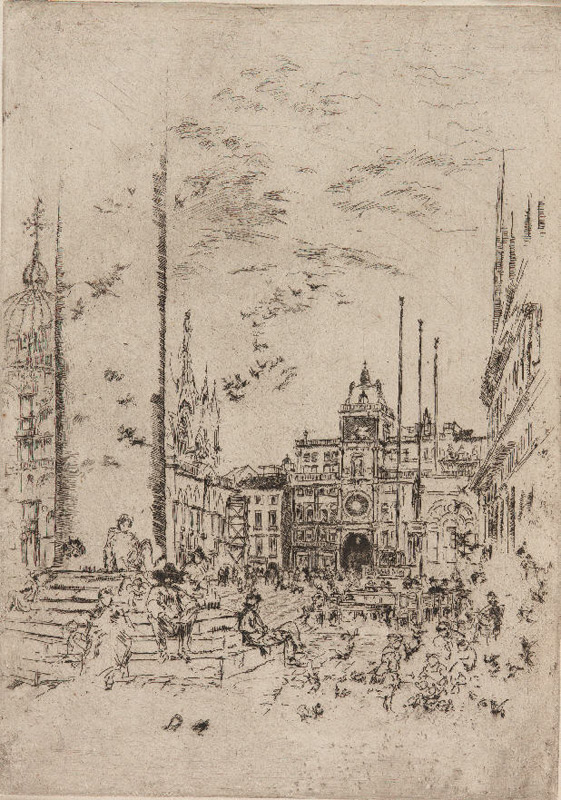
10. The Piazetta (F1898.386), James McNeill Whistler, 1879-1880, etching and drypoint on paper

11. The Mast (F1894.19), James McNeill Whistler, 1879-1880, etching and drypoint on paper
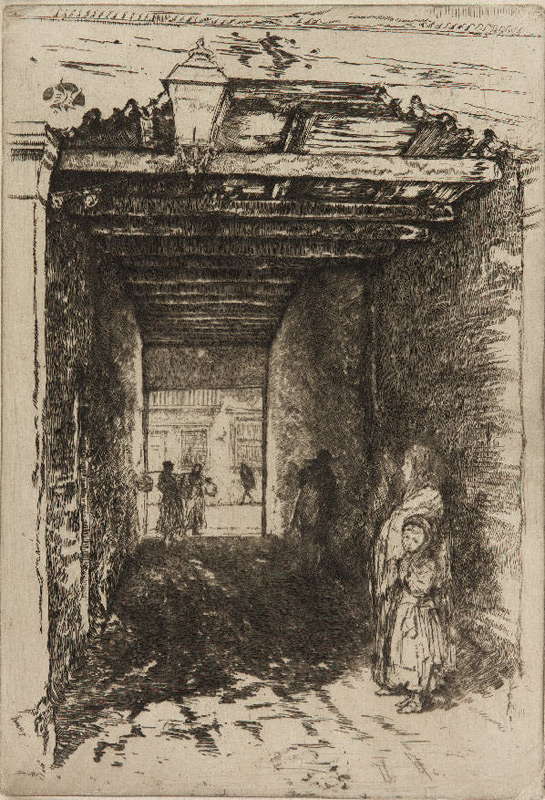
12. The Beggars (F1898.391), James McNeill Whistler, 1879-1880, etching and drypoint on paper
Freer and Hecker move to Detroit to help launch the Peninsular Car Works
Whistler exhibits Venice pastels at the Fine Art Society
-
1881
International Exhibition of Electricity in Paris
-
1882
Oscar Wilde lectures in Detroit on 'The House Beautiful'
Detroit Club founded
U.S. Congress passes Chinese Exclusion Act
-
1883
Whistler stages major exhibition of fifty-one Venice etchings at the Fine Art Society ('Yellow and White' exhibition)
U.S. railroads adopt four standard time zones
Freer acquires first artwork, a European etching, from the New York dealer Frederick Keppel
-
1884
Whistler stages solo exhibition 'Notes' -- 'Harmonies' -- 'Nocturnes' at Dowdeswell Gallery in London
Third Reform Act passed by British Parliament
-
1885
Whistler presents 'Ten O'Clock' lecture
-
1886
Whistler publishes Twenty-Six Etchings (the 'Second Venice Set')
-
1887
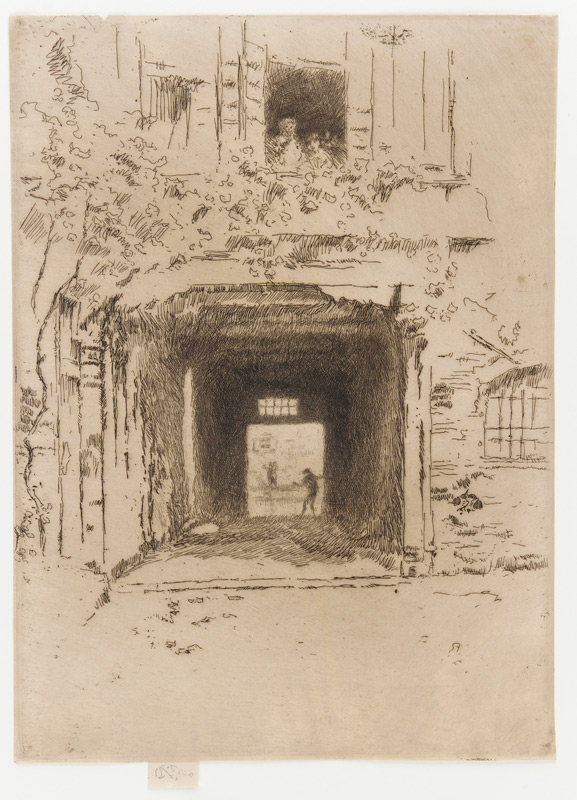
1. Doorway and Vine (F1887.2), James McNeill Whistler, 1879-1880, etching on paper
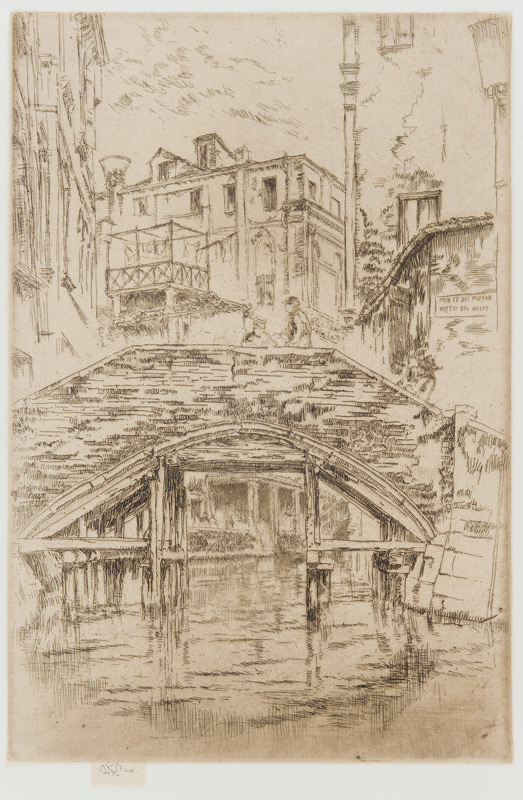
2. Ponte del Piovan (F1887.20), James McNeill Whistler, 1879-1880, etching on paper
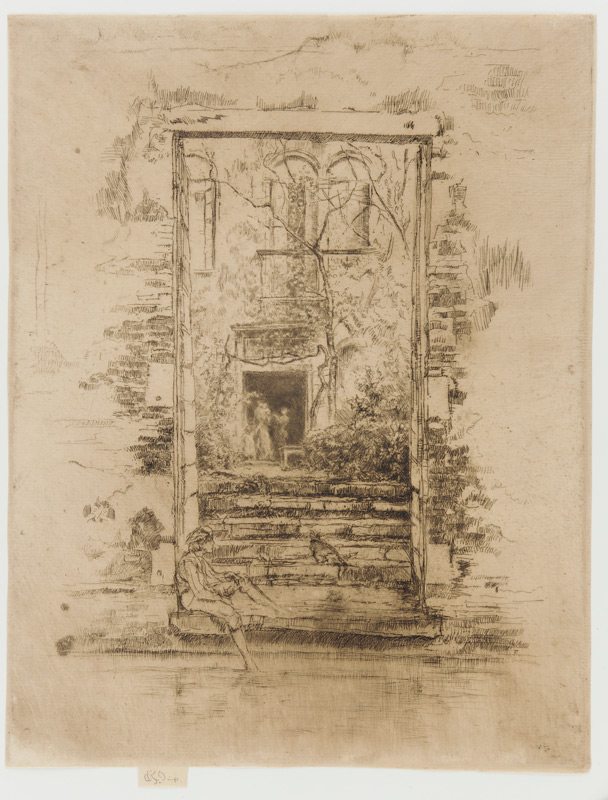
3. Garden (F1887.21), James McNeill Whistler, 1879-1880, etching on paper
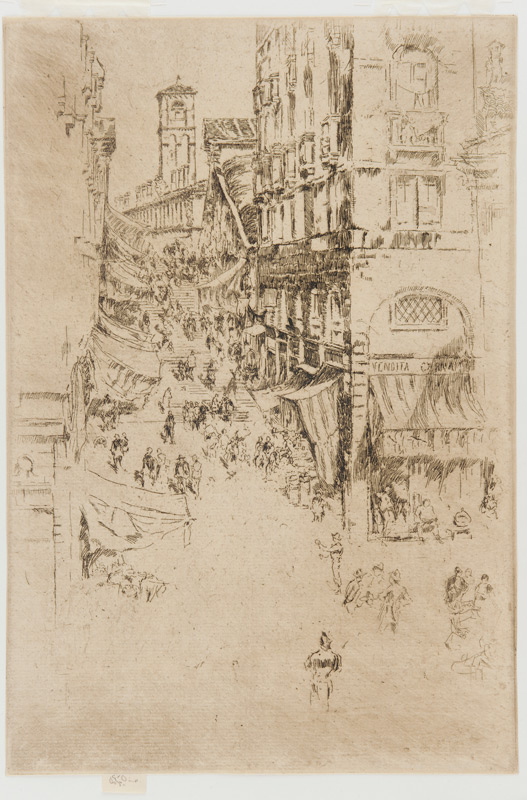
4. The Rialto (F1887.22), James McNeill Whistler, 1879-1880, etching on paper
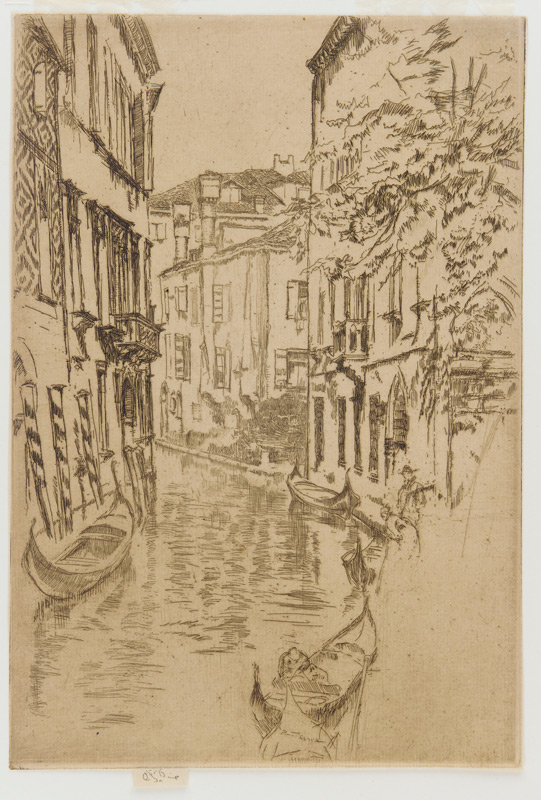
5. Quiet Canal (F1887.25), James McNeill Whistler, 1879-1880, etching on paper
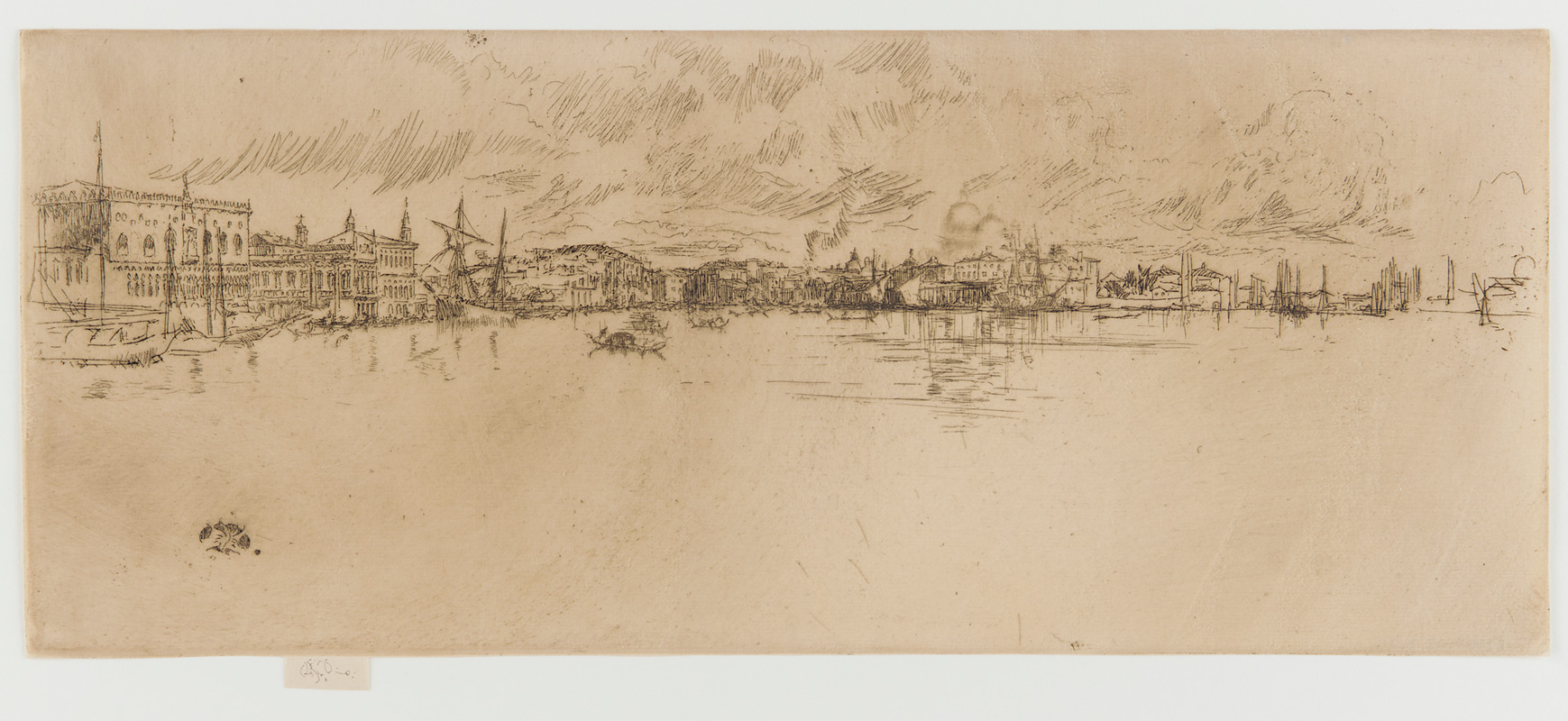
6. Long Venice, James McNeill Whistler, 1879-1880, etching on paper (F1887.23)
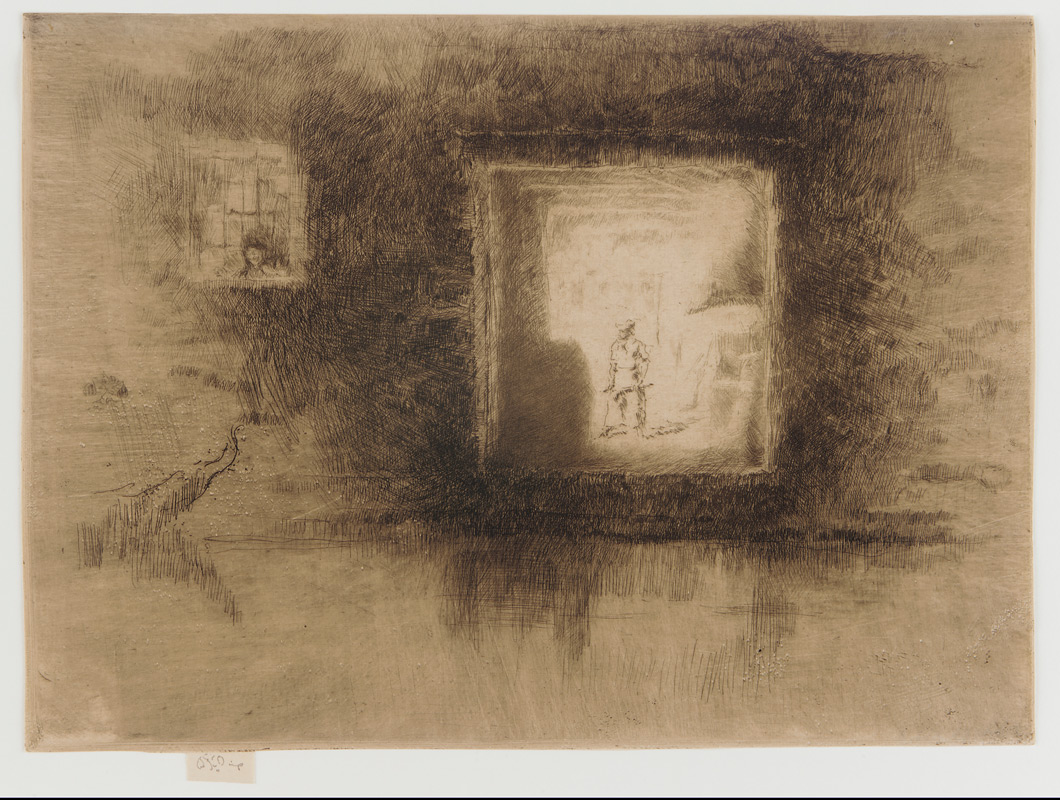
7. Nocturne: Furnace, James McNeill Whistler, 1879-1880, etching on paper (F1887.24)
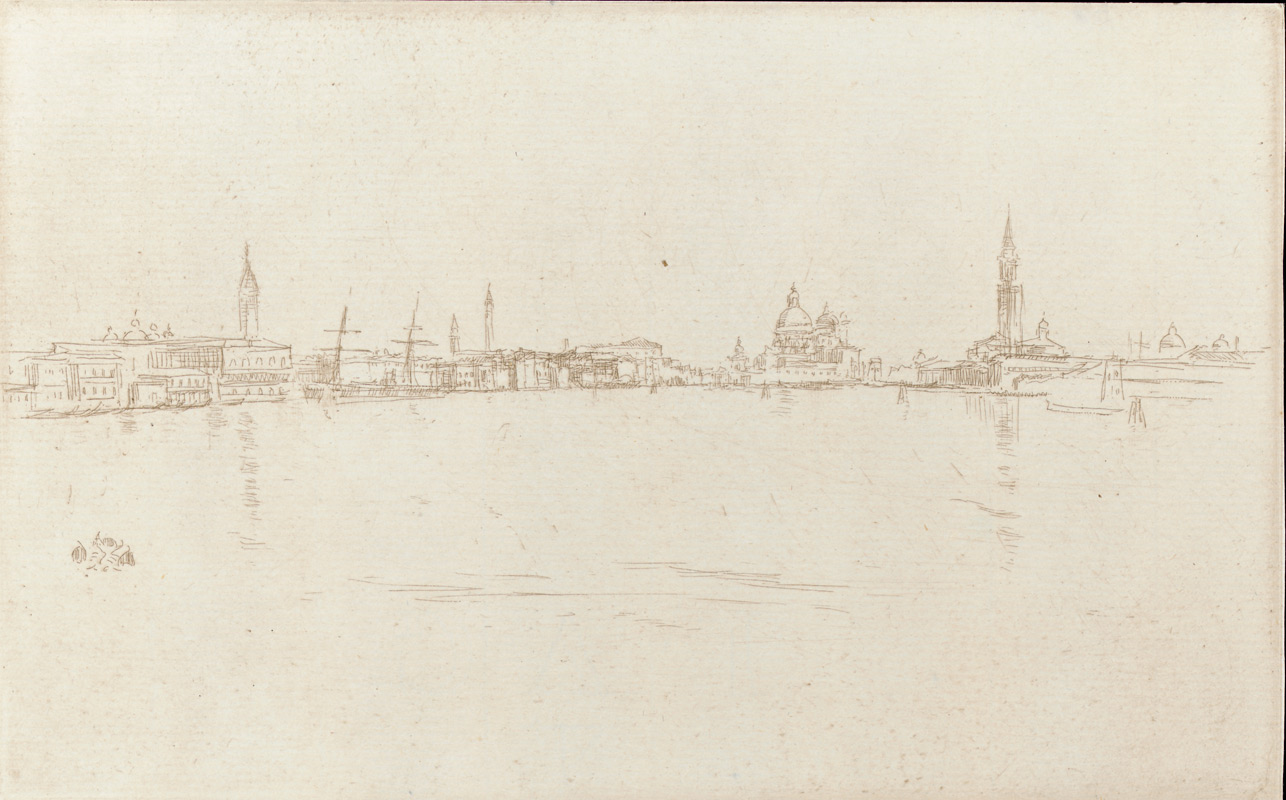
8. La Salute, James McNeill Whistler, 1879-1880, etching on paper (F1887.26)
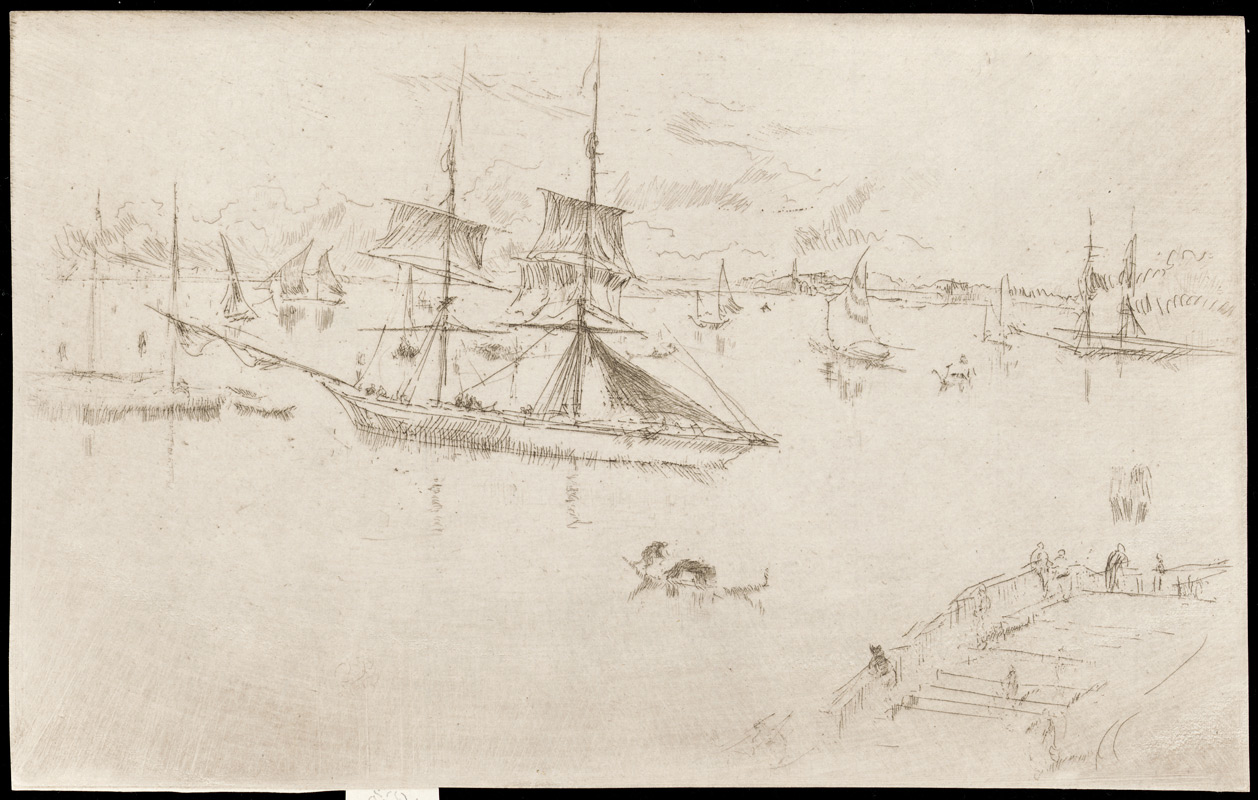
9. Lagoon: Noon, James McNeill Whistler, 1879-1880, etching on paper (F1887.27)
Freer introduced to Whistler's etchings by Howard Mansfield, an attorney and fellow-collector; he immediately busy the entire 'Second Venice Set' from Frederick Keppel's New York gallery
Freer and Hecker purchase adjoining lots on Ferry Avenue
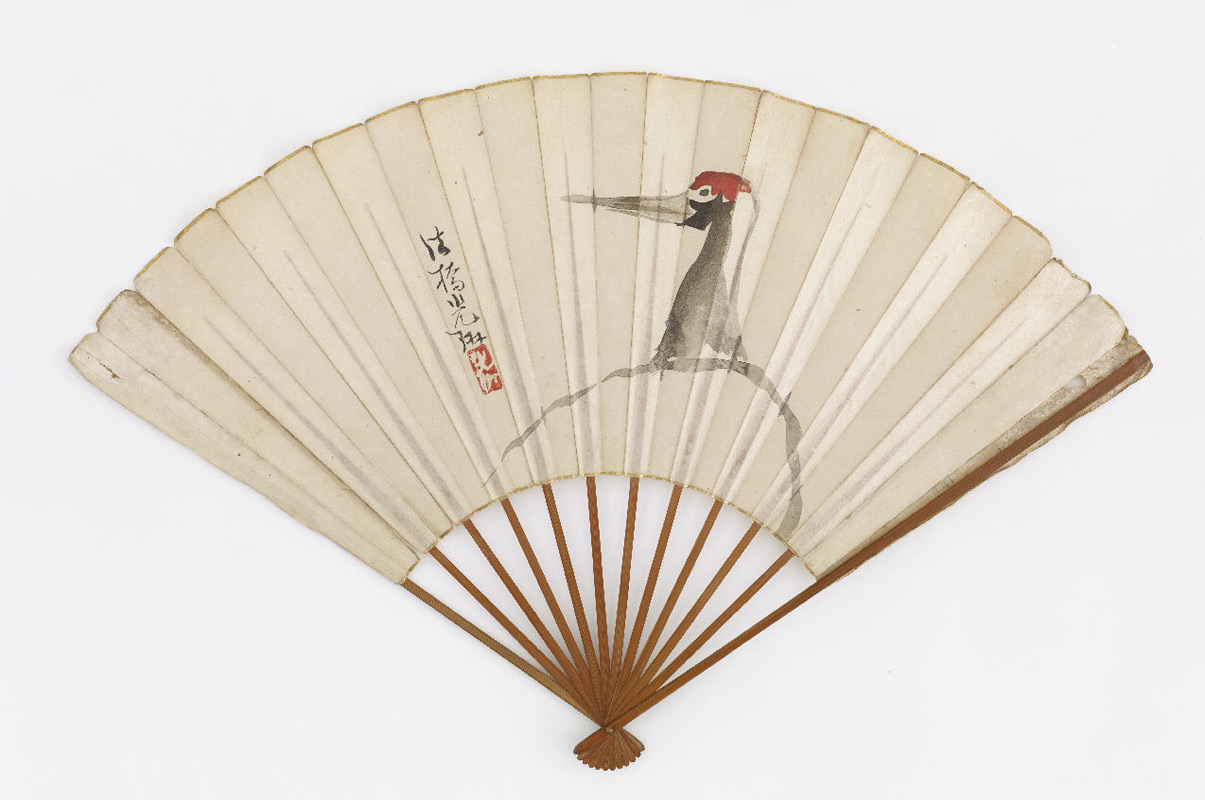
A crane, style of Ogata Kōrin, Edo period, 19th century, ink and color on paper (F1887.1)
Freer purchases a Japanese fan attributed to Ogata KÅrin
-
1888
Detroit establishes an art museum; inaugural exhibition features etchings from Freer's collection
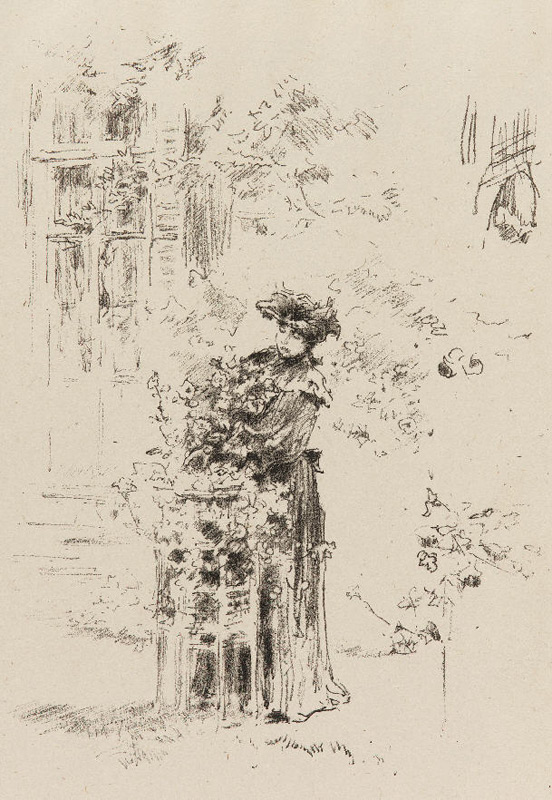
La Belle Jardinière, James McNeill Whistler, 1894, lithograph (F1906.180)
Whistler marries Beatrice Godwin
-
1889
Major solo exhibition of Whistler's oils, watercolors, and pastels held at Wunderlich Gallery in New York
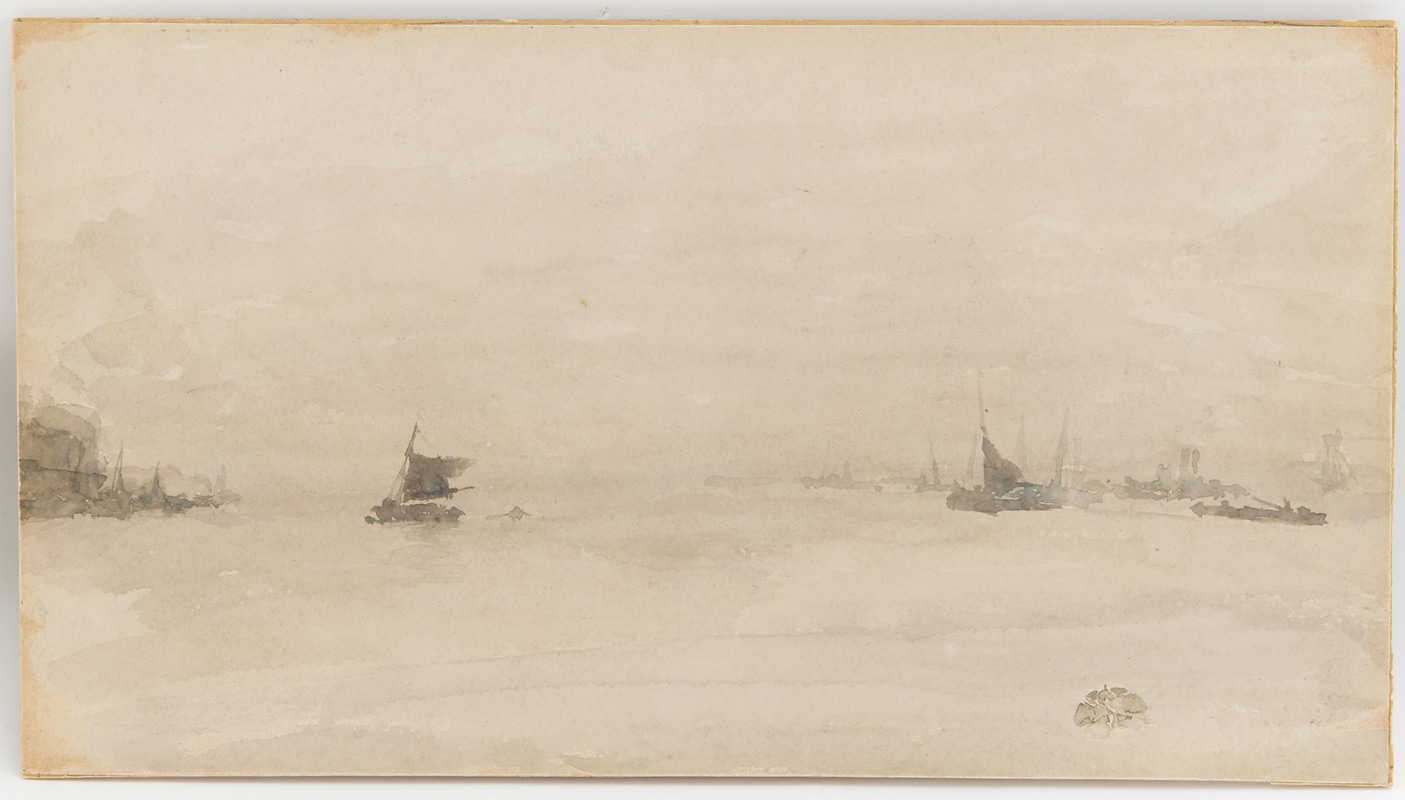
Grey and Silver - The Mersey, James McNeill Whistler, ca. 1883-1885, watercolor (F1889.3)
Freer buys first Whistler painting, the watercolor Grey and Silver: The Mersey, from Wunderlich
Freer purchases first oil painting, The Rising Moon: Autumn, by American artist Dwight William Tryon (1849-1925)
-
1890
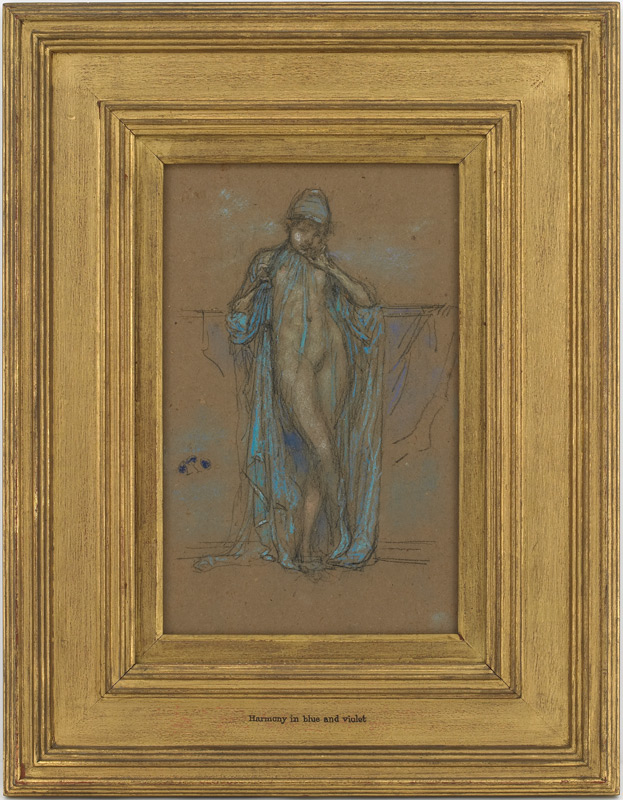
Harmony in Blue and Violet, James McNeill Whistler, late 1800s, pastel on brown paper (F1890.8)
Freer travels to London and meets Whistler meet for the first time; Freer buys a pastel, etchings, and a cancelled plate from the artist
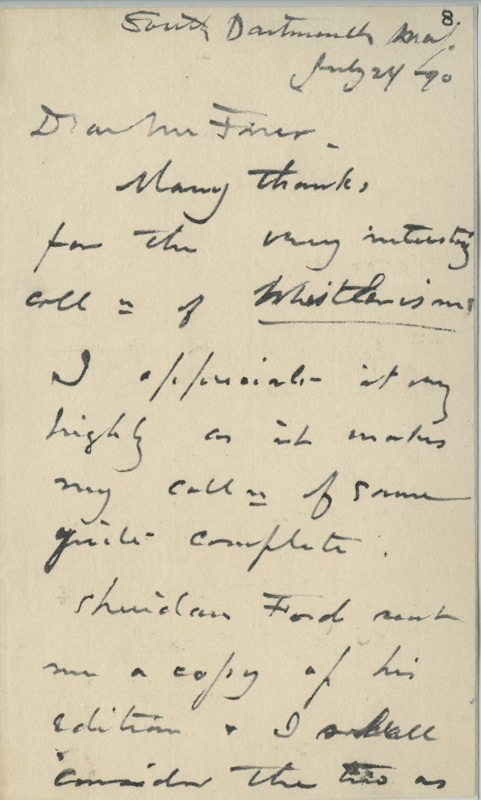
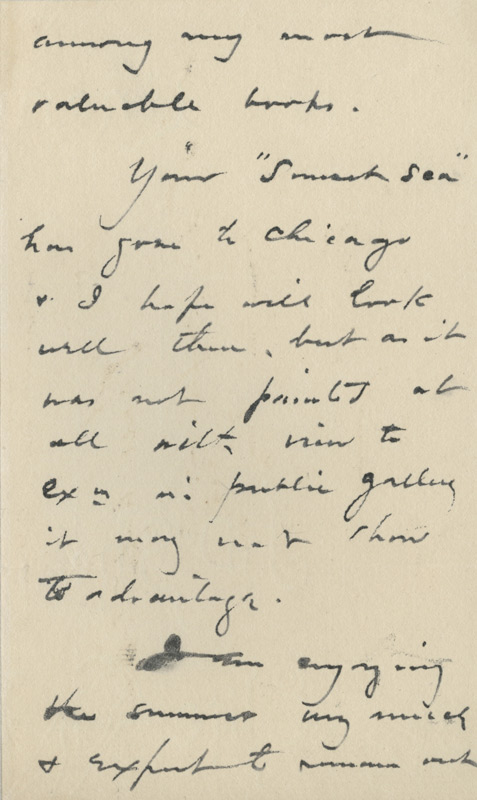
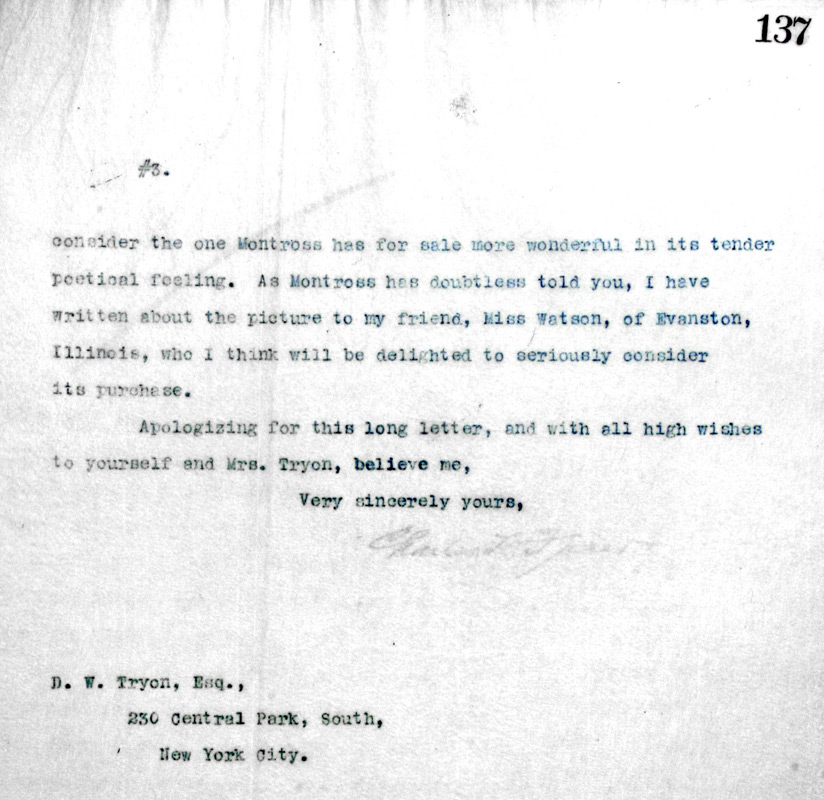
Dwight William Tryon to Charles Lang Freer, July 24, 1890
"Many thanks for the very interesting colln. Of Whistlerisms. I appreciate it very highly as it makes my colln. of same quite complete. Sheridan Ford sent me a copy of his edition and I shall consider the two as among my most valuable books."
Whistler publishes The Gentle Art of Making Enemies. Freer sends a copy to Dwight Tryon
Theodore Child publishes 'A Pre-Raphaelite Mansion' in Harper's New Monthly Magazine (December) - an account of Leyland's mansion that includes the first-ever published photograph of the Peacock Room
Blueprints for Freer's new home on Ferry Avenue completed by Wilson Eyre
Jacob Riis publishes How the Other Half Lives; U.S. Census Bureau announces the settlement of the west and the closing of the frontier
-
1891
Whistler's work enters public collections when the Corporation of Glasgow purchases his 1872 portrait of Thomas Carlyle and the French government purchases The Mother
-
1892
Whistler stages 'Nocturnes, Marines, Chevalet Pieces' at Goupil Gallery in London, attracting a new generation of collectors to his work
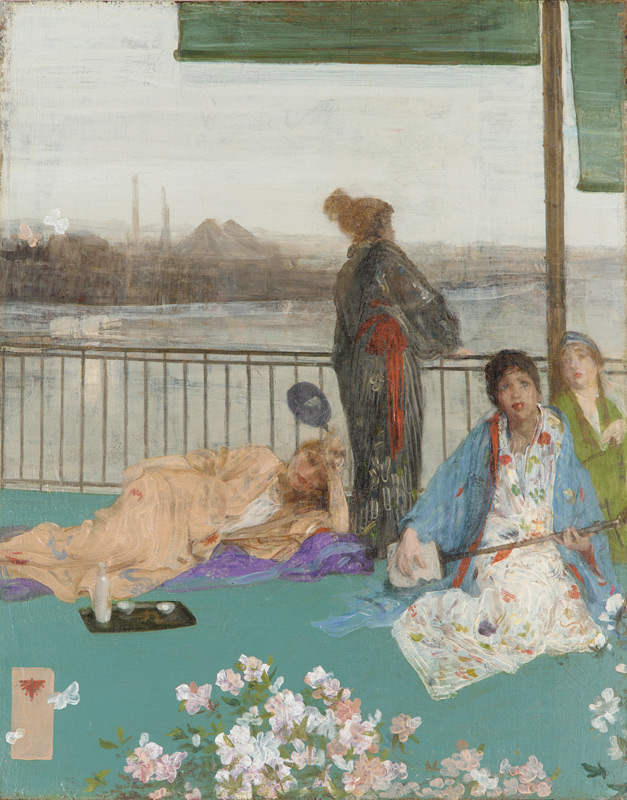
Variations in Flesh Colour and Green - The Balcony, James McNeill Whistler, 1864-1870; additions 1870-1879, oil on wood panel (F1892.23)
Freer purchases first Whistler oil, Variations in Flesh Colour and Green: The Balcony
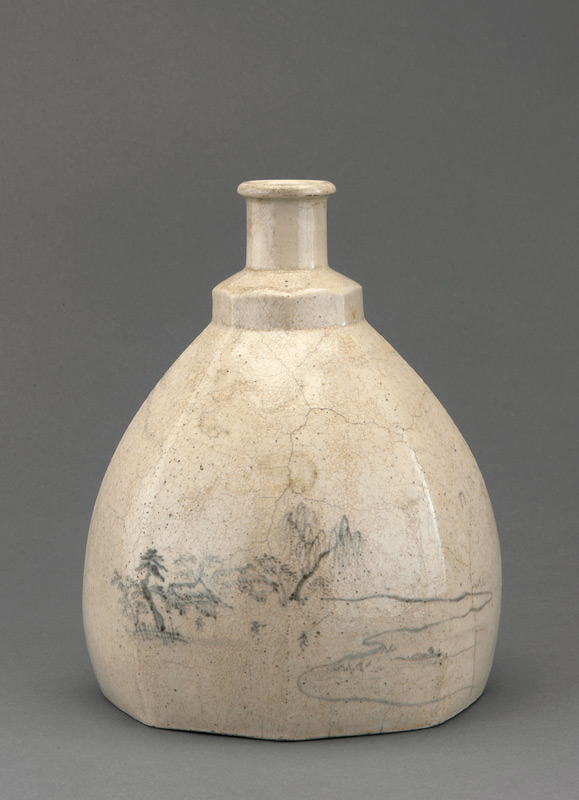
Bottle, decoration attributed to Kano Tangen, Edo period, 18th century, stoneware with cobalt pigment under clear glaze (F1892.26)
Freer purchases first Japanese ceramics from New York-based dealer Tozo Takayanagi (33 Union Square)
Freer acquires first Japanese paintings - a group of hanging scrolls - from New York dealer R. E. Moore
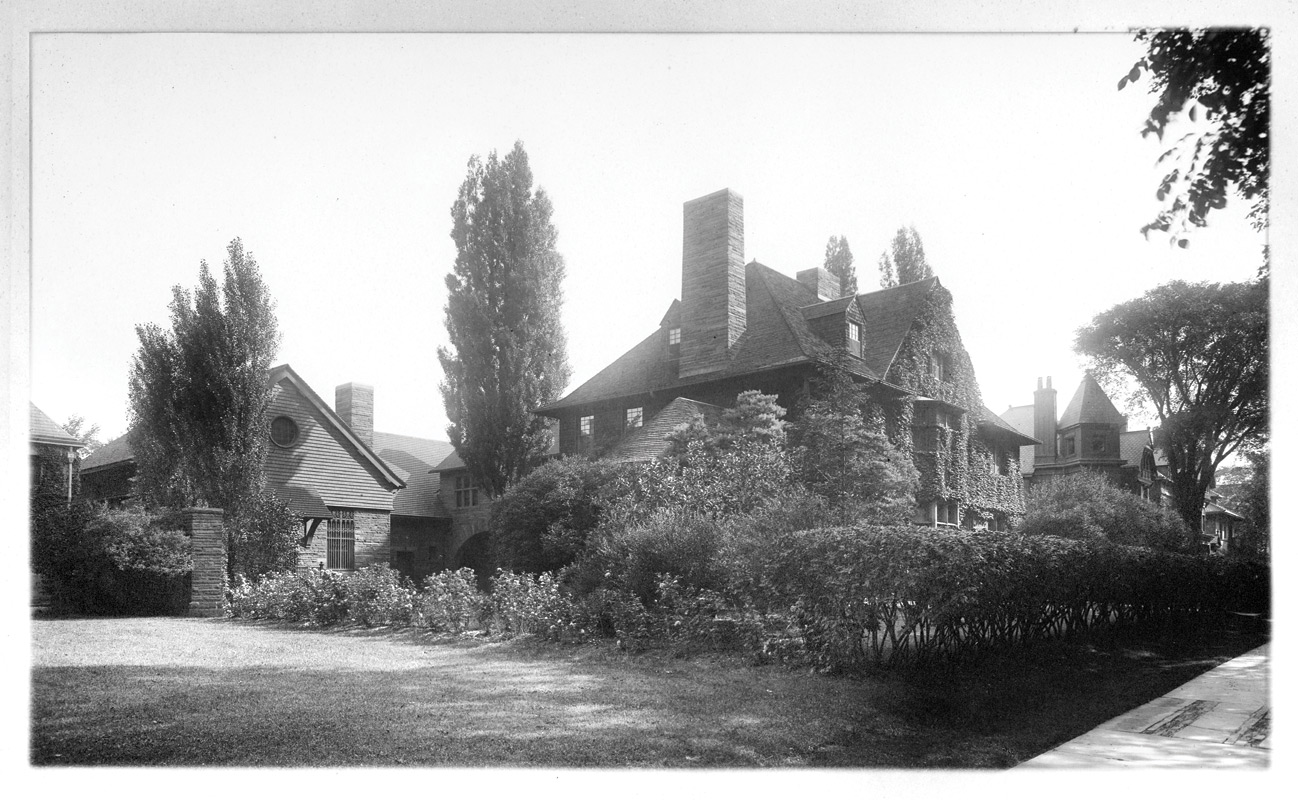
The home of Charles Lang Freer, 33 Ferry Street, Detroit, Michigan
Freer moves into his new home and engages Tryon and Thomas Dewing (1851-1938) to decorate the front hall and parlor
Freer helps organize the merger of five manufacturers of railway rolling stock into the Michigan-Peninsular Car Company
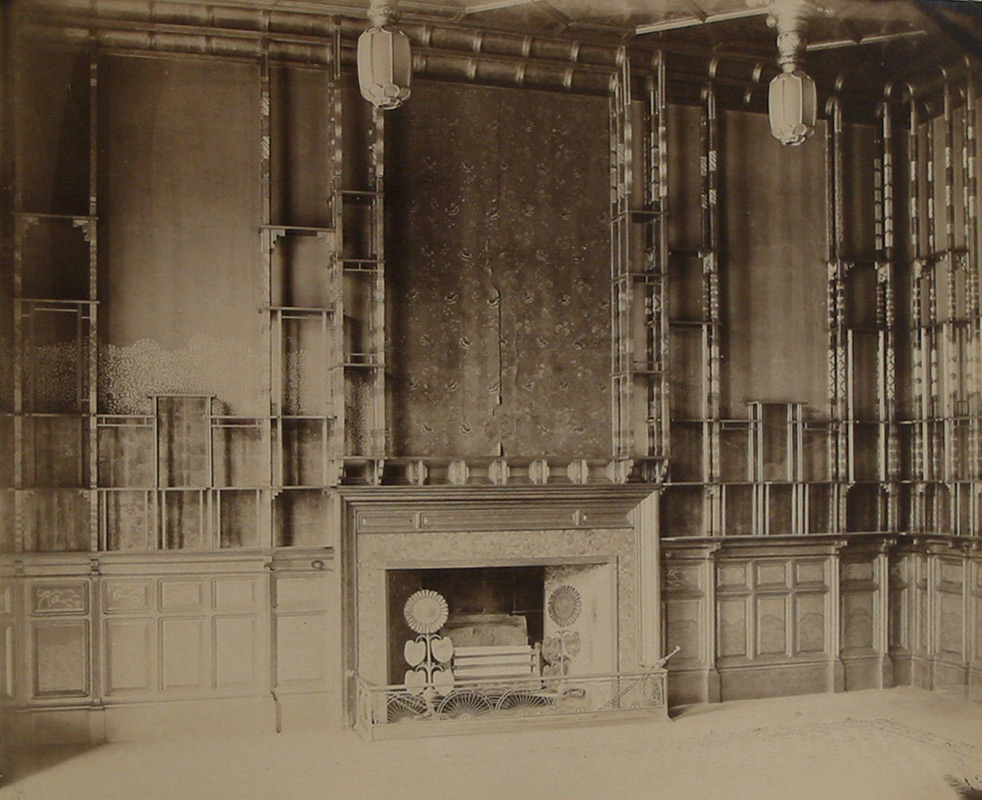
North wall of Harmony in Blue and Gold: The Peacock Room, James McNeill Whistler, 1876-1877, oil paint and gold leaf on canvas, leather, and wood
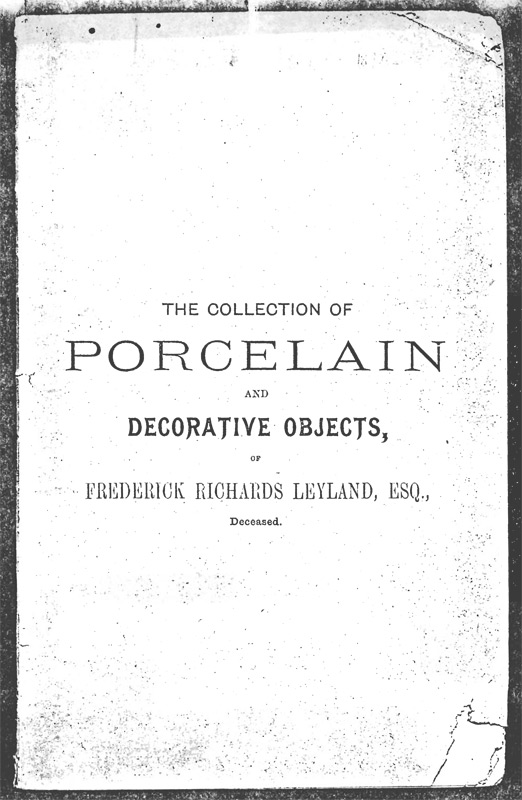
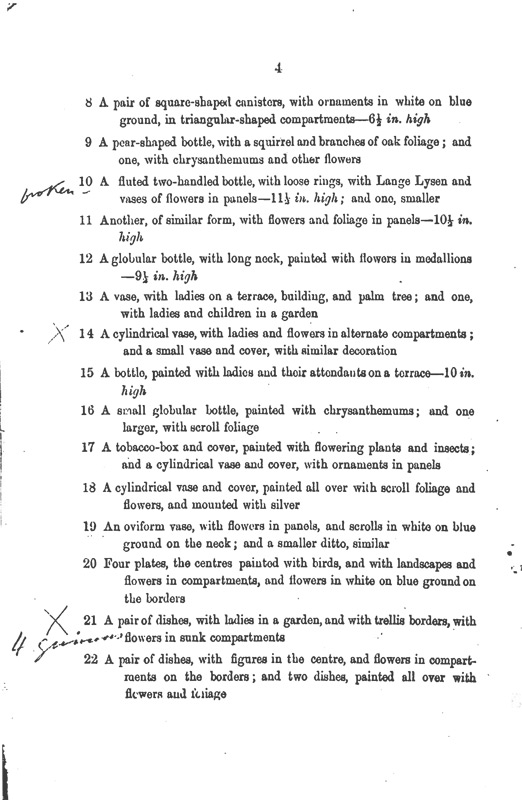
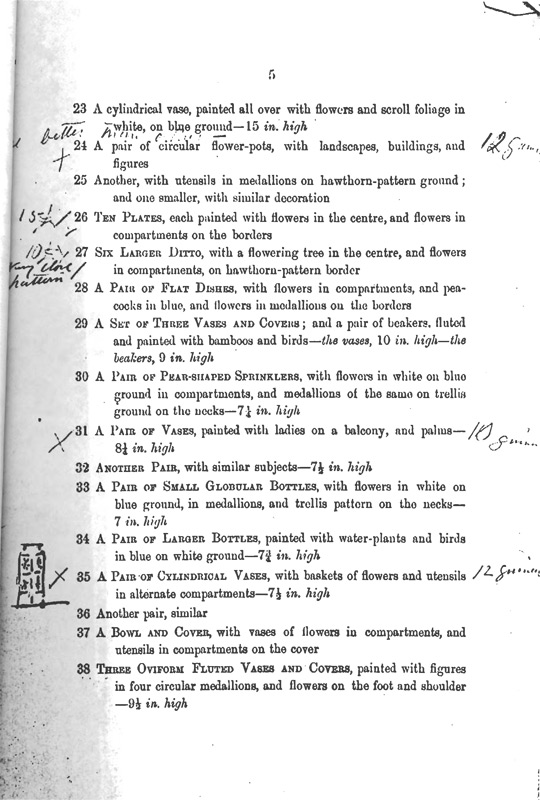
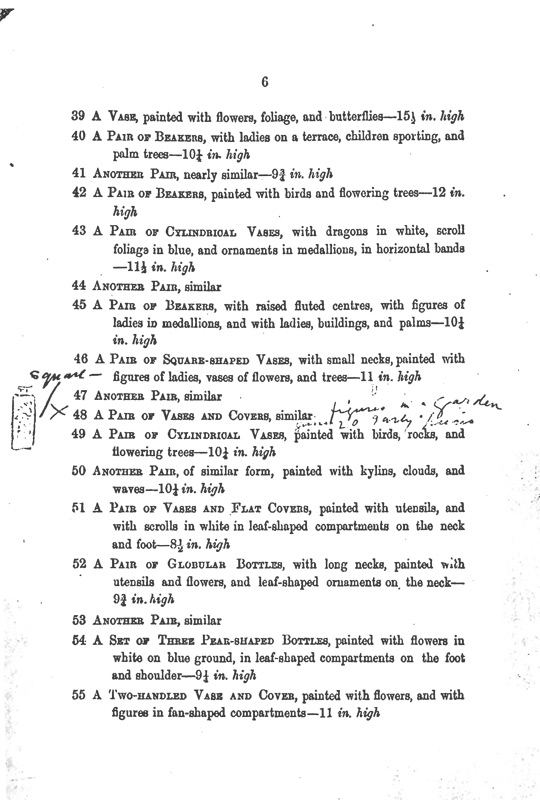
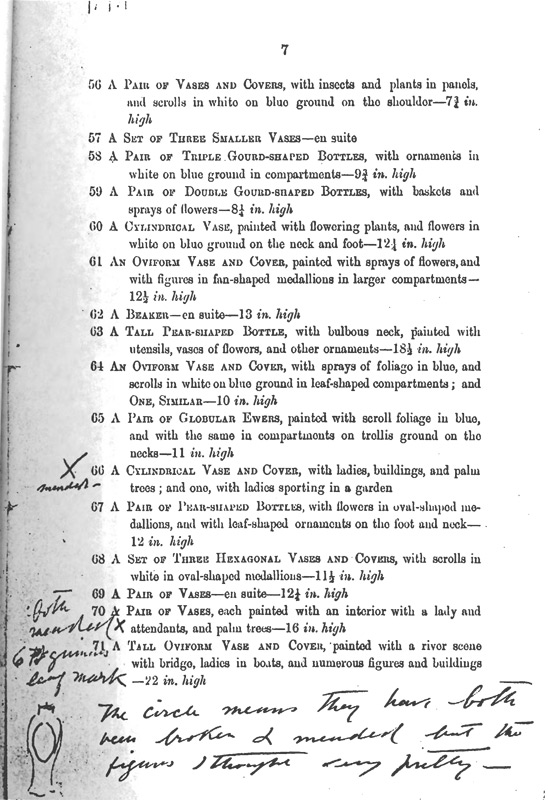
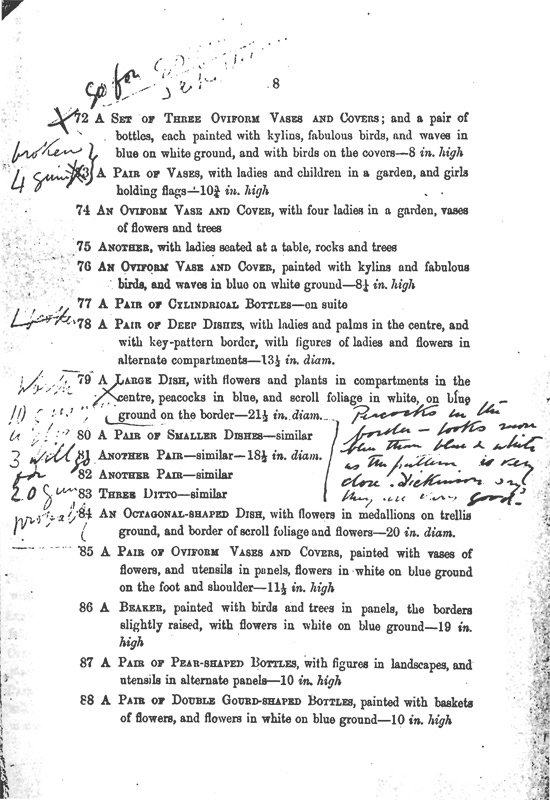
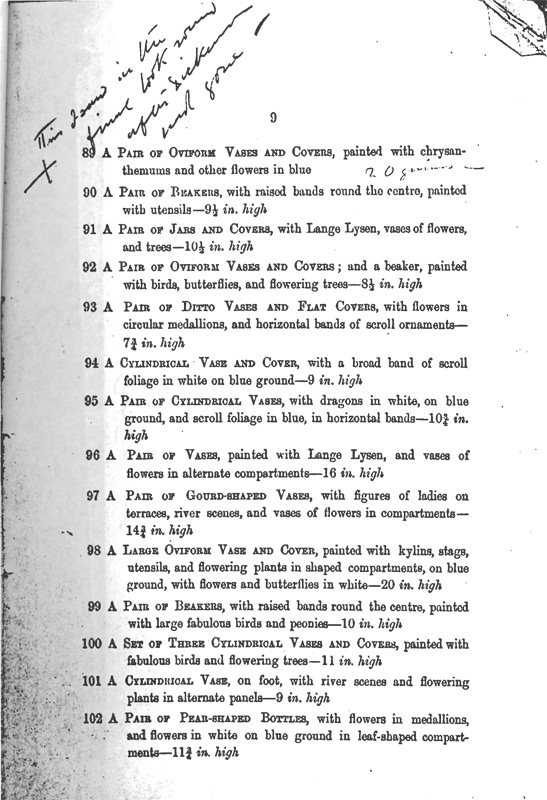
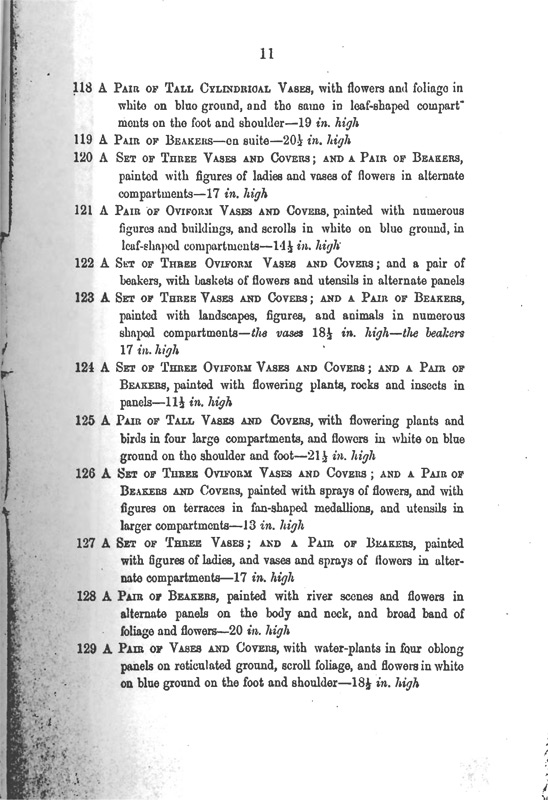
The Collection of Porcelain and Decorative Objects of Frederick Richards Leyland, Esq., Deceased. May 26, 1892
Leyland dies; his art and furnishings are sold at auction
-
1893
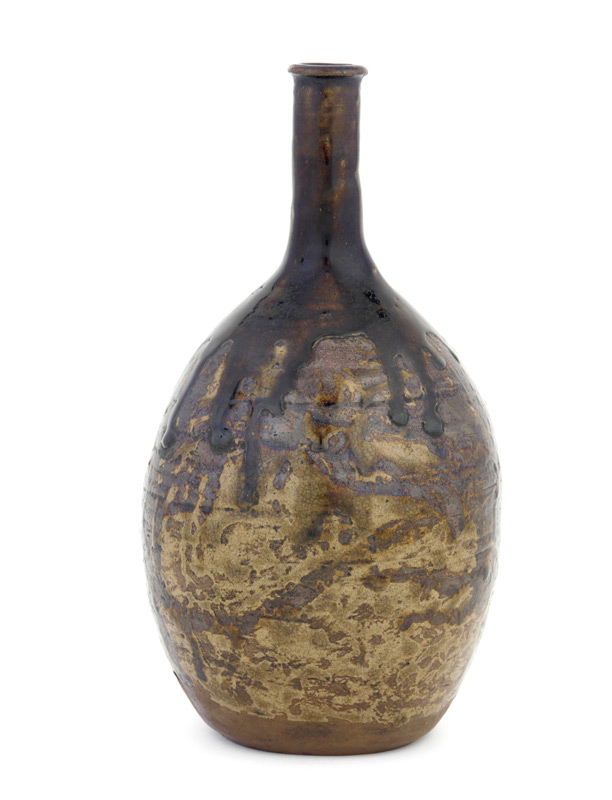
Sake bottle, Edo period or Meiji era, 19th century, stoneware with ash and iron glazes (F1893.2)
Freer purchases twelve Japanese wares from Takayanagi
Freer purchases first Chinese art, a Ming dynasty painting of herons, and more than 70 works by Whistler, including many etchings from the New York dealer Knoedler & Co.
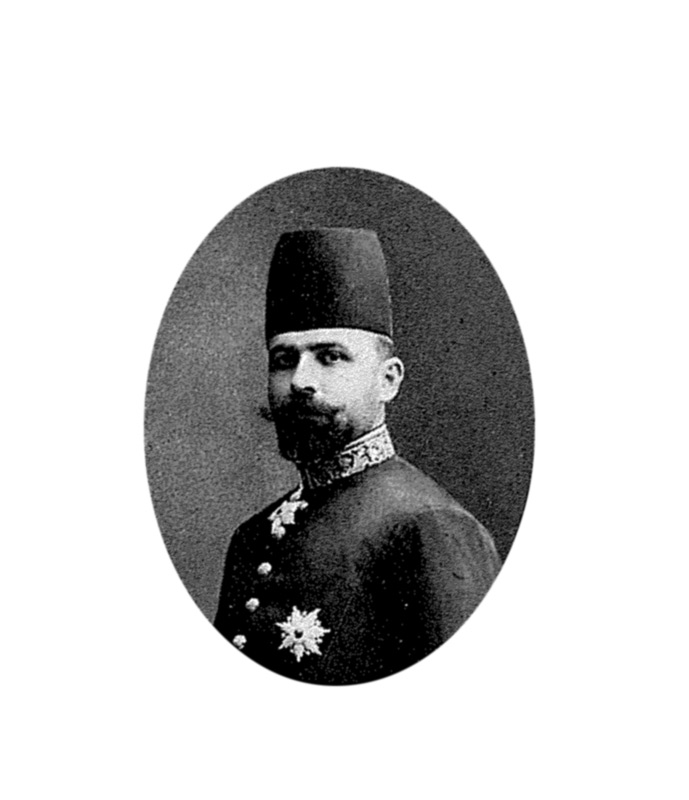
Portrait of Dikran Kelekian
Paris-based art dealer Dikran Kelekian (1868-1951) organizes the Persian Pavilion at the Columbian Exposition, gaining important American clients for Near Eastern and Persian art
'Panic of 1893' sends U.S. into economic depression; Michigan-Peninsular Car Company forced to stop manufacturing for five months
-
1894
Freer purchases Japanese ukiyo-e prints by Hokusai (1760 - 1849)
Freer embarks on eleven-month trip around the world, traveling first to Europe and then to Asia (September 1894 - August 1895)
49 Prince's Gate sold to Blanche Watney, who begins to contemplate the sale of the Peacock Room
-
1895
Sino-Japanese War (August 1894 - April 1895) establishes Japan as a major world power
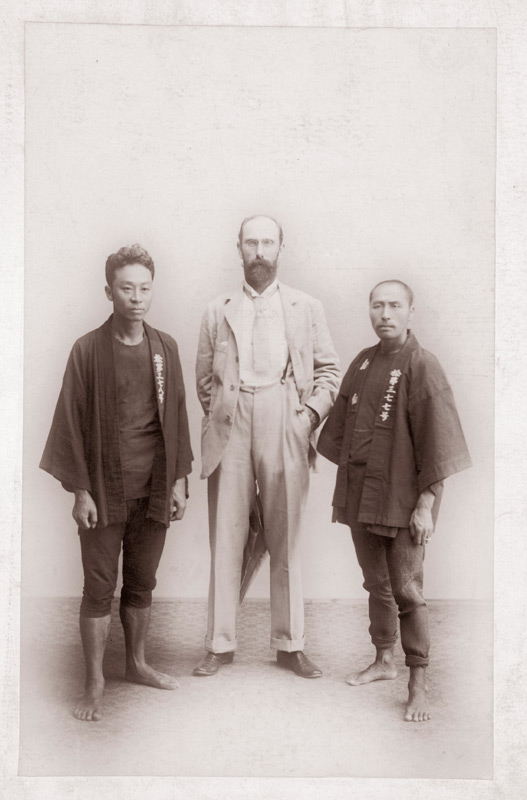
Charles Lang Freer and two ricksha men, Kyoto, 1895 (A0712)
Freer travels through India, Singapore, Hong Kong and Shanghai, reaching Japan in April
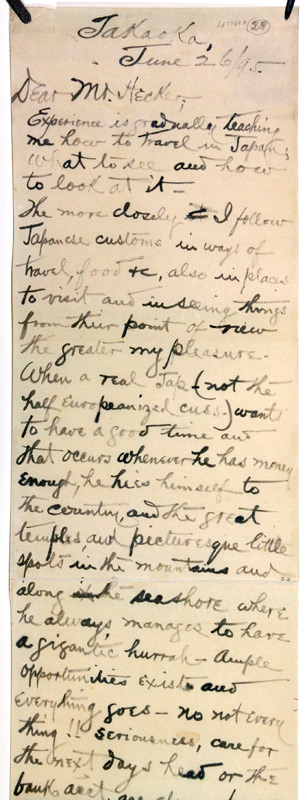
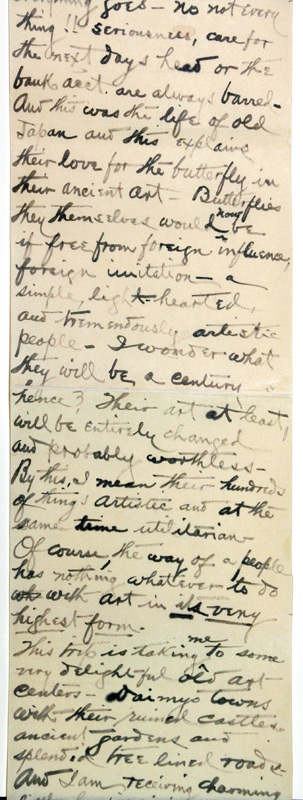
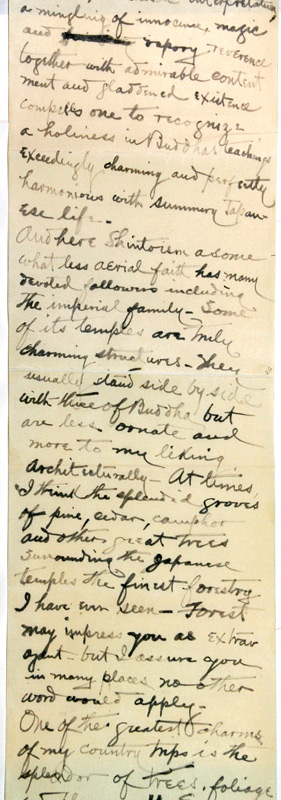
Charles Lang Freer to Frank J. Hecker, Scroll letter, June 26, 1895
Takaoka,
June 26/95.
Dear Mr. Hecker;
Experience is gradually teaching me how to travel in Japan; what to see and how to look at it - The more closely I follow Japanese customs in ways of travel, food, &c., also in places to visit and in seeing things from their point of view the greater my pleasure...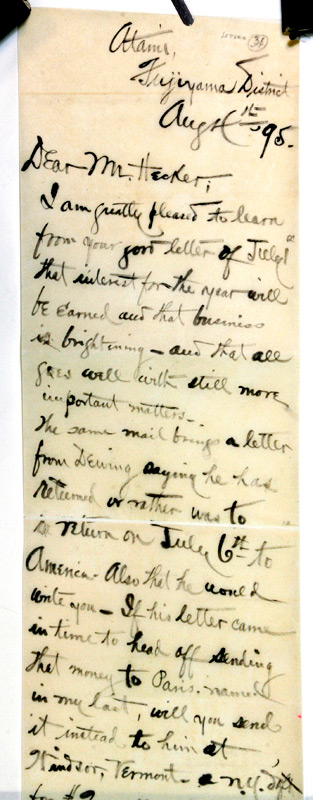
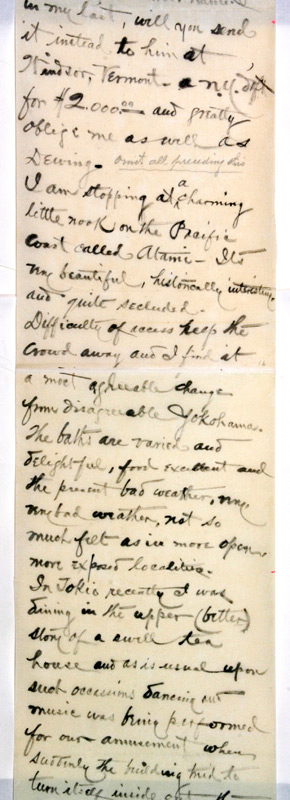
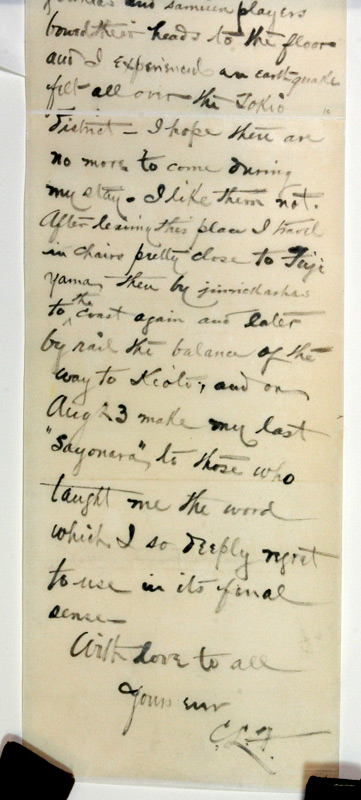
Charles Lang Freer to Frank J. Hecker, Scroll letter, August 4, 1895
Atami,
Fujiyama District
August 4th, 95
Dear Mr. Hecker...
...After leaving this place I travel in chairs pretty close to Fujiyama, then by jinrickshas to the coast again and later by rail the balance of the way to Kioto, and on Aug. 23 make my last "Sayonara" to those who taught me the word which I so deeply regret to use in its final sense... -
1896
Freer meets Boston-based Japanese dealer Matsuki Bunkyō (1867-1940)

1. Lidded jar with design of butterflies, Qing dynasty, 19th century, stoneware with white slip, iron pigment under and over clear glaze (F1896.42a-b)
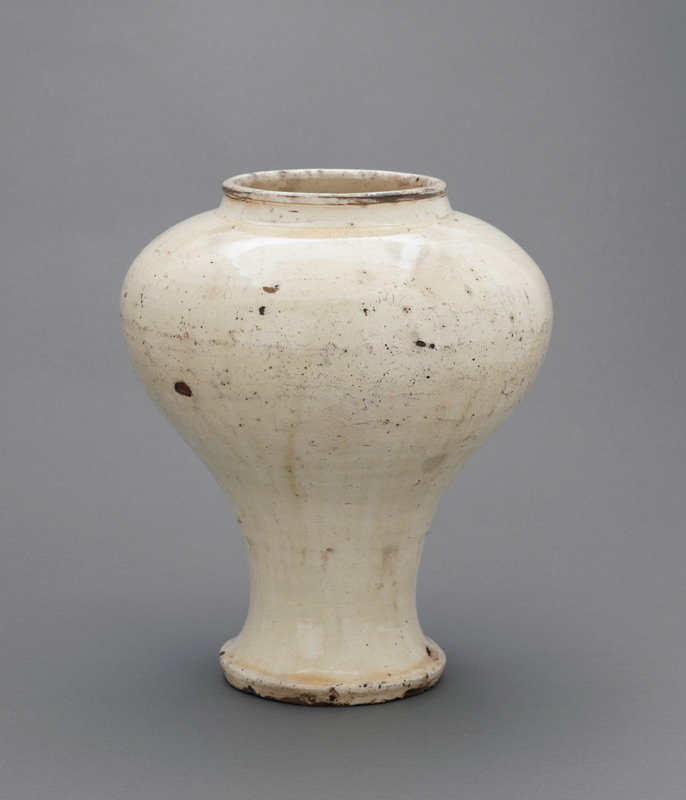
2. Jar, Yuan dynasty, 14th century, stoneware with white flip beneath clear glaze (F1896.84)
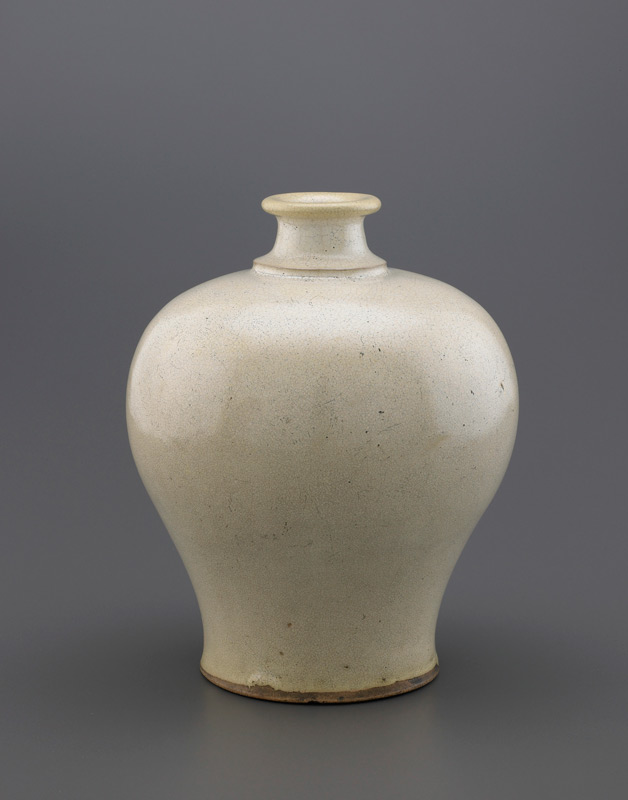
3. Vase, Ming dynasty, 17th century, stoneware with opaque white glaze (F1896.35a-b)
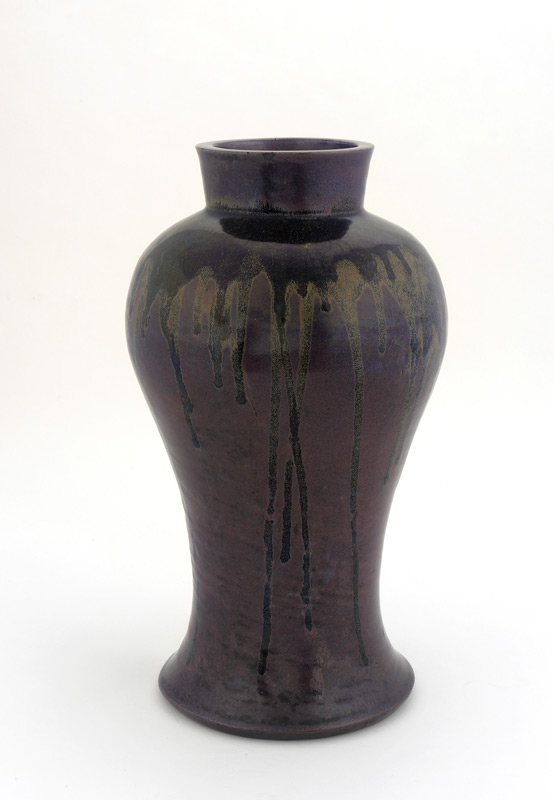
4. Sake flask, Edo period, 17th-18th century, stoneware with iron glazes (F1896.34)
Freer purchases 26 East Asian ceramics from R. E. Moore, Matsuki, and the New York branch of Yamanaka
Freer acquires first Japanese screens, purchasing two from Matsuki, and loans Japanese prints to exhibition at the Grolier Club in New York
Whistler's wife, Beatrice, dies of cancer
William Jennings Bryan gives 'Cross of Gold' speech at Democratic National Convention in Chicago; U.S. Supreme Court upholds racial segregation in Plessy v. Fergusson decision
-
1897
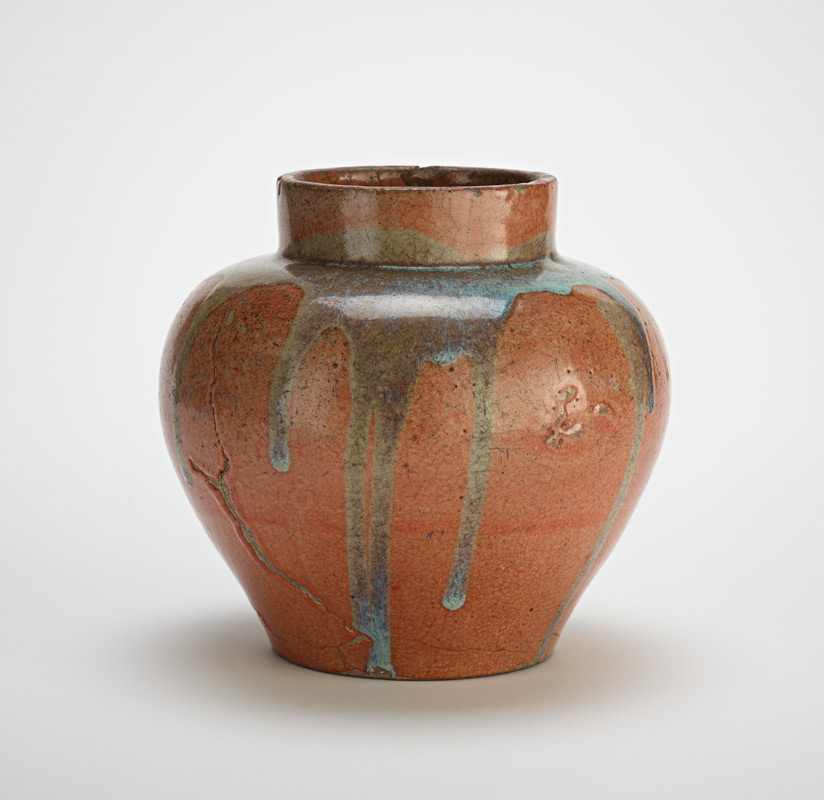
Jar, Edo period, late-18th-19th century, stoneware with feldspathic and rice-straw-ash glazes (F1897.44)
Freer purchases 74 East Asian ceramics from dealers in Boston, New York, and Paris
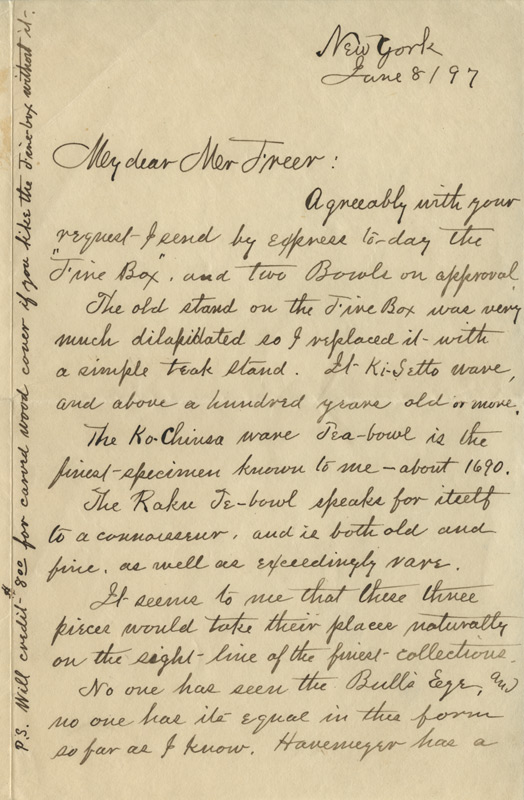
R.E. Moore to Charles Lang Freer, June 8, 1897
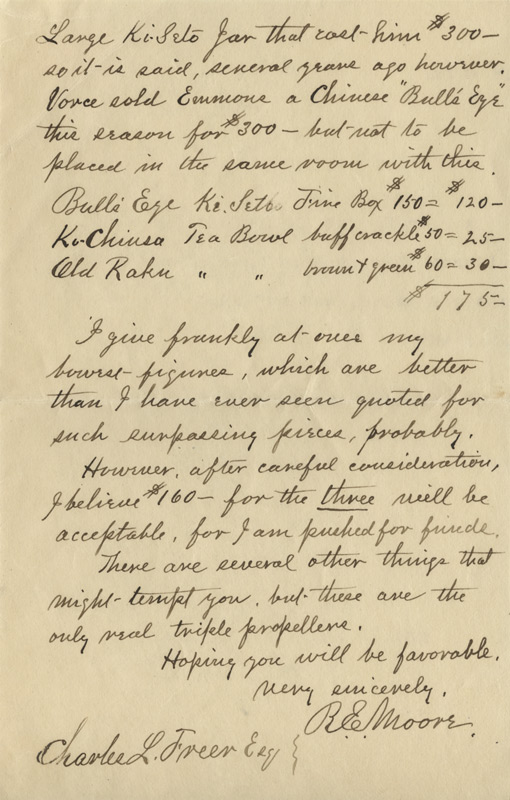
"...these three pieces would take their place naturally on the sight-line of the finest collections."
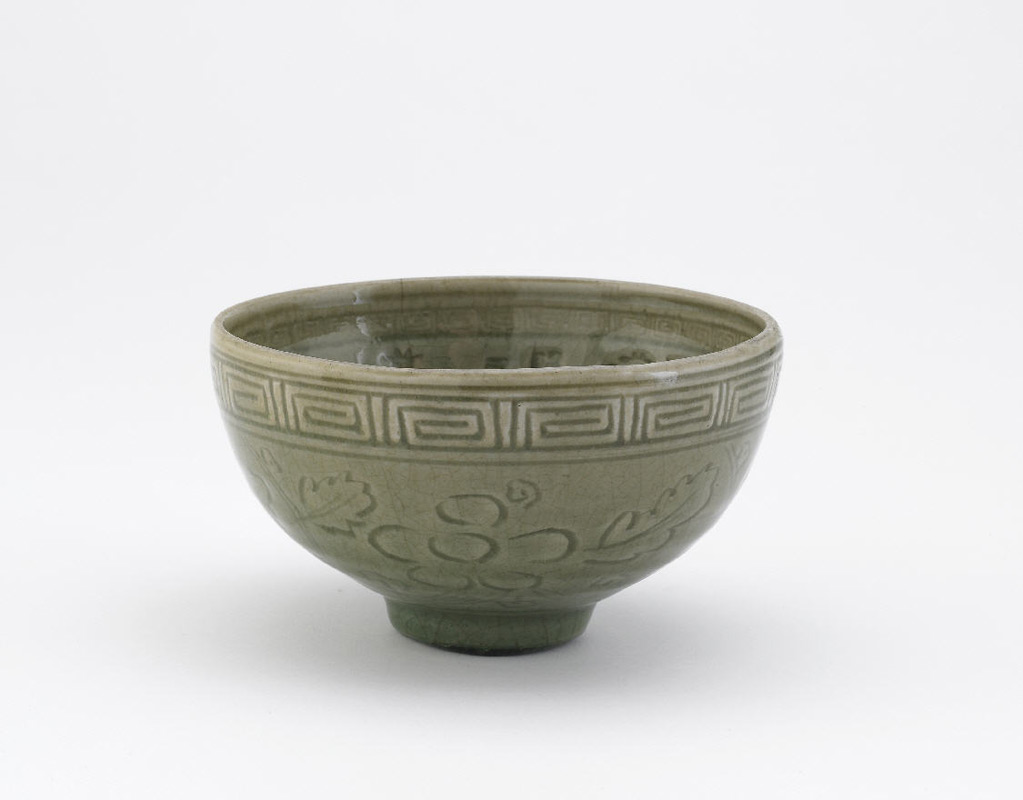
Serving bowl in style of Longquan ware, Edo period, late 18th-early 19th century, stoneware with celadon glaze (F1897.11)
Freer's purchase of three ceramics from the sale of the Goncourt collection establish his relationship with dealer Siegfried Bing (1838-1905)

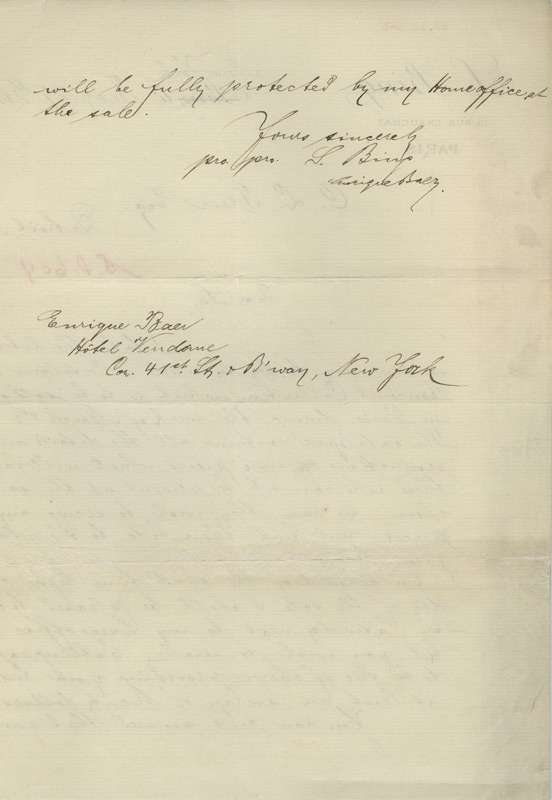
Sigfried Bing to Charles Lang Freer, February 27, 1897
"I take the liberty of sending you today... a Catalogue of the Goncourt Collection which is to be sold at auction in Paris during the week of March 8th."
National economic difficulties affect Michigan-Peninsular stock; as shares plummet, Hecker and Freer gain controlling interest in the company
Queen Victoria's Diamond Jubilee celebrated in London
-
1898
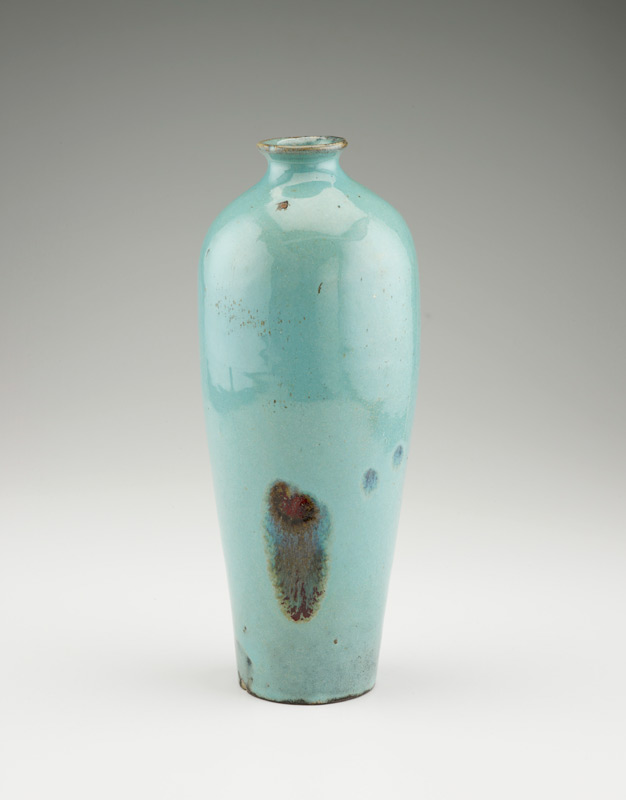
1. Vase, Qing dynasty, mid 17th-18th century, stoneware with Jun-style glaze (F1898.32)
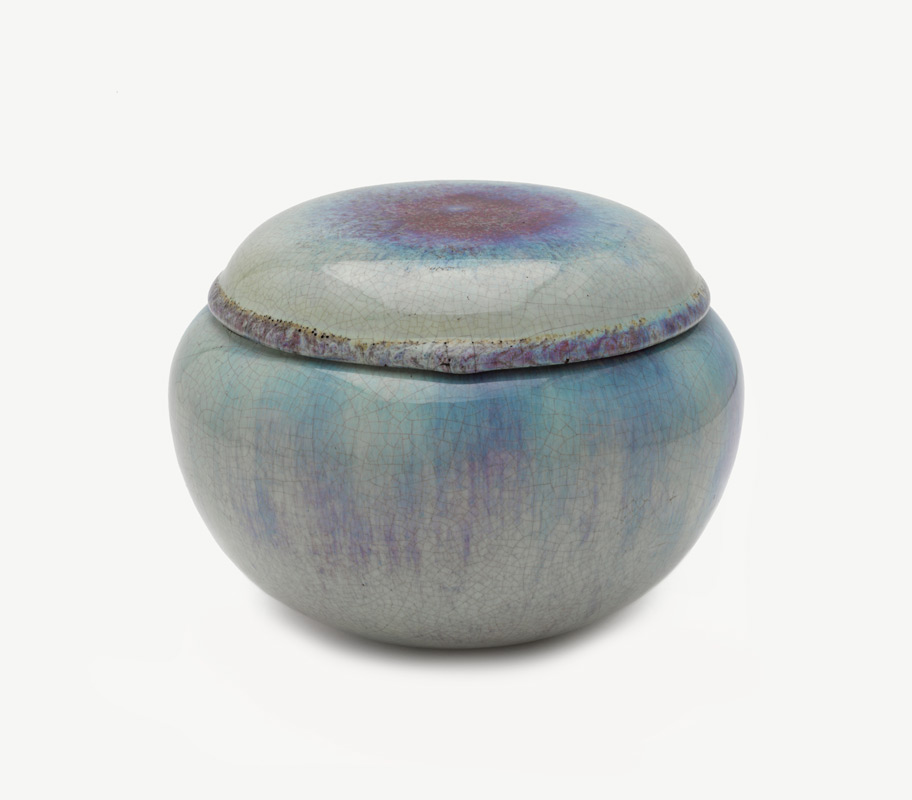
2. Vessel in the shape of a lidded alms bowl, Qing dynasty, 18th-19th century, stoneware with Jun-style glaze (F1898.44)
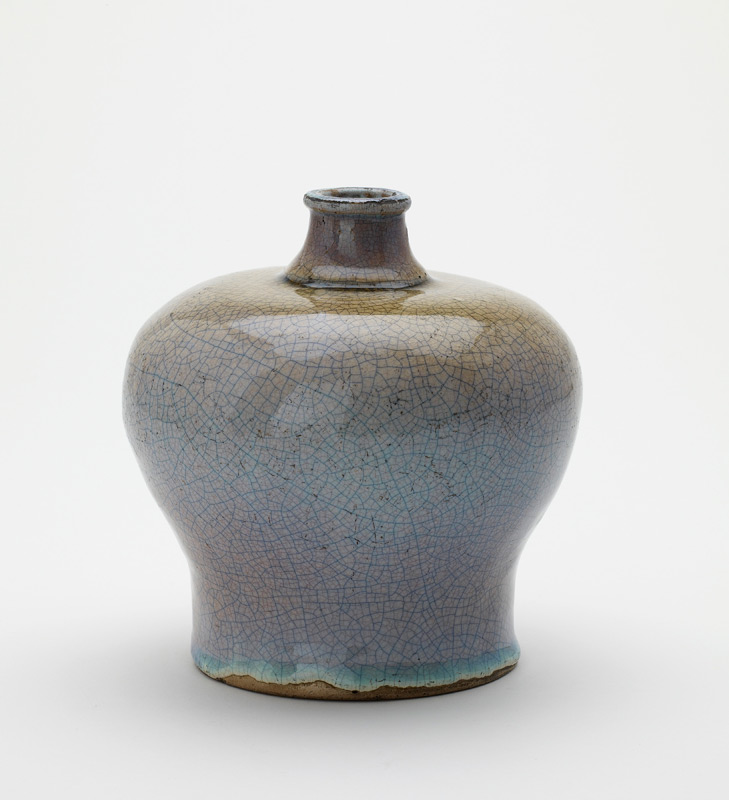
3. Bottle, Qing dynasty, 17th-19th century, stoneware with rice-straw ash glaze (F1898.46)
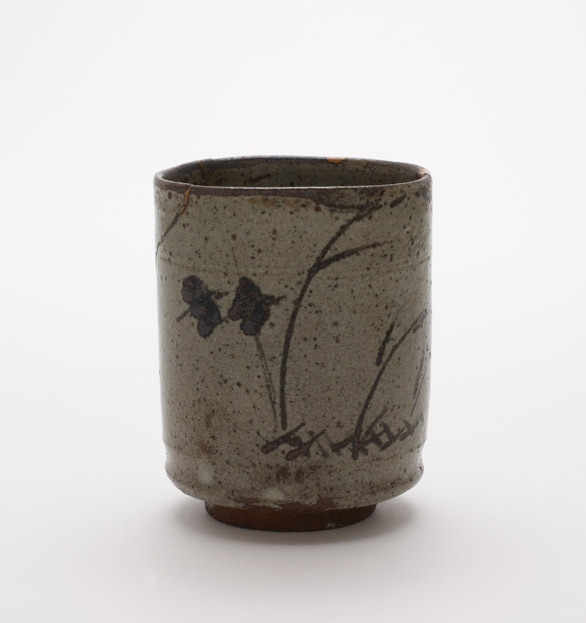
4. Individual food-serving cup, Momoyama period, 1596-1615, stoneware with iron decoration under wood-ash glaze; gold lacquer repairs (F1898.84)
Freer purchases more than 150 East Asian ceramics at auction and from his customary dealers
Freer purchases 276 works by Whistler, mostly etchings and drawings from the Haden Collection
-
1899
Freer is instrumental in consolidating thirteen railroad car companies into the American Car and Foundry Company; he then retires from business to devote himself to collecting art
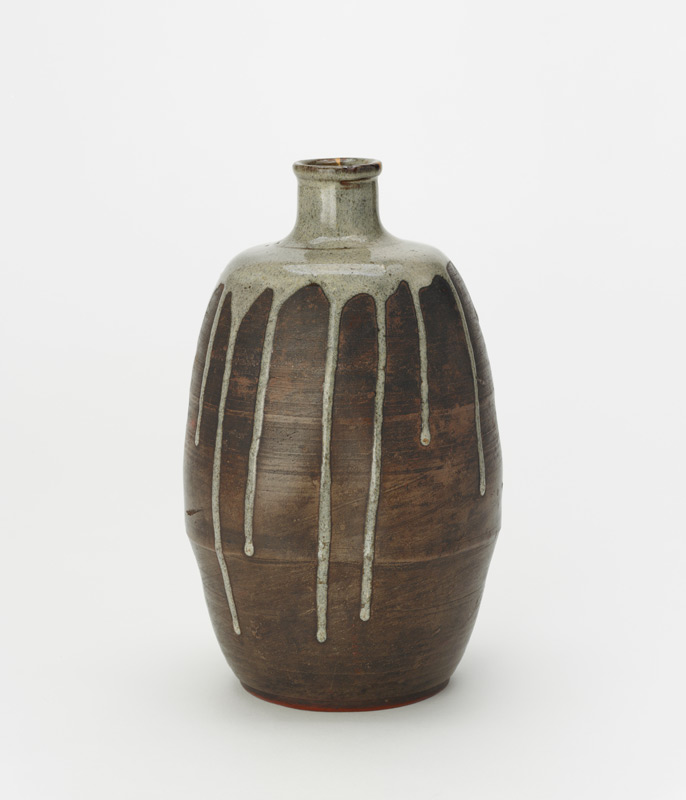
Sake bottle, Edo period, 19th century, stoneware with iron slip and rice-straw ash glaze (F1899.45)
Freer purchases 87 East Asian ceramics, chiefly from Yamanaka and Matsuki
Freer purchases seven works on paper by Whistler as well as thirteen Japanese paintings
Boxer Rebellion breaks out in China in response to western 'spheres of influence'
-
1900
Freer attends Exposition Internationale in Paris
Freer purchases 99 East Asian ceramics, most from his customary dealers in the U.S.; he also makes his first purchases from the Paris-based Japanese dealer Hayashi Tadamassa
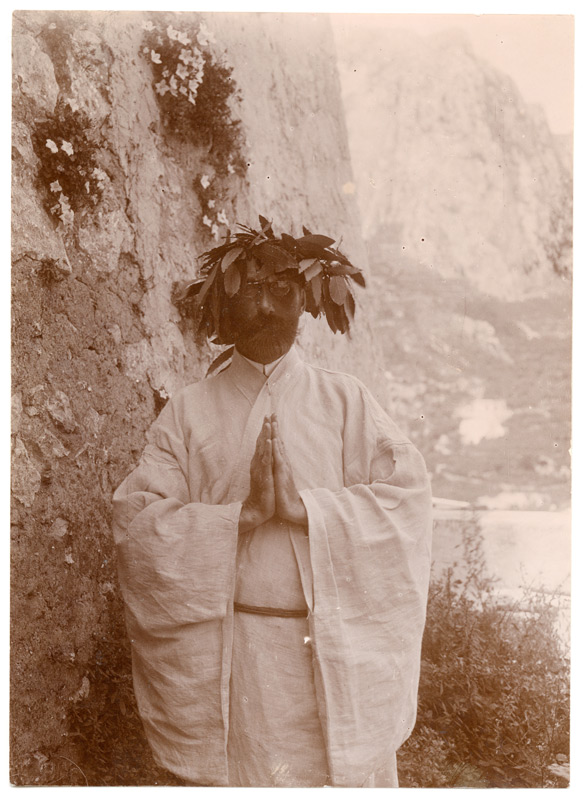
Charles Lang Freer in Capri, 1903 (A1187)
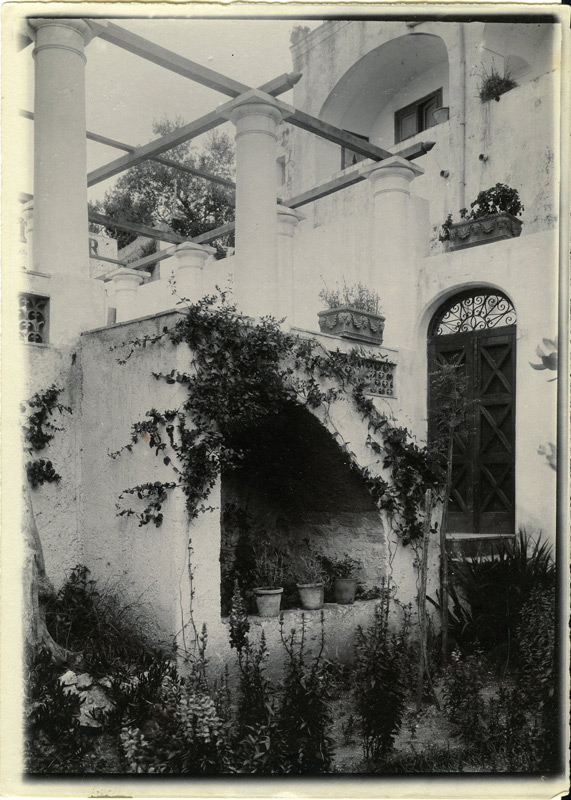
View of Villa Castello in Capri
Freer buys villa in Capri with Thomas S. Jerome
-
1901
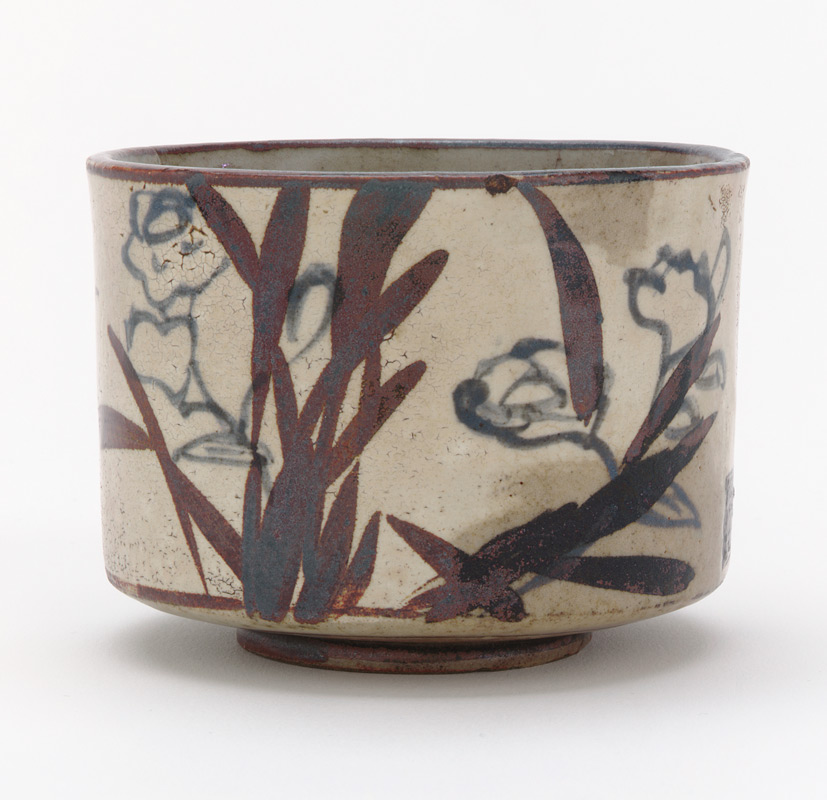
Tea bowl with inscription and design of narcissus, style of Ogata Kenzan, Kyoto workshop, Kenzan style, mid- to late-18th century, buff clay with white slip, iron, and cobalt pigments under transparent glaze (F1900.50)
Freer adds more than 150 East Asian ceramics to his collection, including many purchased from Siegfried Bing and two from painter Charles Caryl Coleman (1840-1928), whom Freer had met in Capri
Freer meets Siegfried Bing in Paris
Freer meets Ernest Fenollosa (1853-1908), a scholar-dealer and key advisor in Freer's quest to become a knowledgeable connoisseur of Asian art
U.S. President William McKinley assassinated at Pan-American Exposition in Buffalo, New York; is succeeded by his vice president, Theodore Roosevelt
-
1902
Freer acquires first examples of Near Eastern pottery, chiefly Raqqa wares, from Kelekian
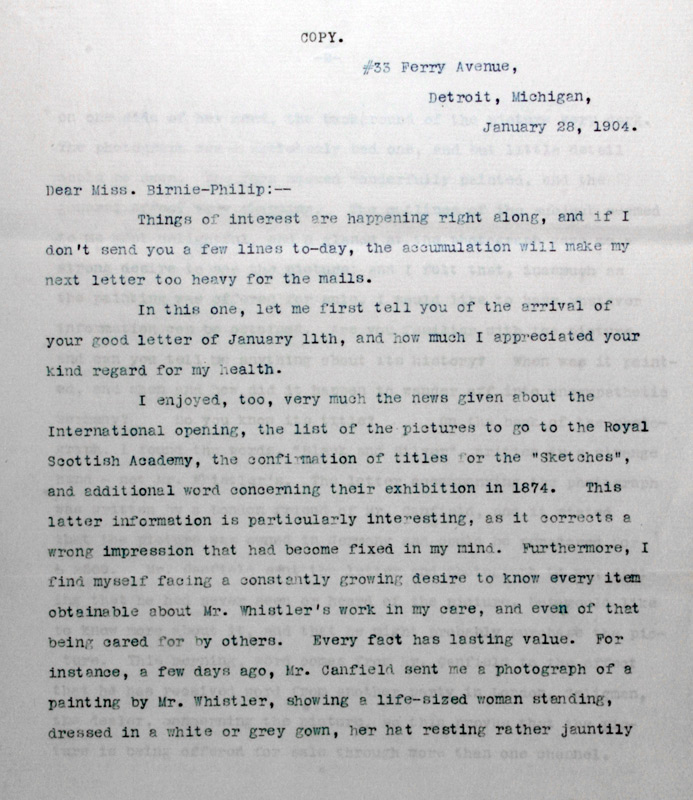
Charles Lang Freer to Rosalind Birnie Philip, January 28, 1904
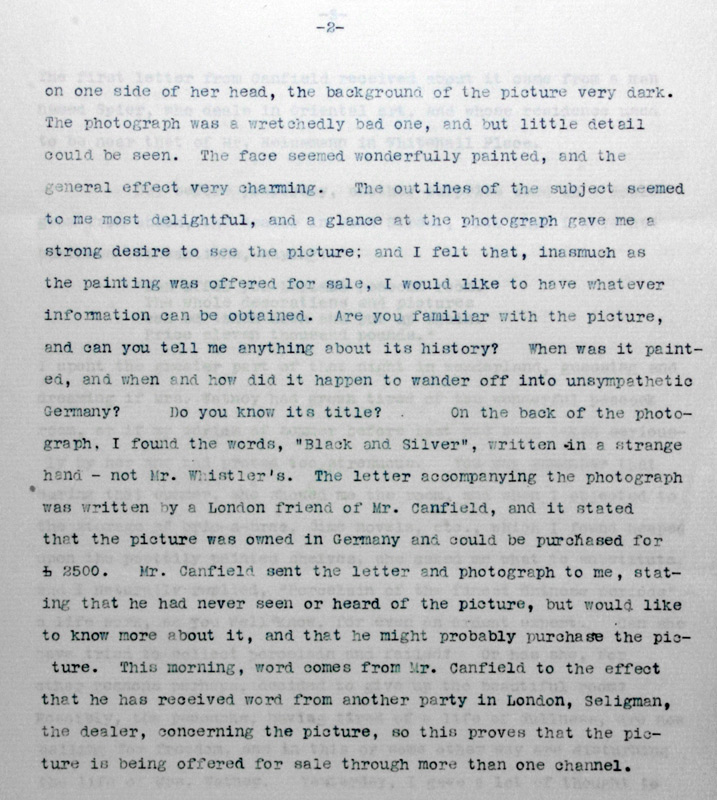
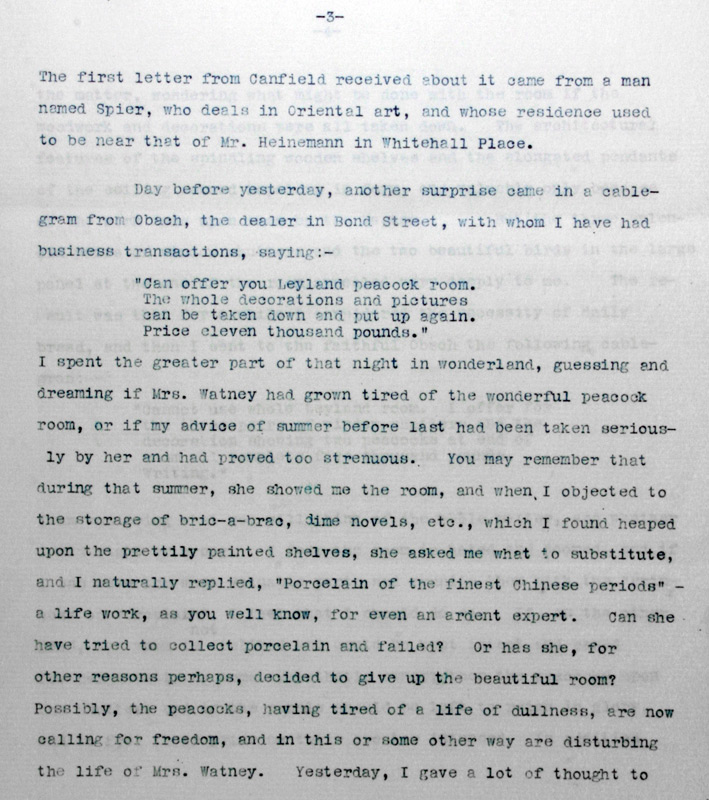
"Mrs Watney... showed me the room, and when I objected to the storage of bric-a-brac, dime novels, etc., which I found heaped upon the prettily painted shelves, she asked me what to substitute, and I naturally replied, 'Porcelain of the finest Chinese periods' - a life work, as you well know, even for an ardent expert"
Freer travels to England for the summer, in an effort to greatly increase his Whistler holdings; sees the Peacock Room for the first time
Anglo-Japanese Alliance signed
-
1903
Freer travels to Europe and is with Whistler in London during the artist's final illness
Freer purchases La Princesse from the Glasgow collector William Burrell -- one of more than 130 works by Whistler to enter Freer's collection in 1903
Freer purchases 57 East Asian, Near Eastern, and Islamic ceramics from western dealers and at auction
-
1904
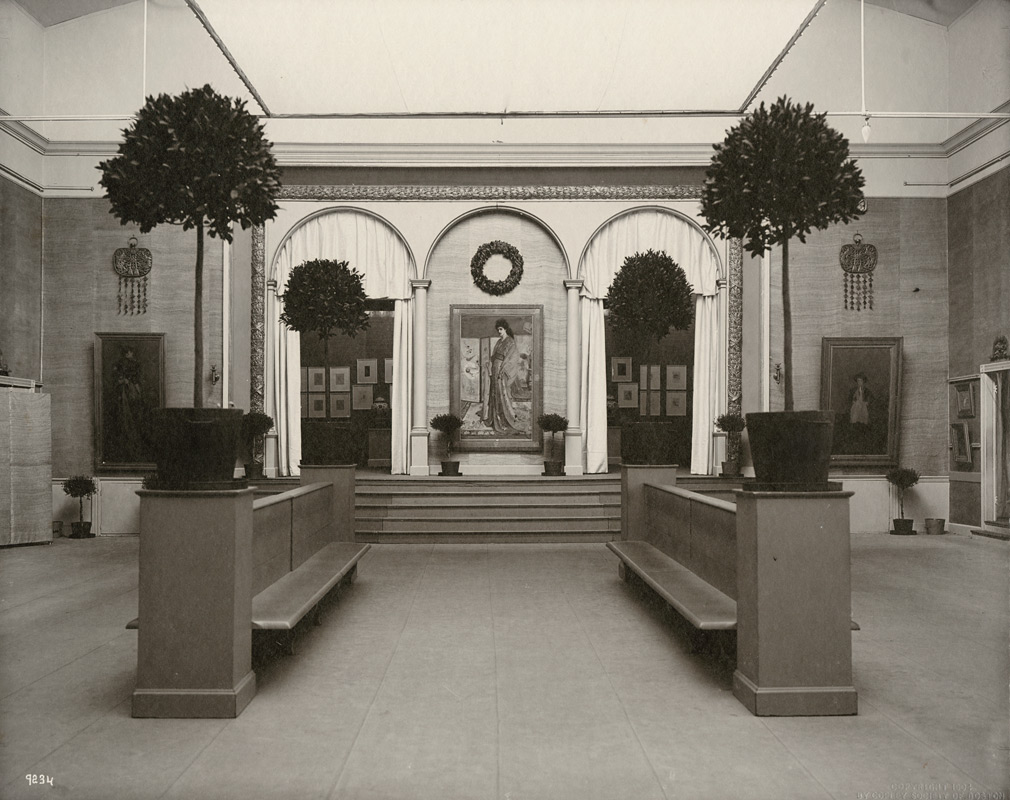
Copley Hall, looking north, March 20, 1904 (A1135)
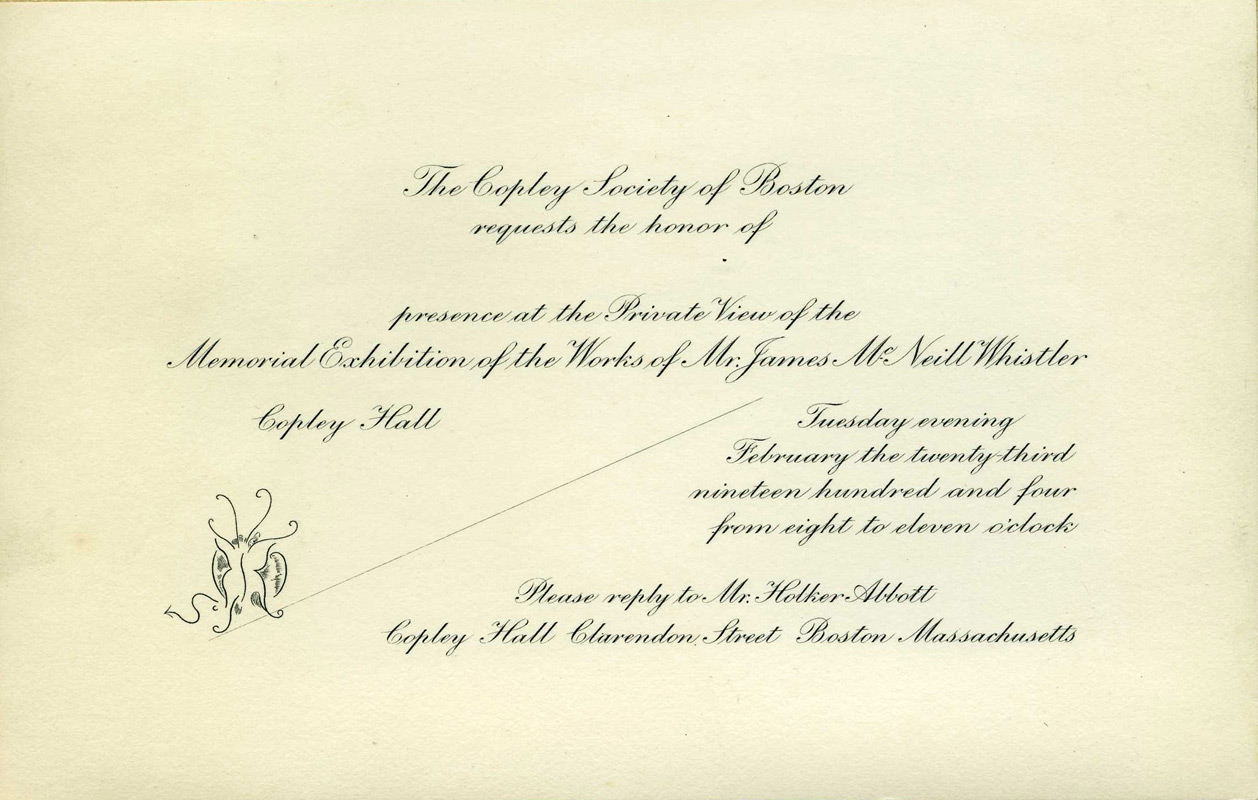
Invitation to Copley Society of Boston, Memorial Exhibition of the Works of James McNeill Whistler, March 20, 1904
Freer helps organize Whistler Memorial Exhibition at Boston's Copley Hall
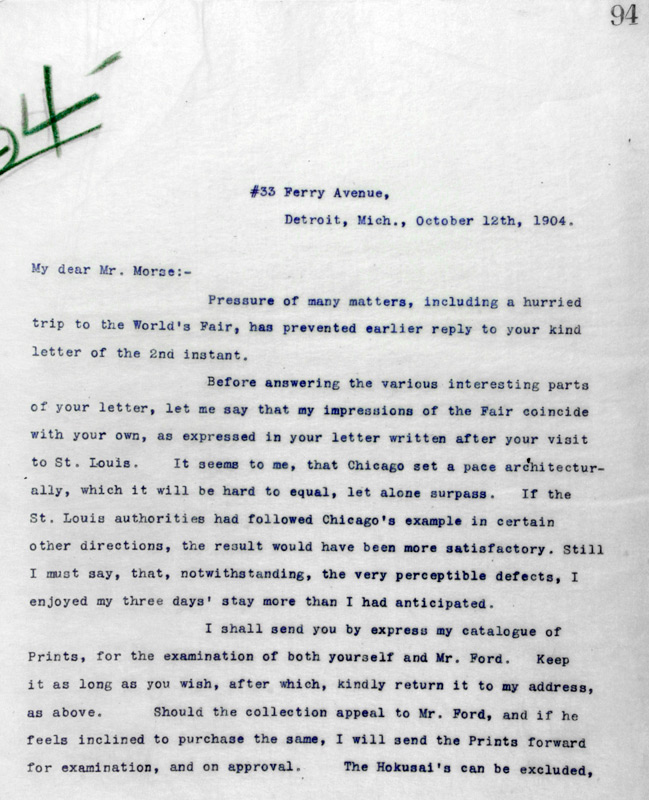
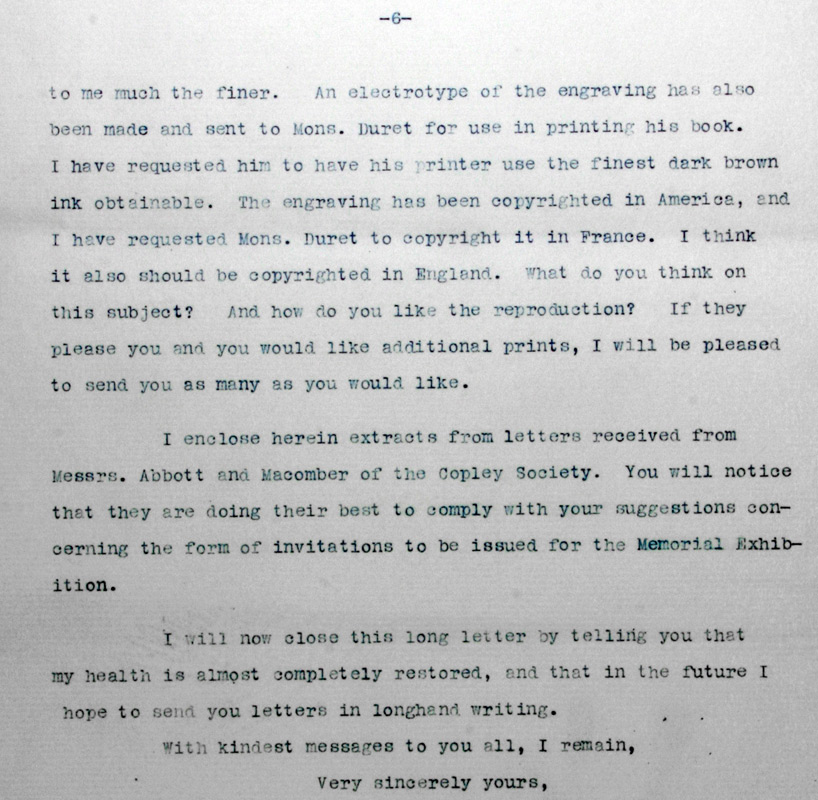
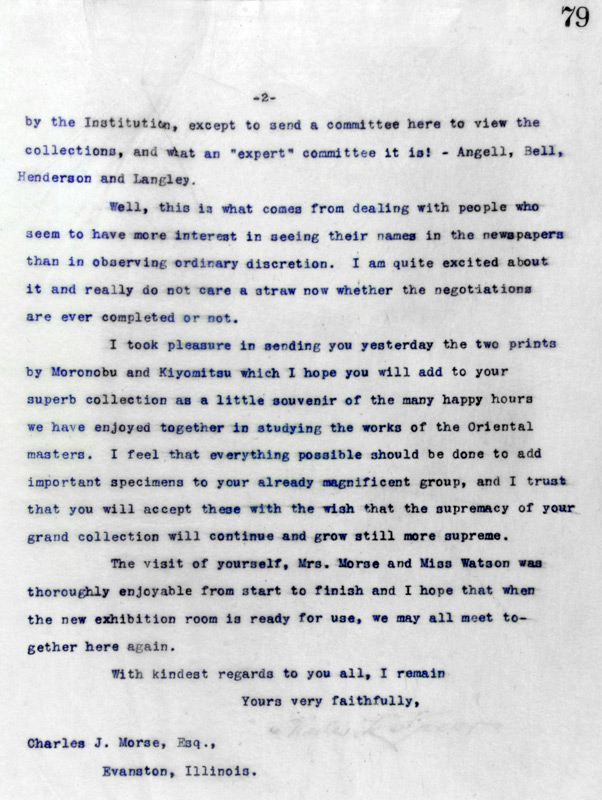
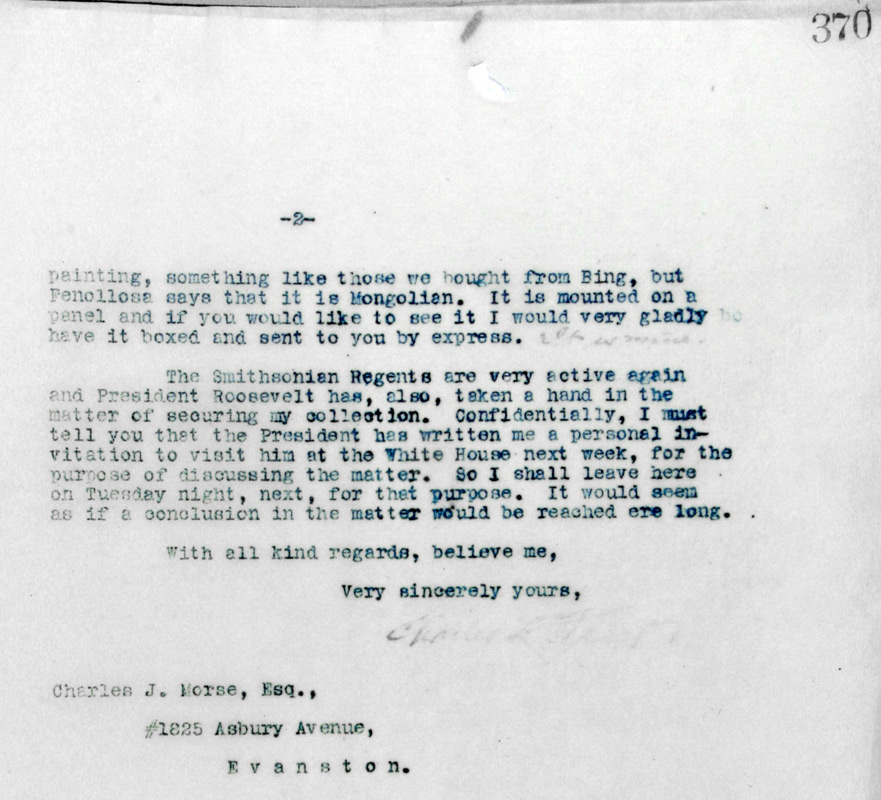
Charles Lang Freer to Charles Morse, October 12, 1904
Freer organizes bijou gallery in Fine Arts Palace at Louisiana Purchase Exposition in St. Louis
Kelekian serves as Commissioner General for Iran at the Louisiana Purchase Exposition
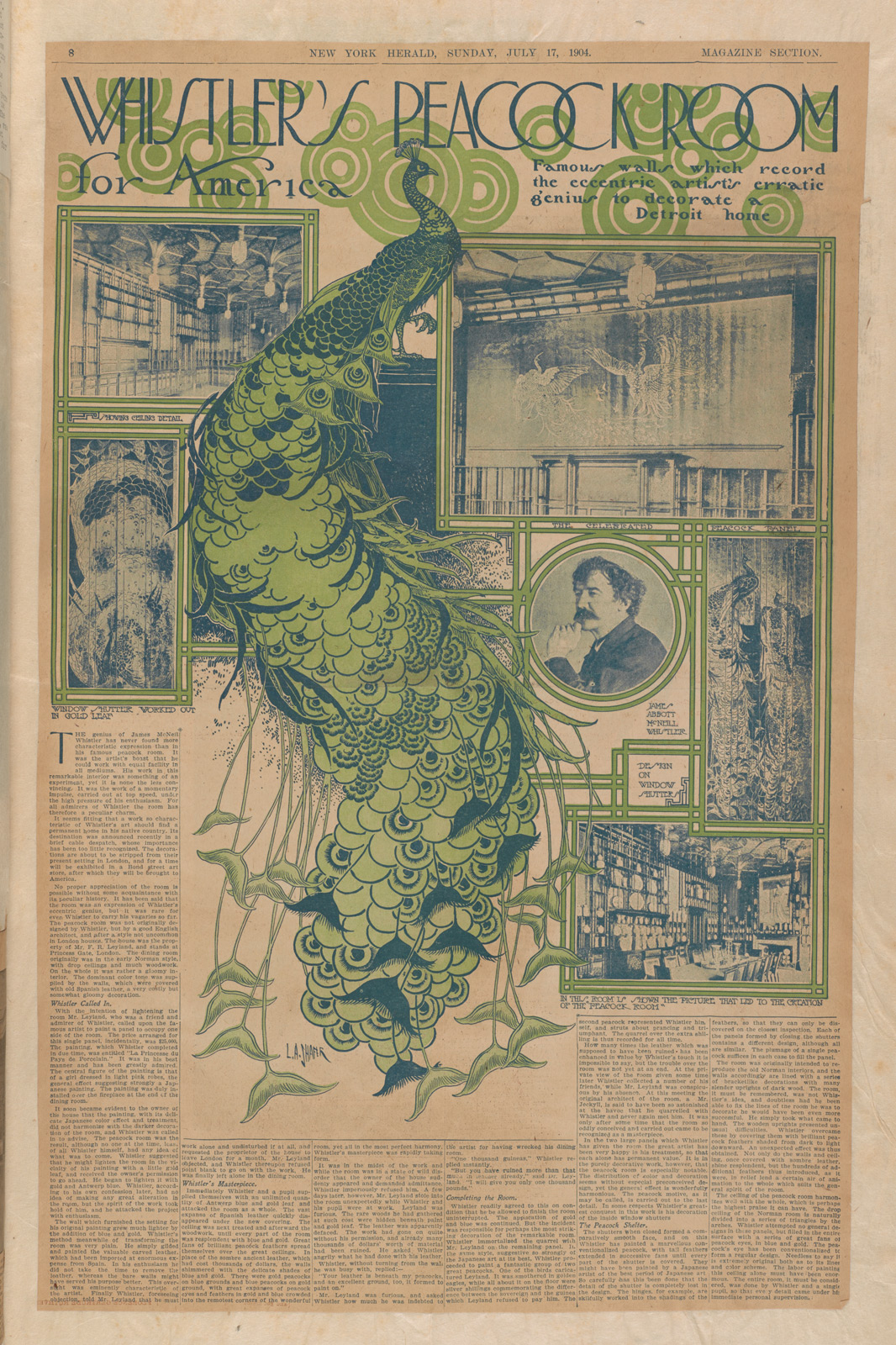
"Whistler's Peacock Room for America," New York Herald, July 17, 1904 (A0404)
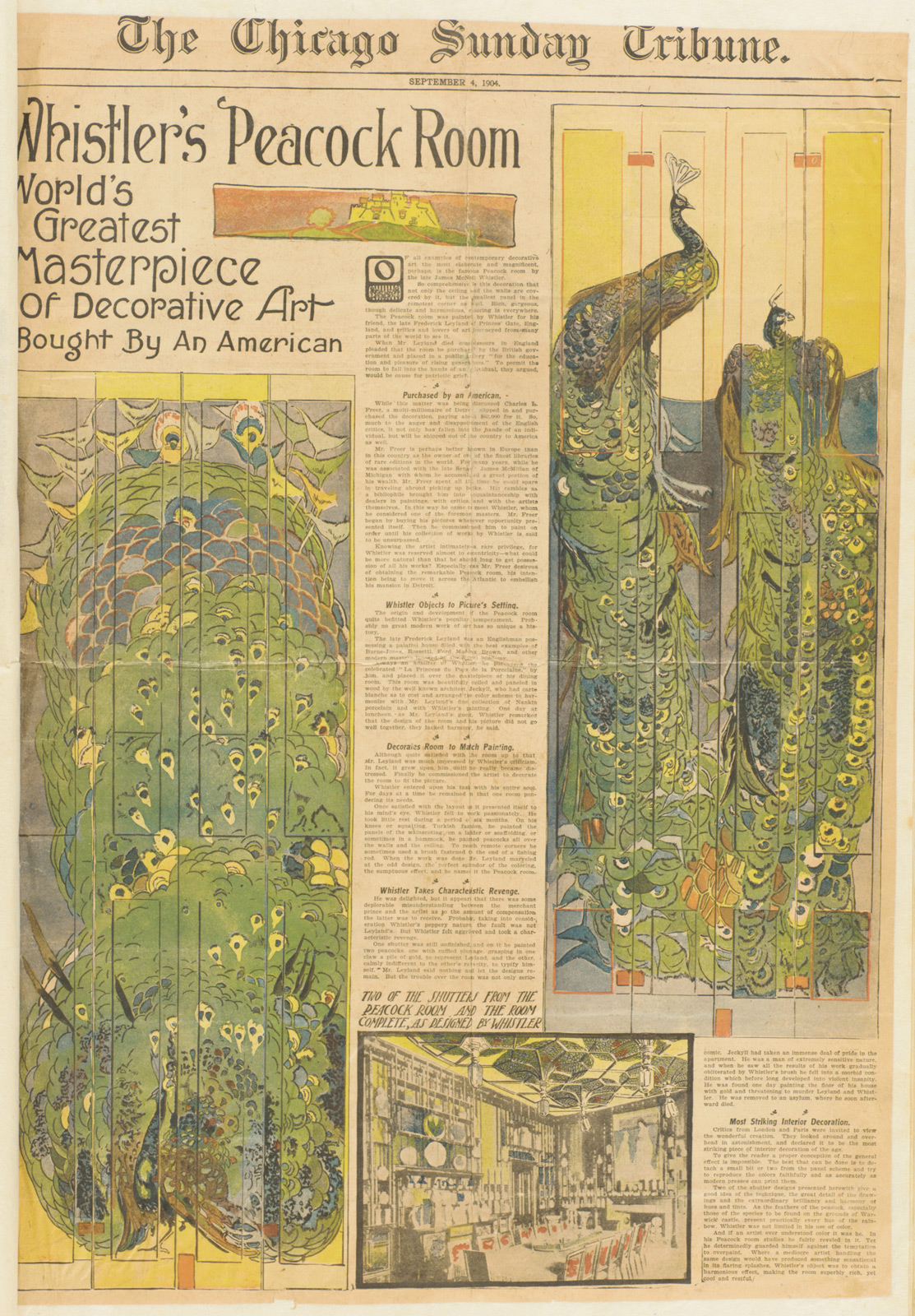
"Whistler's Peacock Room: World's Greatest Masterpiece of Decorative Art Bought by An American," Chicago Tribune, September 4, 1904 (A0686)
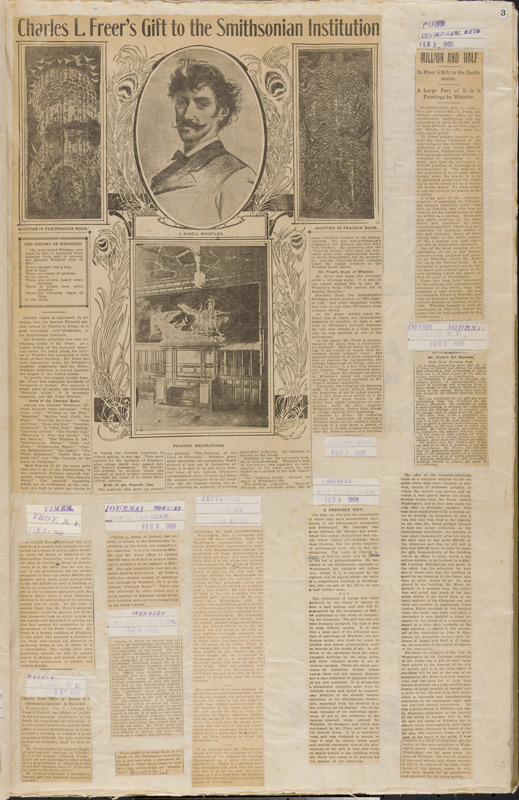
"Charles L. Freer's Gift to the Smithsonian Institution," unknown newspaper, Detroit, MI, February 3, 1905 (A0414)
Freer purchases the Peacock Room from London's Obach & Co. on New Bond Street
Freer purchases eight blue-glazed Near Eastern wares from Kelekian; receives 3 cases of art from Bing, including a number of Near Eastern ceramics
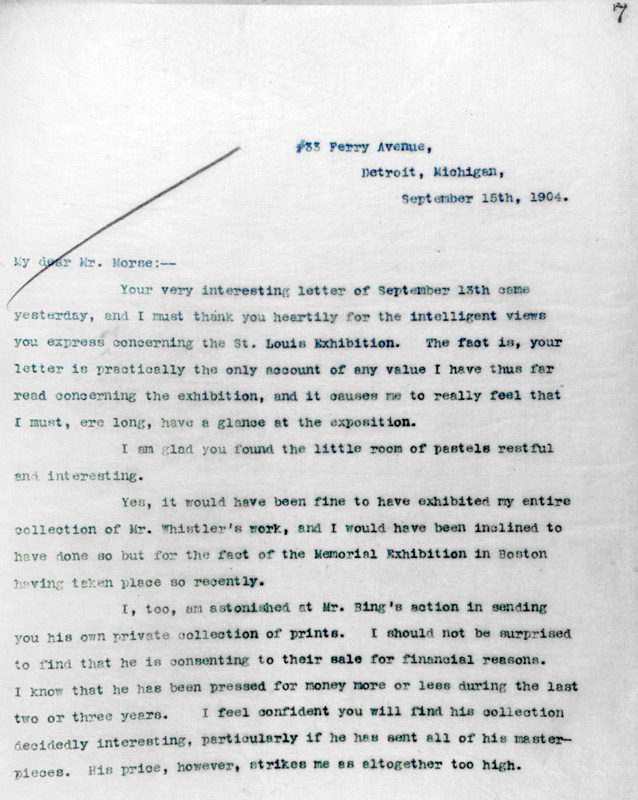
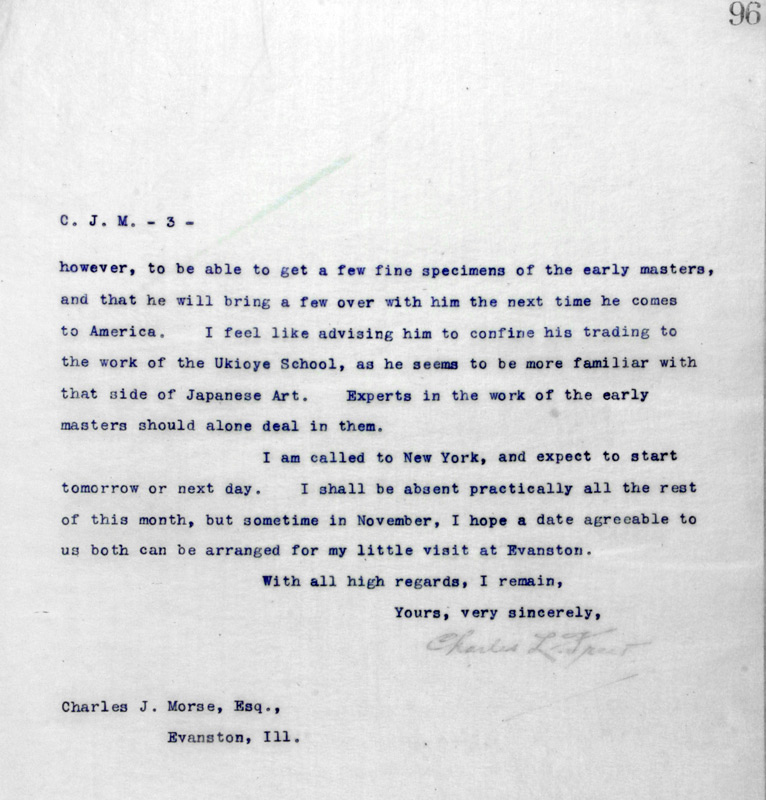
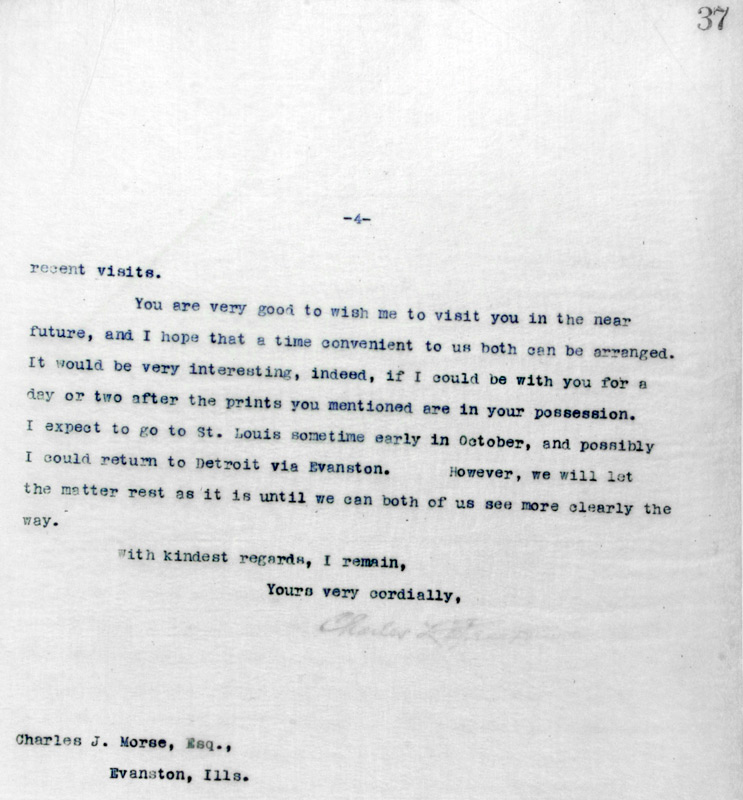
Charles Lang Freer to Charles Morse, September 15, 1904
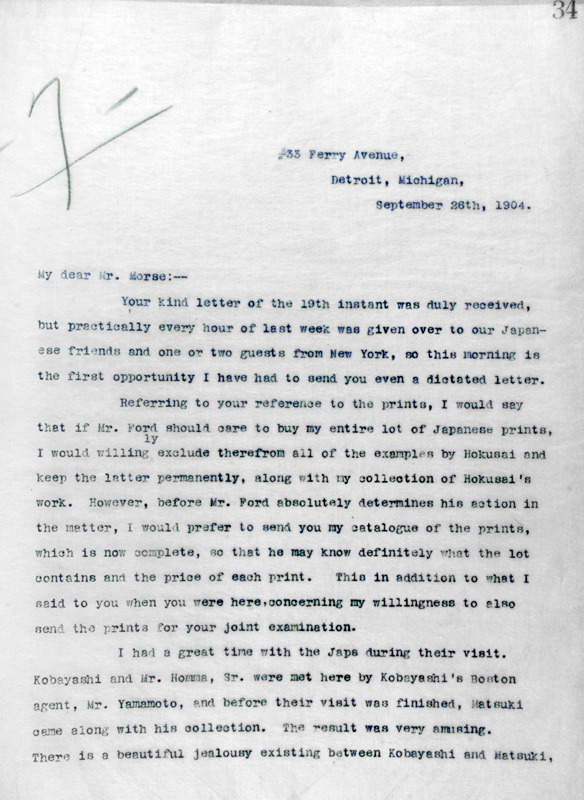
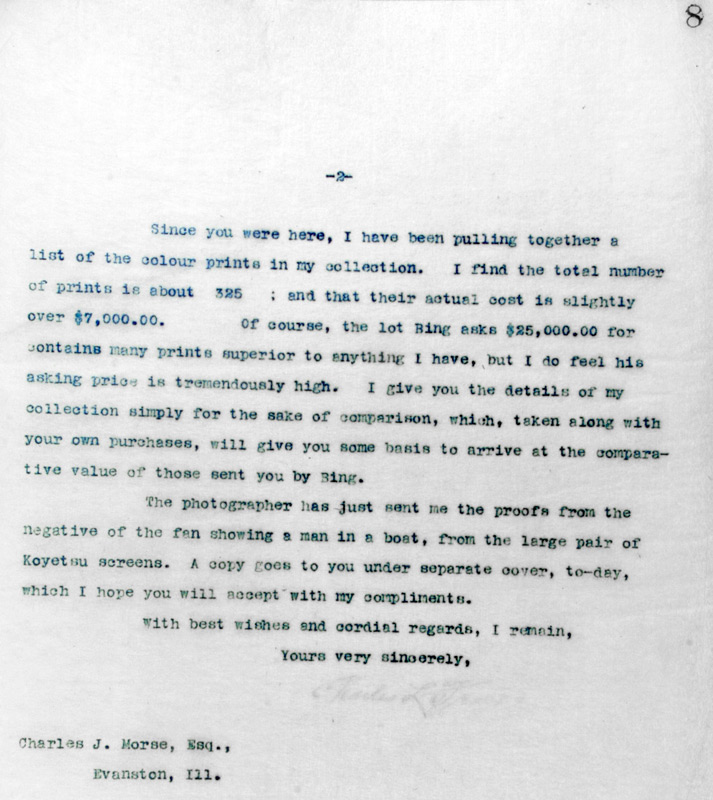
Charles Lang Freer to Charles Morse, September 26, 1904
Freer hosts a group of Japanese art dealers in Detroit
Freer offers his art collection and funds for a building to house them to the Smithsonian Institution
Russo-Japanese War
-
1905
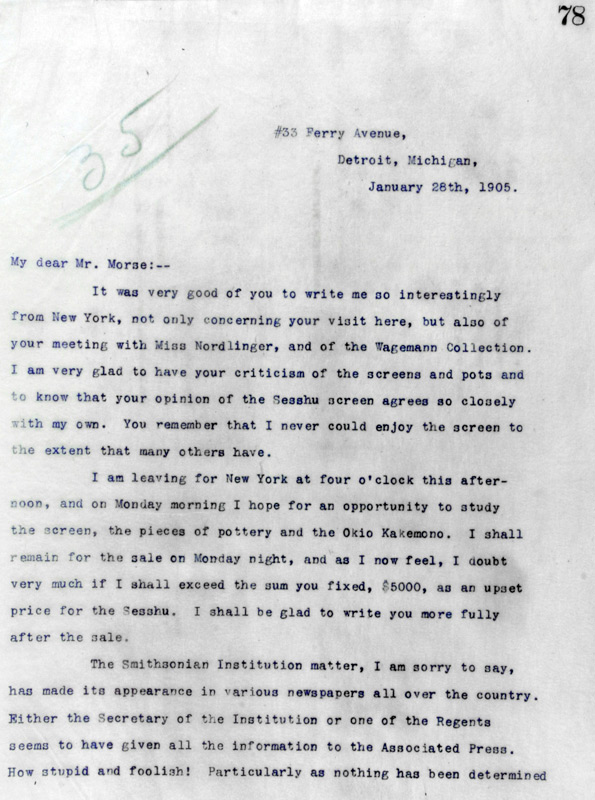
Charles Lang Freer to Charles Morse January 28, 1905
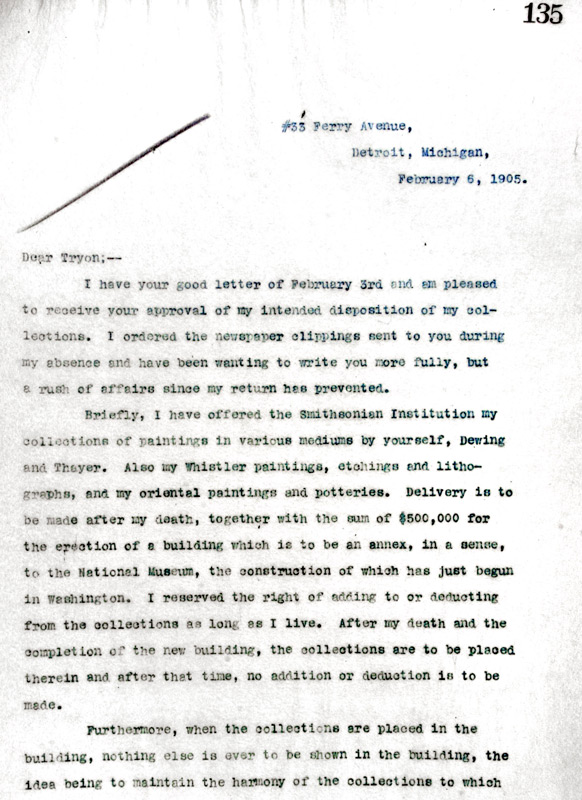
Charles Lang Freer to Dwight Tryon, February 6, 1905
Freer travels to Washington to discuss his offer of gift

Charles Lang Freer to Charles Morse February 8, 1905
Smithsonian committee visits Freer in Detroit
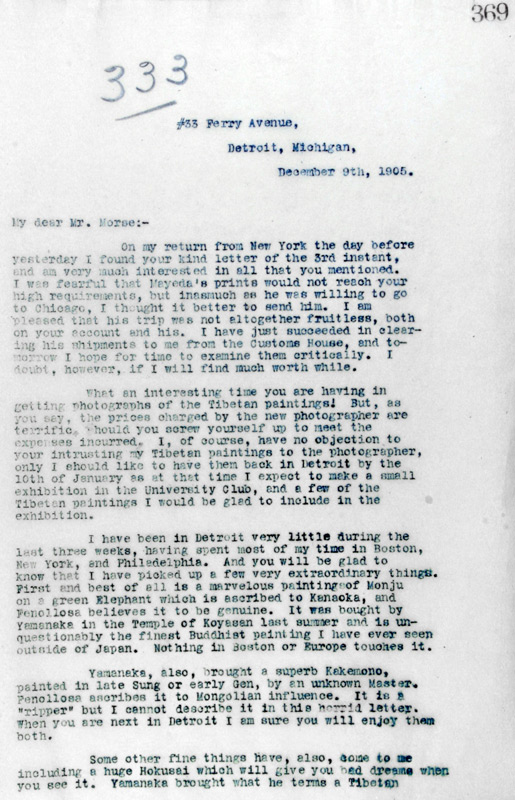
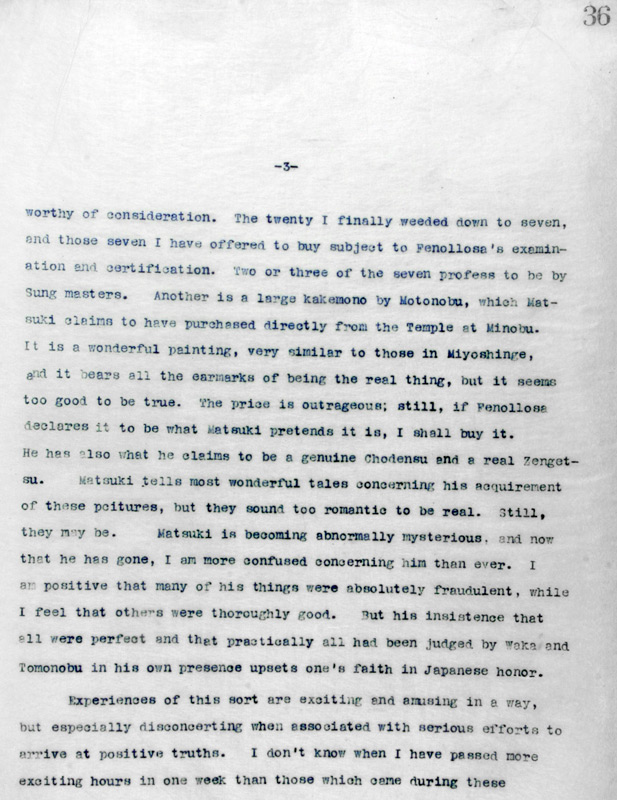
Charles Lang Freer to Charles Morse, December 9, 1905
Matsuki visits Freer in Detroit
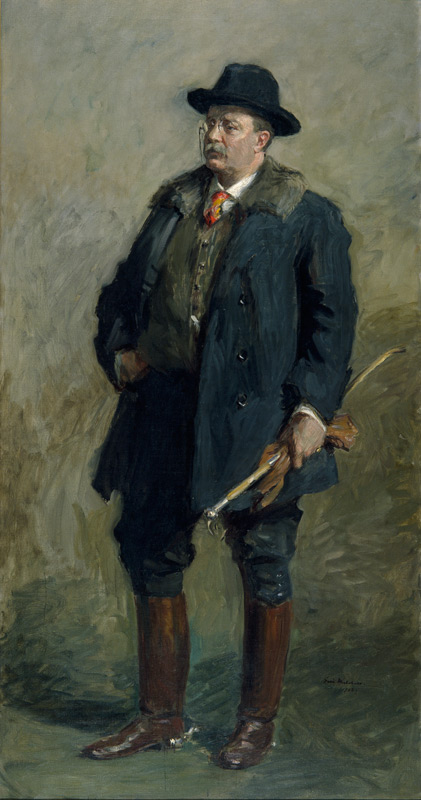
Portrait of President Theodore Roosevelt, Gari Melchers, 1908, oil on canvas (F1908.17)
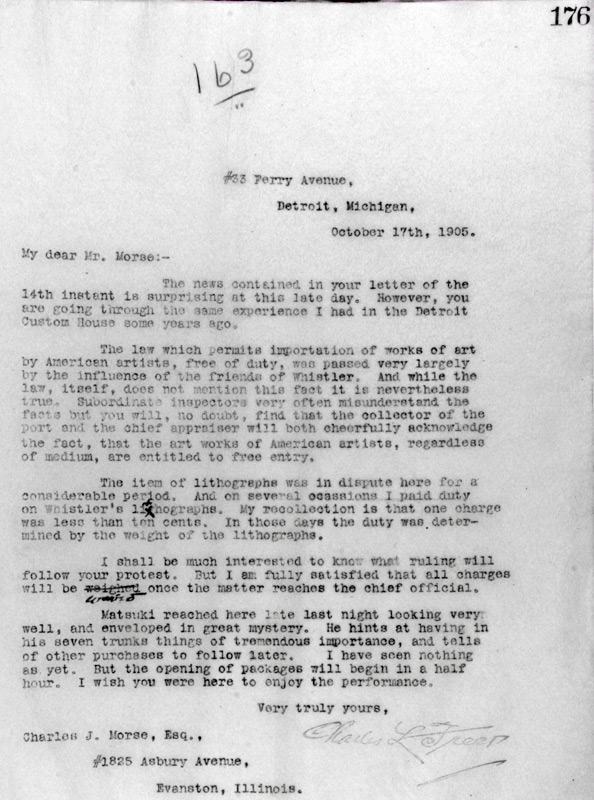
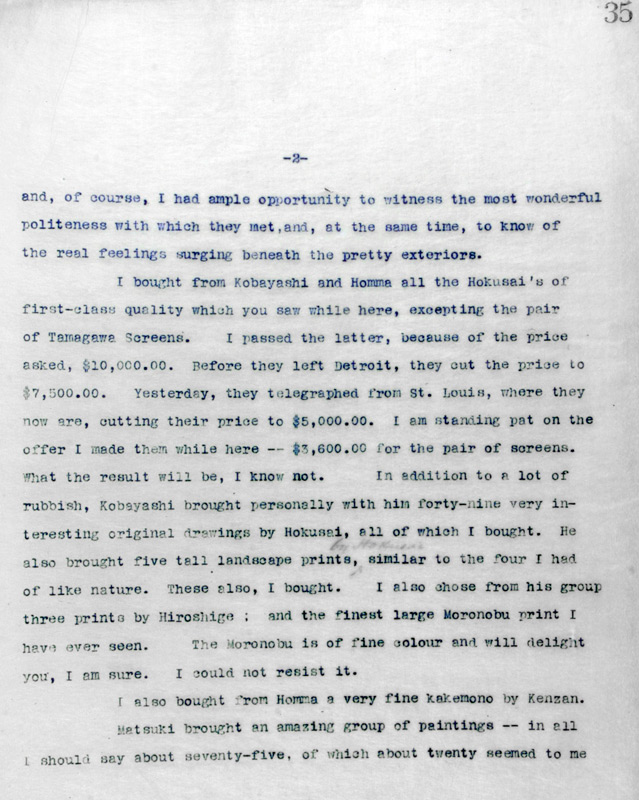
Charles Lang Freer to Charles Morse, October 17, 1905
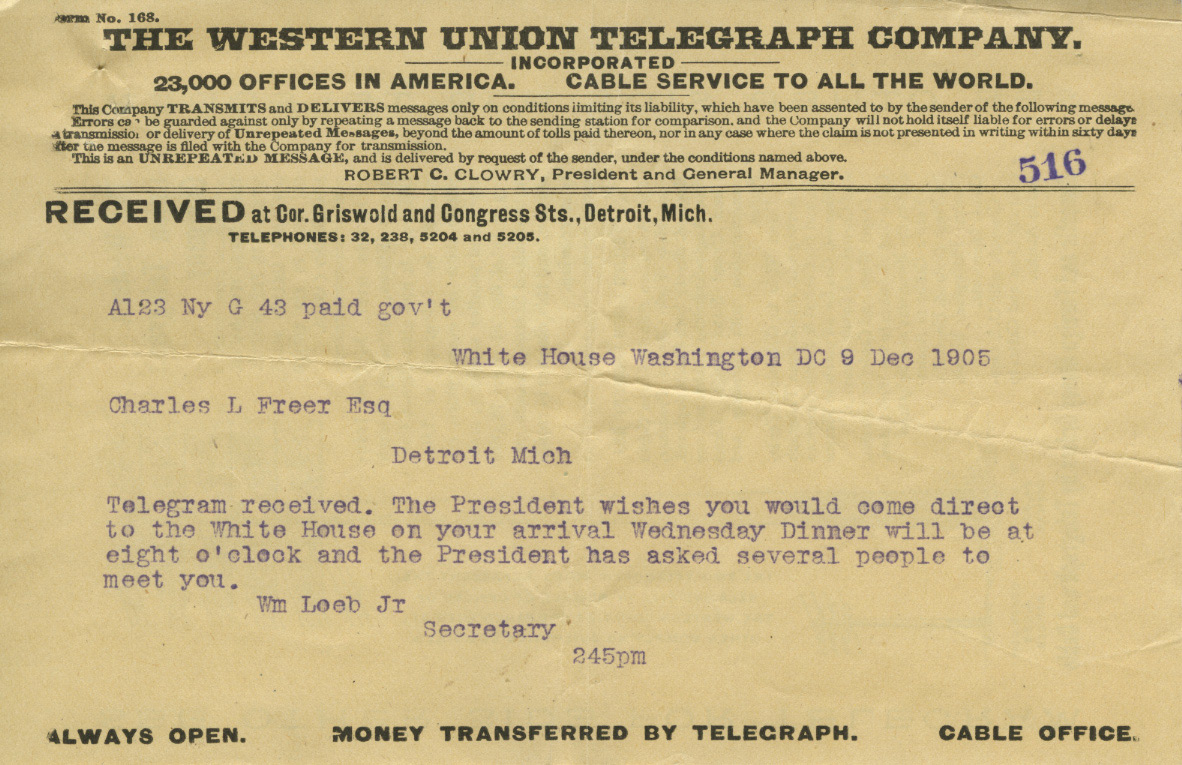
Telegram from President Roosevelt inviting Charles Lang Freer to the White House, December 9, 1905
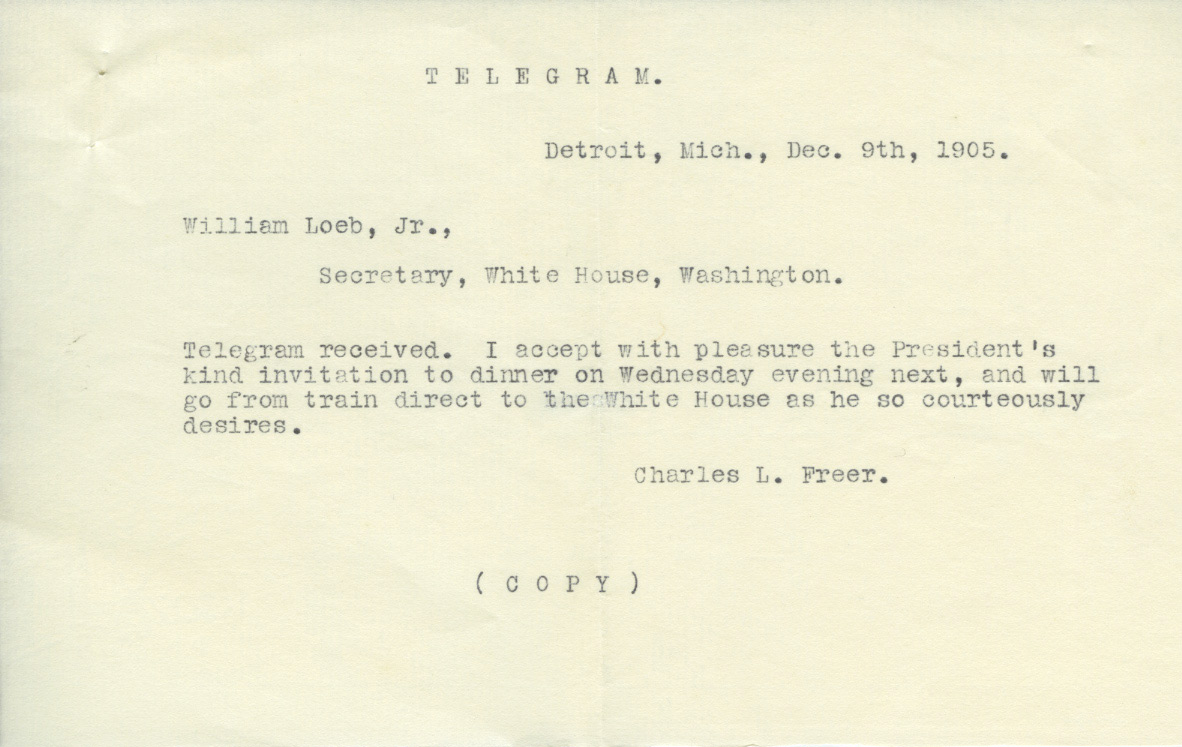
Telegram from Charles Lang Freer to President Roosevelt accepting the offer of hospitality, December 9, 1905
Freer invited to Roosevelt White House to discuss gift
-
1906
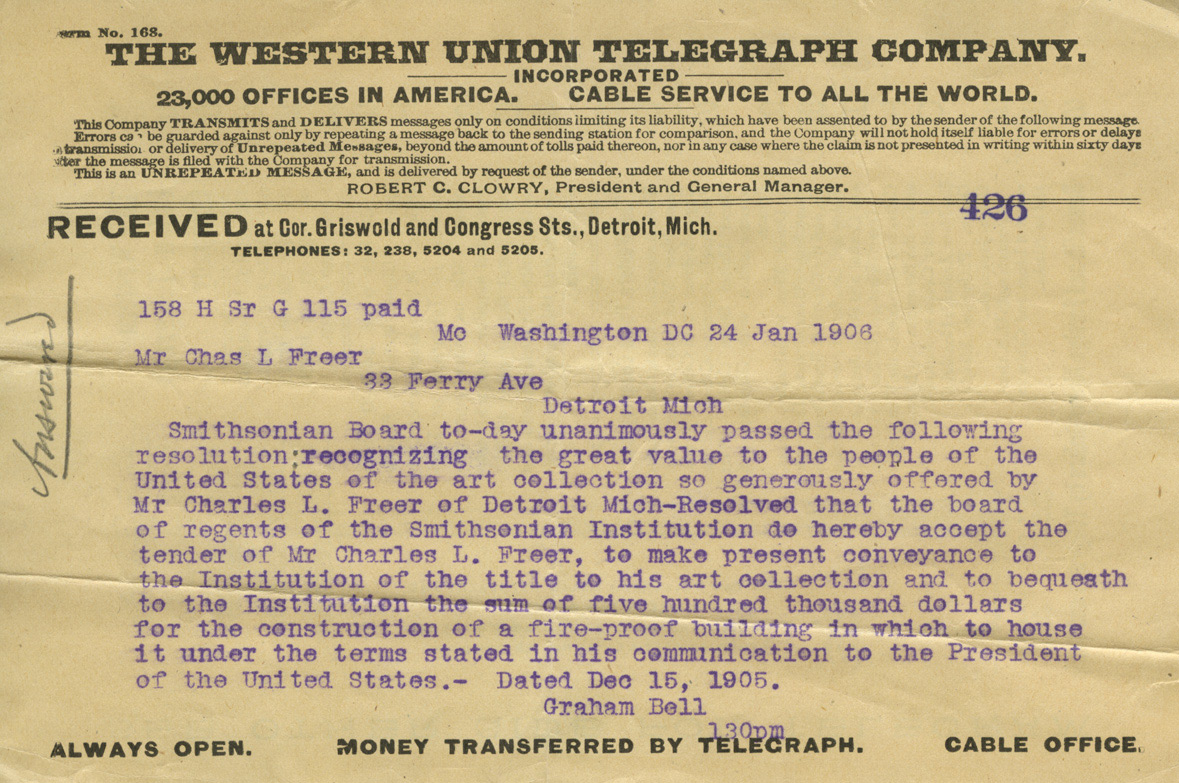
Telegram from Alexander Graham Bell to Charles Lang Freer, January 24, 1906
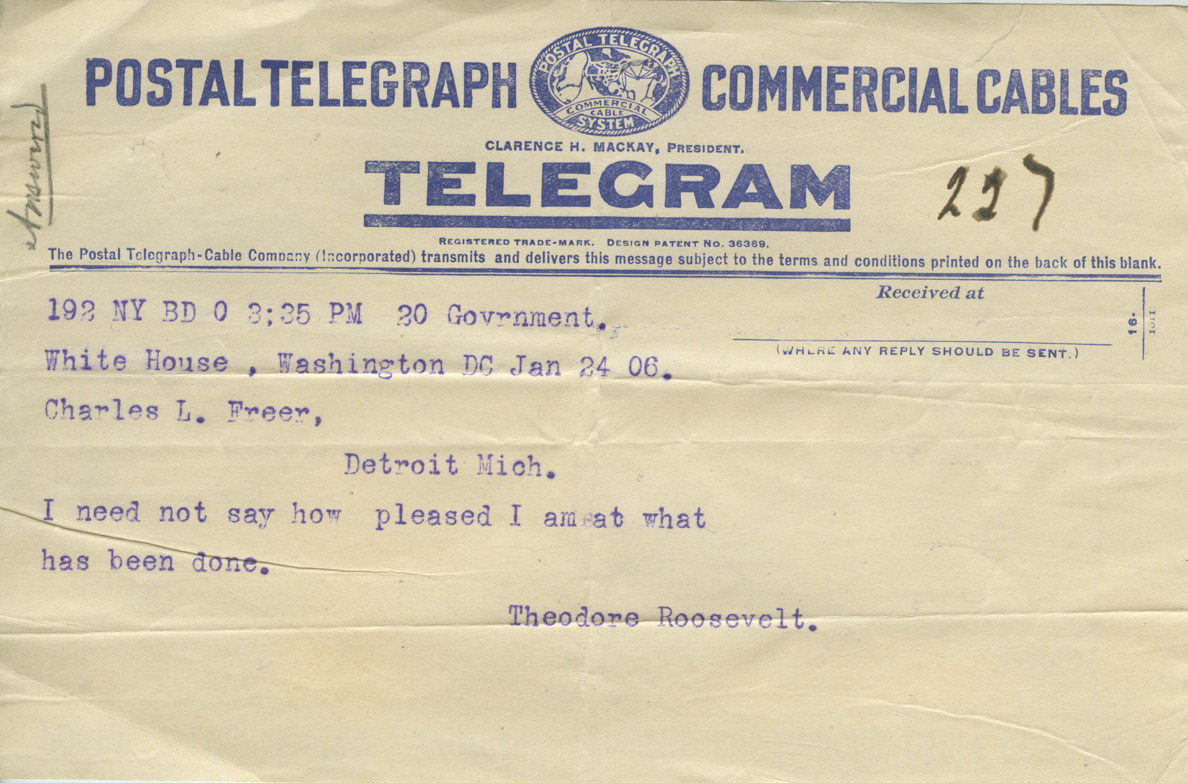
Telegram from President Roosevelt to Charles Lang Freer, January 24, 1906
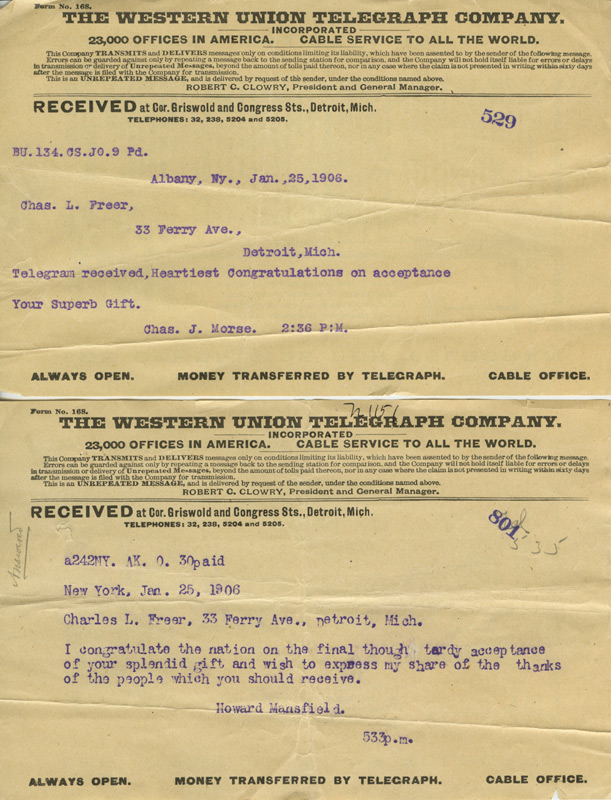
Telegrams to Charles Lang Freer from Charles Morse and Howard Mansfield, January 26, 1906
Freer gift officially accepted on January 24; deed of gift signed on May 6
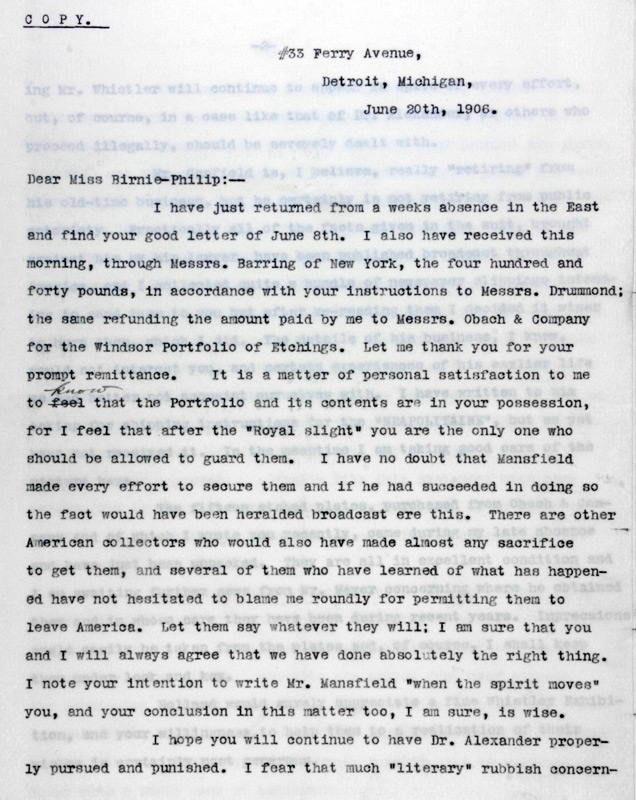
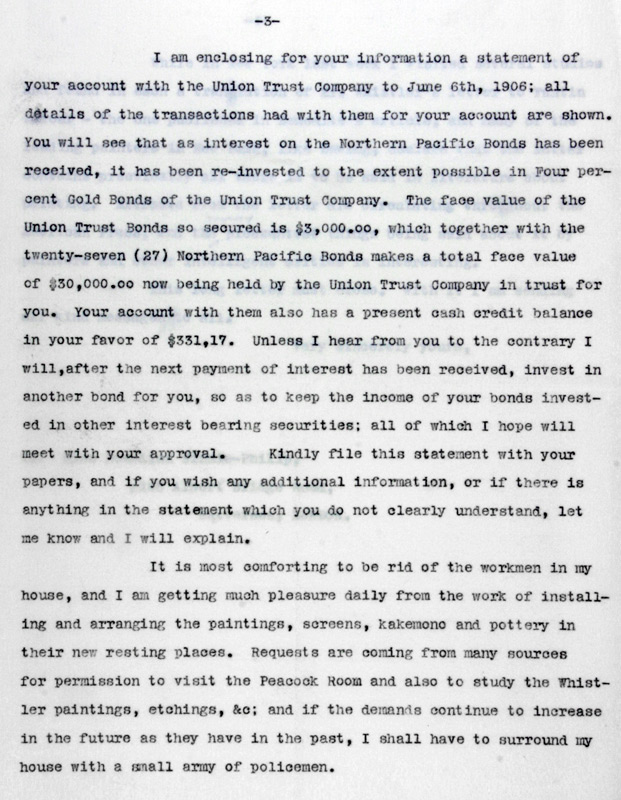
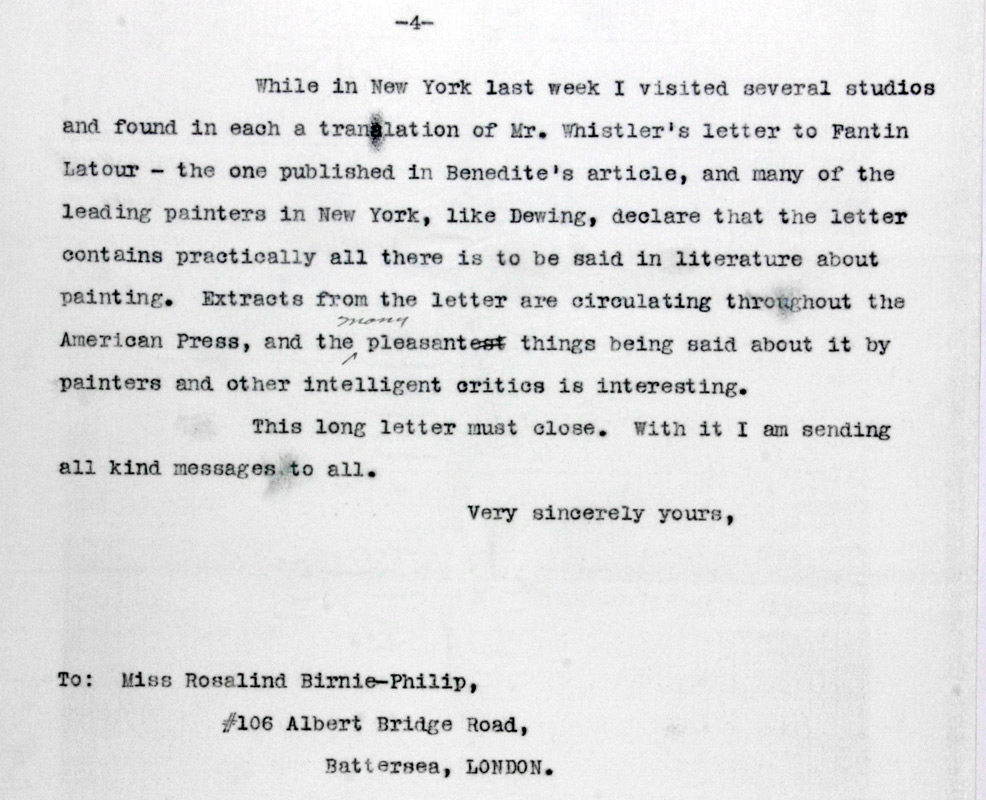
Charles Lang Freer to Rosalind Birnie Philip, June 20, 1906
"Requests are coming from many sources for permission to visit the Peacock Room and also to study the Whistler paintings, etchings, &c.; and if the demands continue to increase in the future as they have in the past, and I shall have to surround my house with a small army of policemen."
Freer continues to collect Raqqa ware
Peacock Room is installed in specially-built annex to Freer's Detroit home
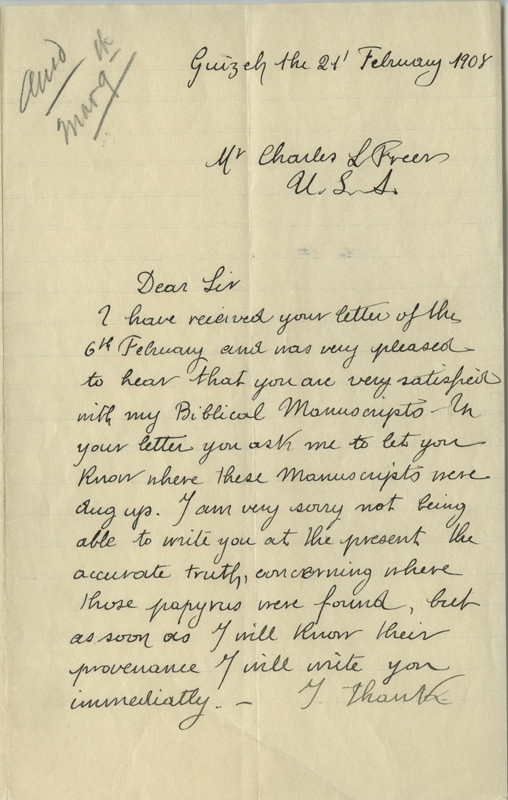
Cheikh Ally to Charles Lang Freer, February 21, 1908
"In your letter [of Feb. 6] you ask me to let you know where these manuscripts were dug up. I am very sorry not being able to write you at the present the accurate truth... but as soon as I will know their provenance I will write you immediately."
Freer travels to Egypt, where he purchases a group of ancient Biblical manuscripts, including the third-oldest extant parchment codex of the Gospels
Upton Sinclair publishes The Jungle
-
1907
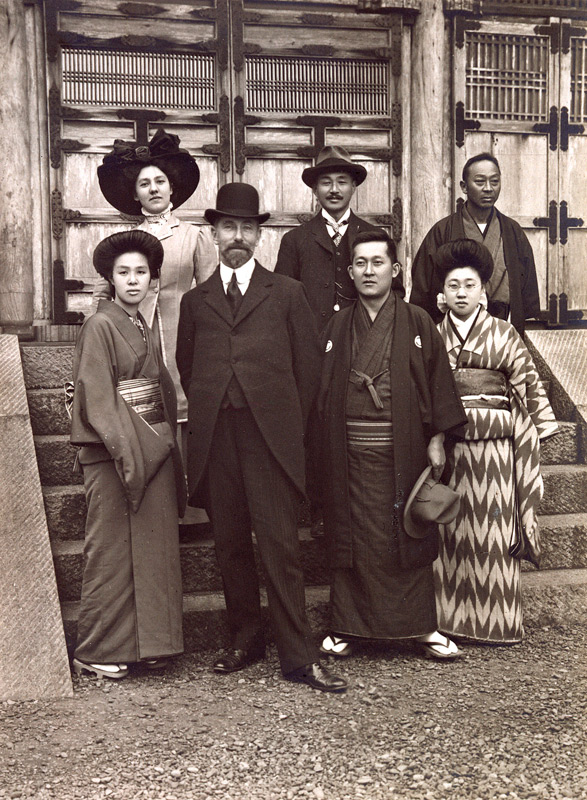
Freer with collector Hara Tomitarō (front right), in front of an ancient temple on Hara's estate, Sannotini, 1907. Also shown: Hara's wife (front, far right) and daughter (front left). Second row, left to right: possibly Margaret Watson, a Detroit collector; Nomura Yōzō, a Yokohama art dealer, and Freer's ricksha man (A1078)
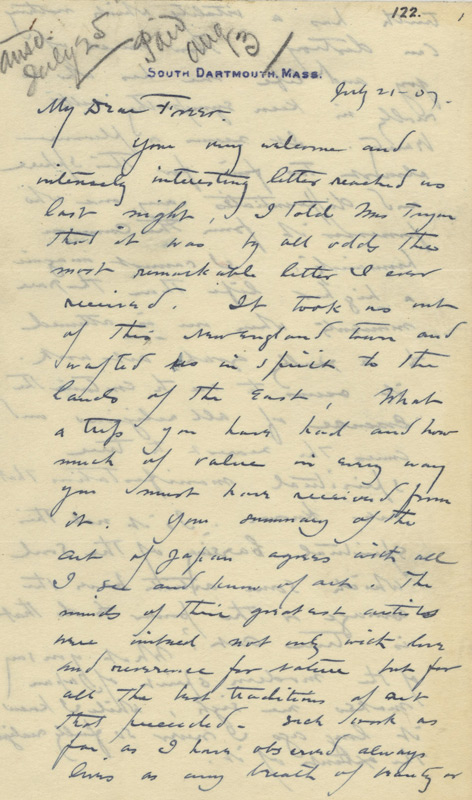
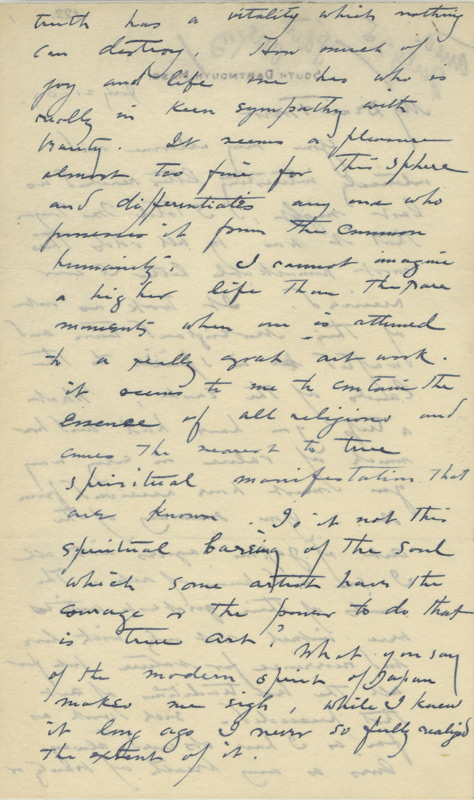
Dwight Tryon to Charles Lang Freer, July 21, 1907
"Your summary of the art of Japan agrees with all I see and know of art... I cannot imagine a higher life than the rare moments when one is attuned to a really great art work. It seems to me to contain the essence of all religions and comes the nearest to true spiritual manifestations that are known. Is it not this spiritual baring of the soul which some artists have the courage or the power to do that is true art?"
Freer makes second trip to Japan, where he acquires a number of works directly from collectors
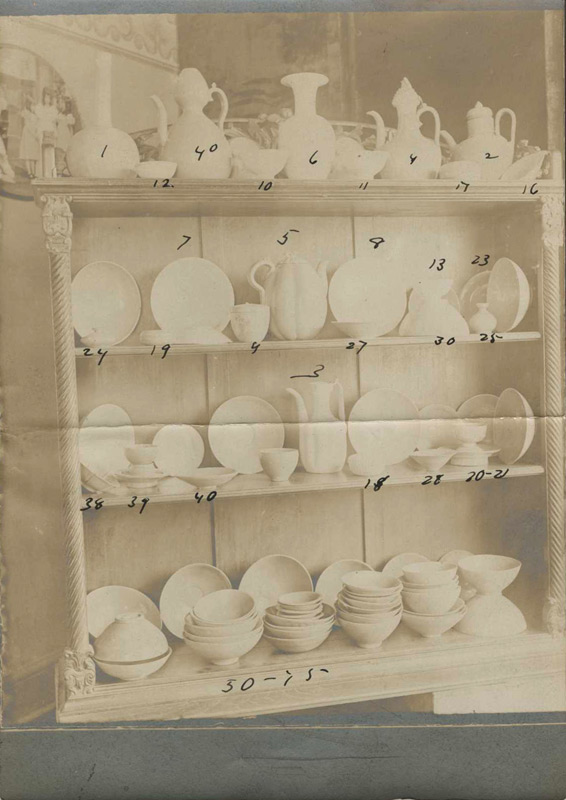
Horace Allen Collection of Korean and Chinese ceramics, ca. 1907
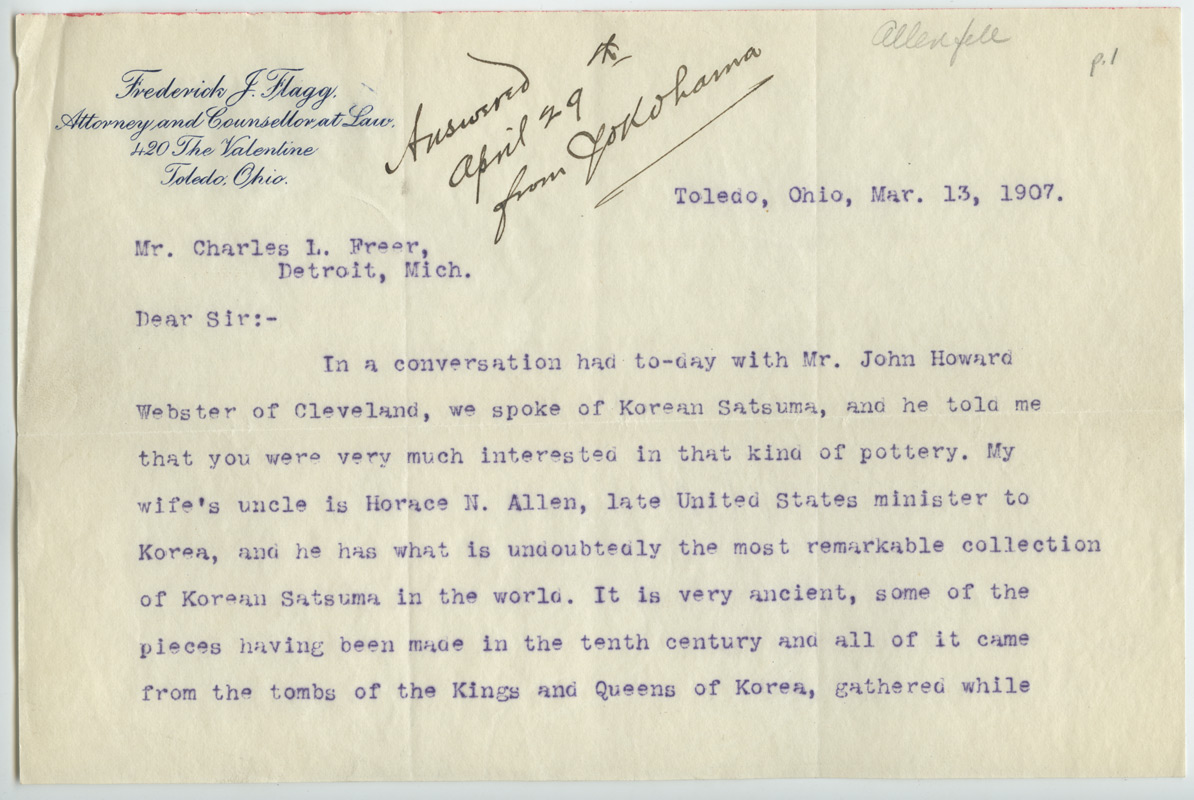
Frederick J. Flagg to Charles Lang Freer, March 13, 1907
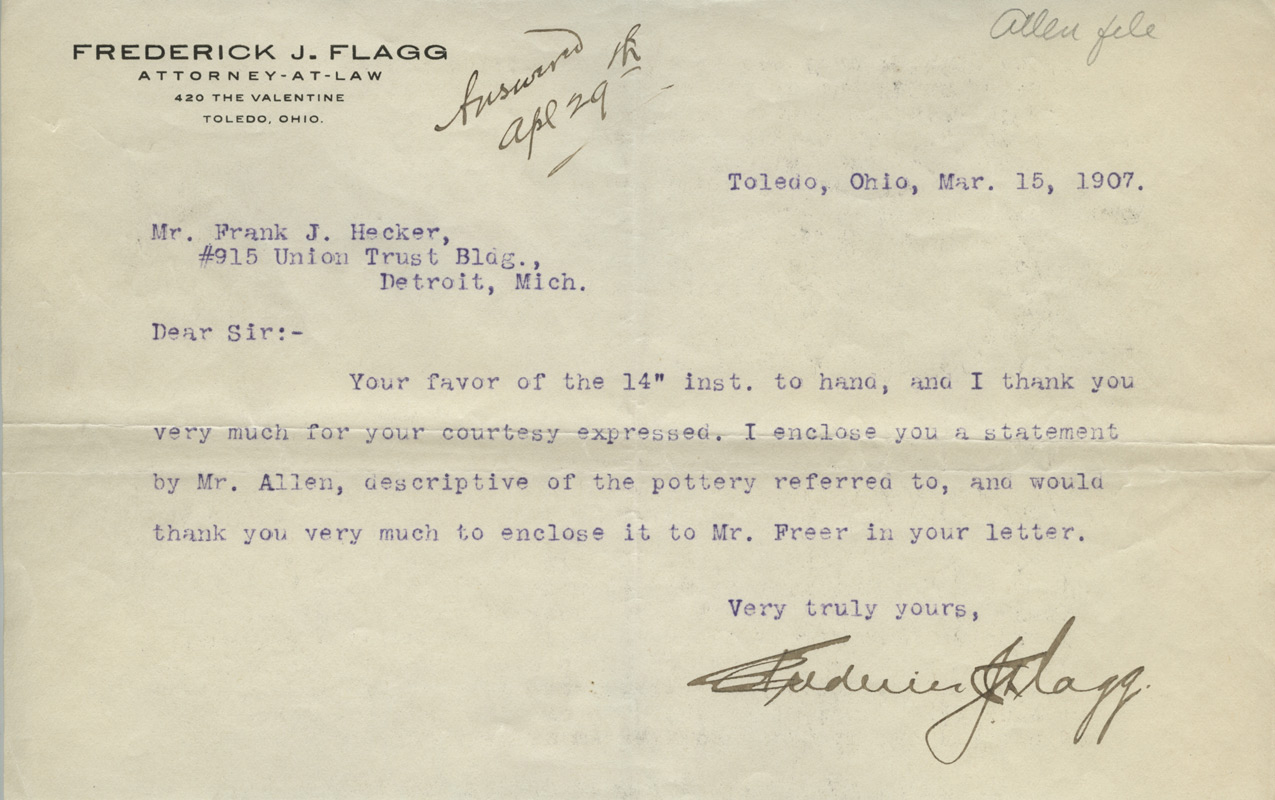
Frederick J. Flagg to Charles Lang Freer, March 15, 1907
Freer commissions Hecker to purchase for him the Allen collection of 82 Korean and Chinese ceramics
-
1908
Freer installs Peacock Room with more than 250 ceramics from his collection of wares from all over Asia
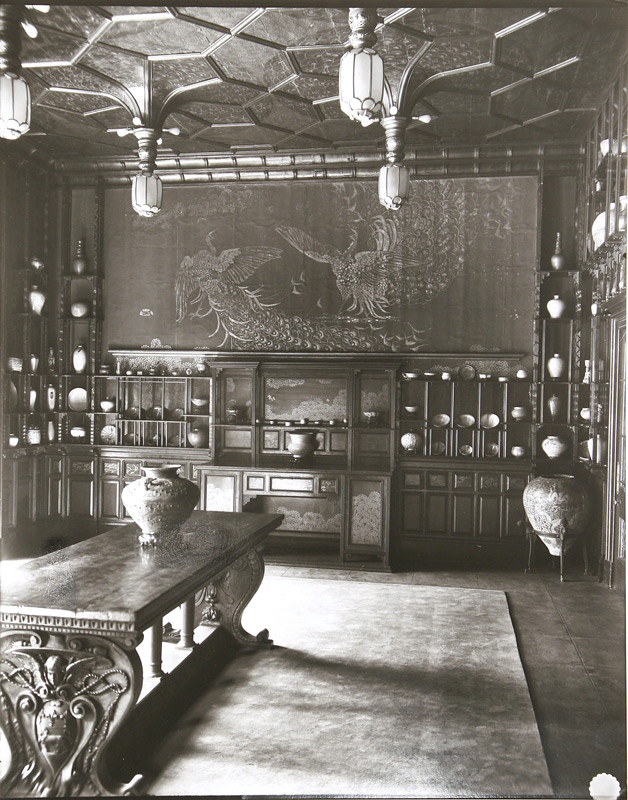
1. George W. Swain, south wall of the Peacock Room, 1908
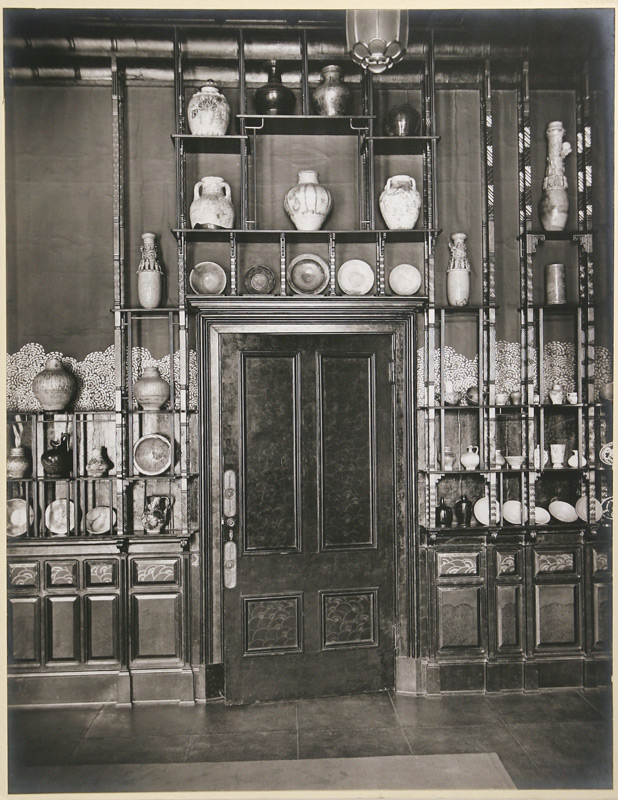
2. George W. Swain, detail of west wall of the Peacock Room, 1908
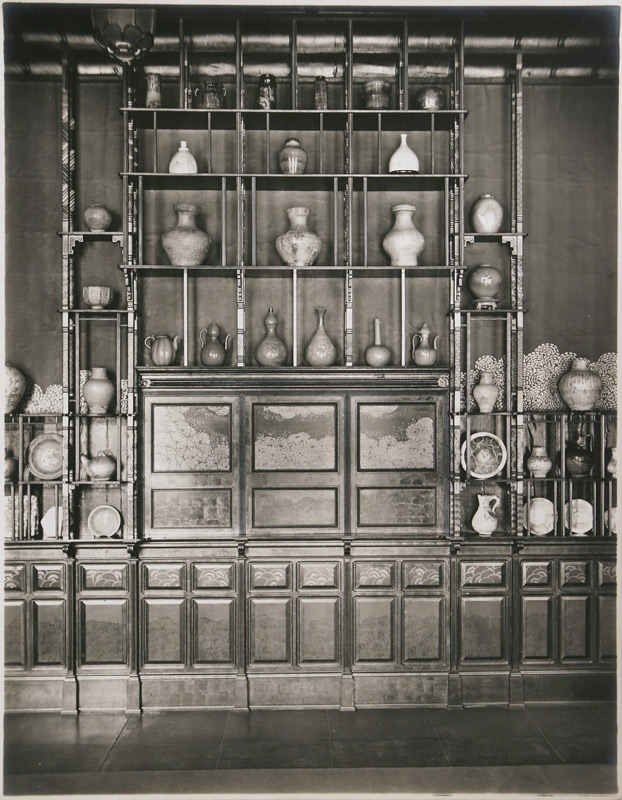
3. George W. Swain, detail of west wall of the Peacock Room, 1908
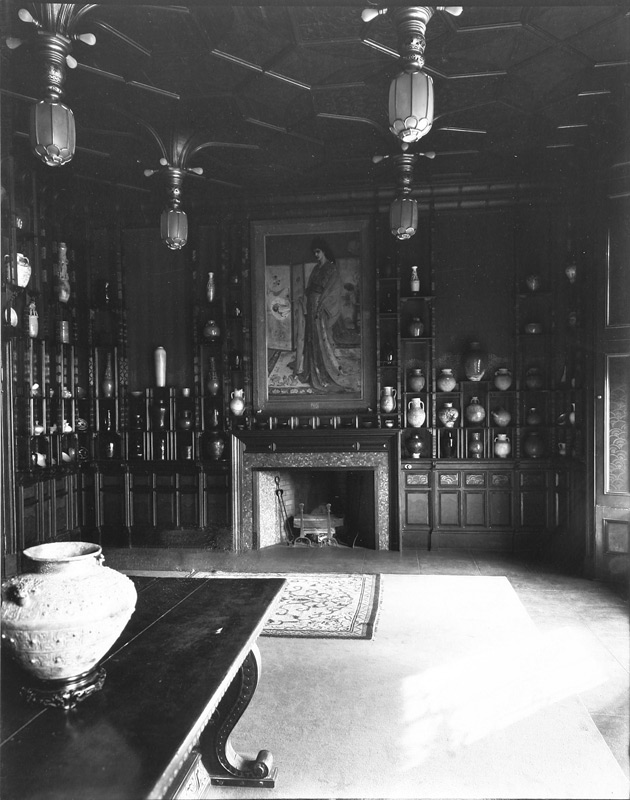
4. George W. Swain, north wall of the Peacock Room, 1908
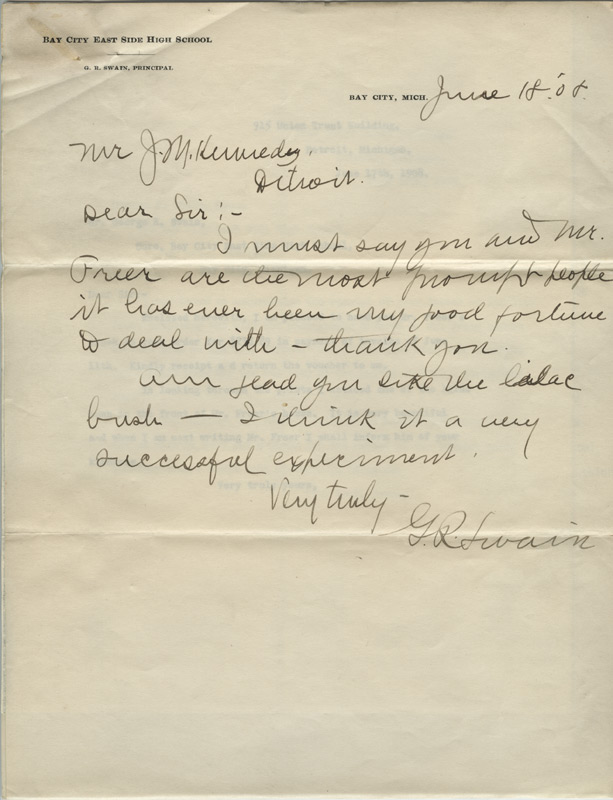
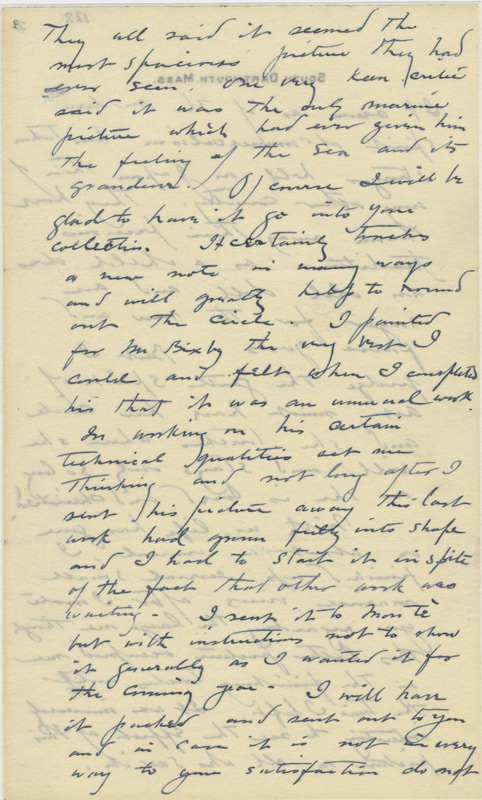
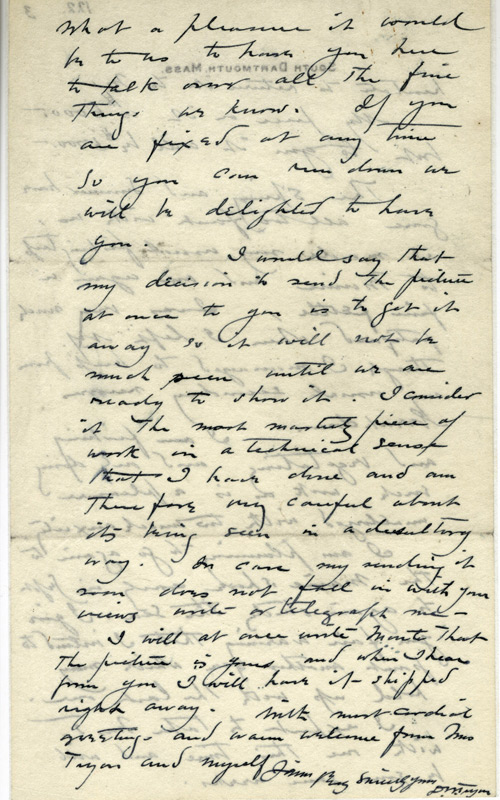
George Swain to JM Kennedy, June 18, 1908
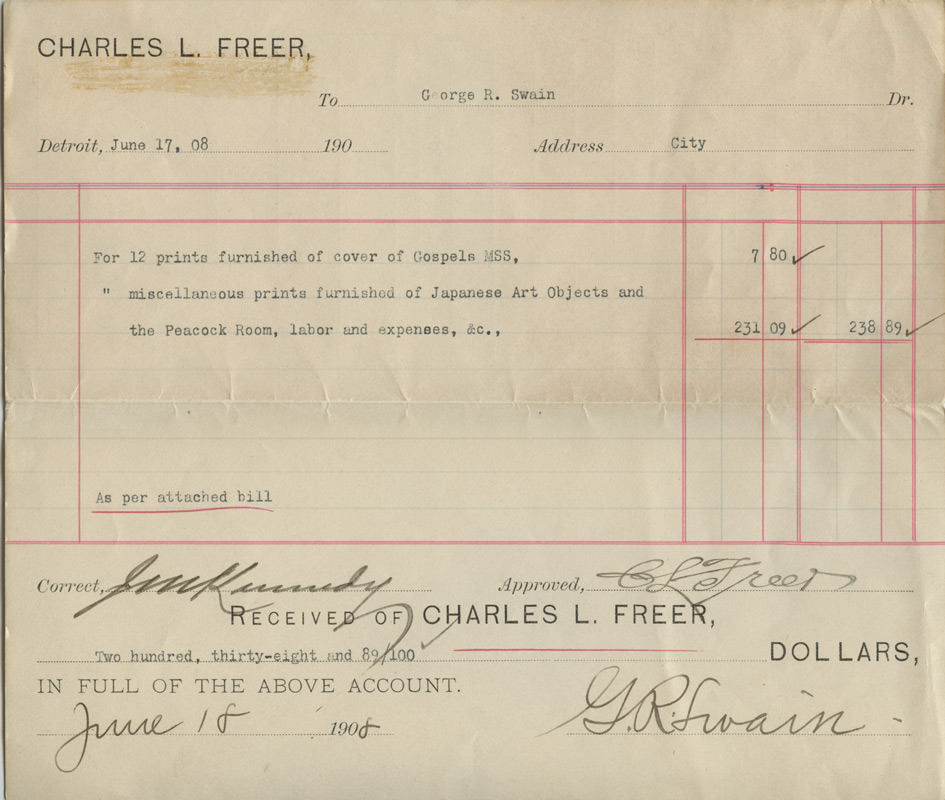
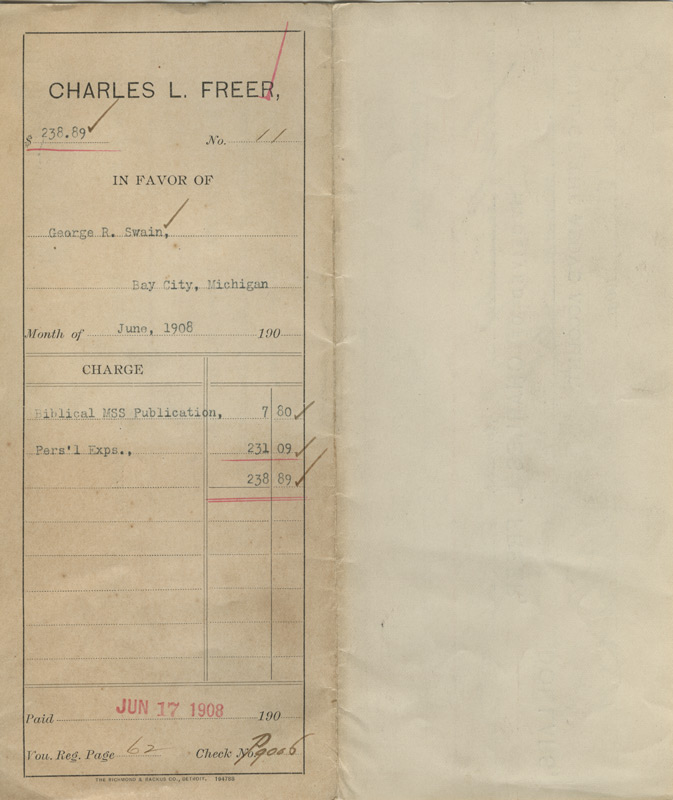
Invoice from Charles Lang Freer to George Swain, June 17, 1908
George W. Swain photographs the Peacock Room in June
Freer makes third trip to Asia, specifically to study Raqqa ware
-
1909
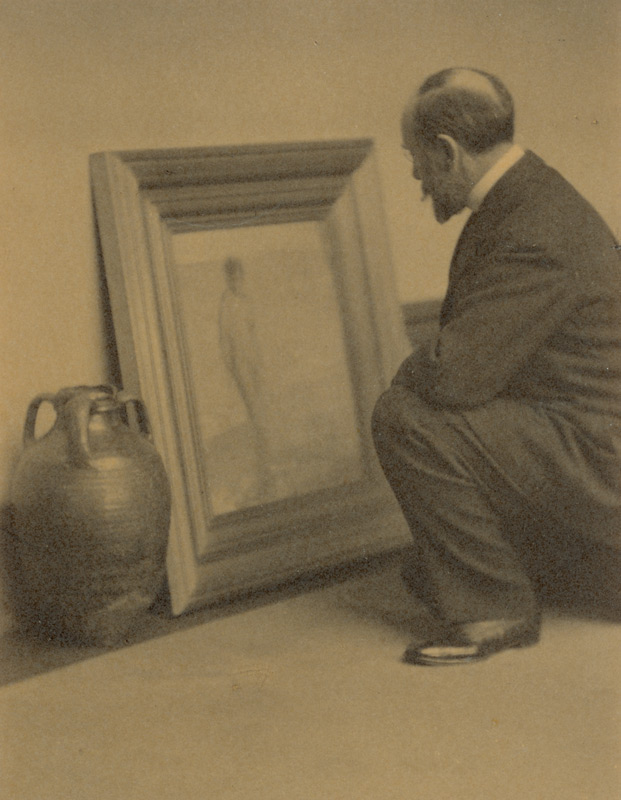
Freer comparing Whistler's Venus Rising from the Sea (F1903.174) to an Islamic glazed ceramic pot (F1905.61), 1909. Photograph by Alvin Langdon Coburn
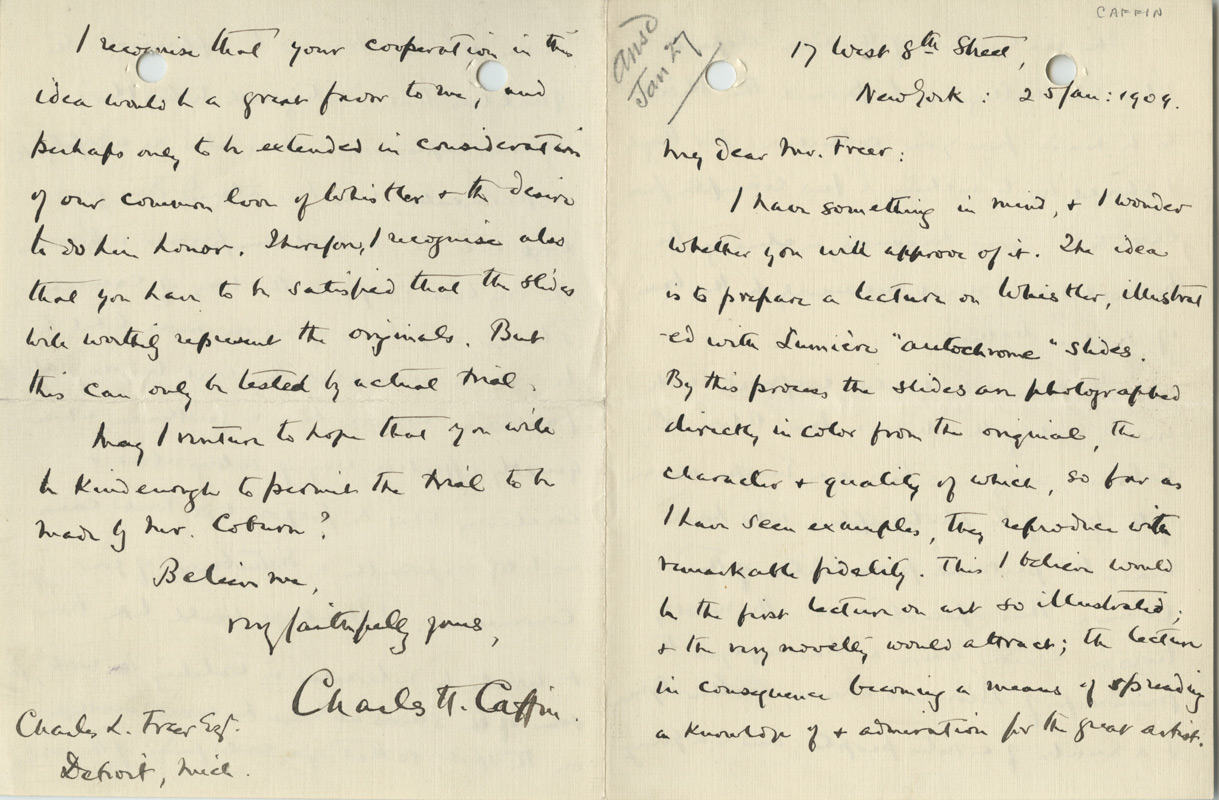
Charles Caffin to Charles Lang Freer, January 25, 1904
"The idea is to prepare a lecture on Whistler, illustrated with Lumière 'autochrome' slides... [by] Mr. Alvin L. Coburn..., one of the best of the photographers who have made the pictorial possibilities of the camera their special aim... Your treasures, including the Peacock Room, must necessarily be the basis of such a lecture."
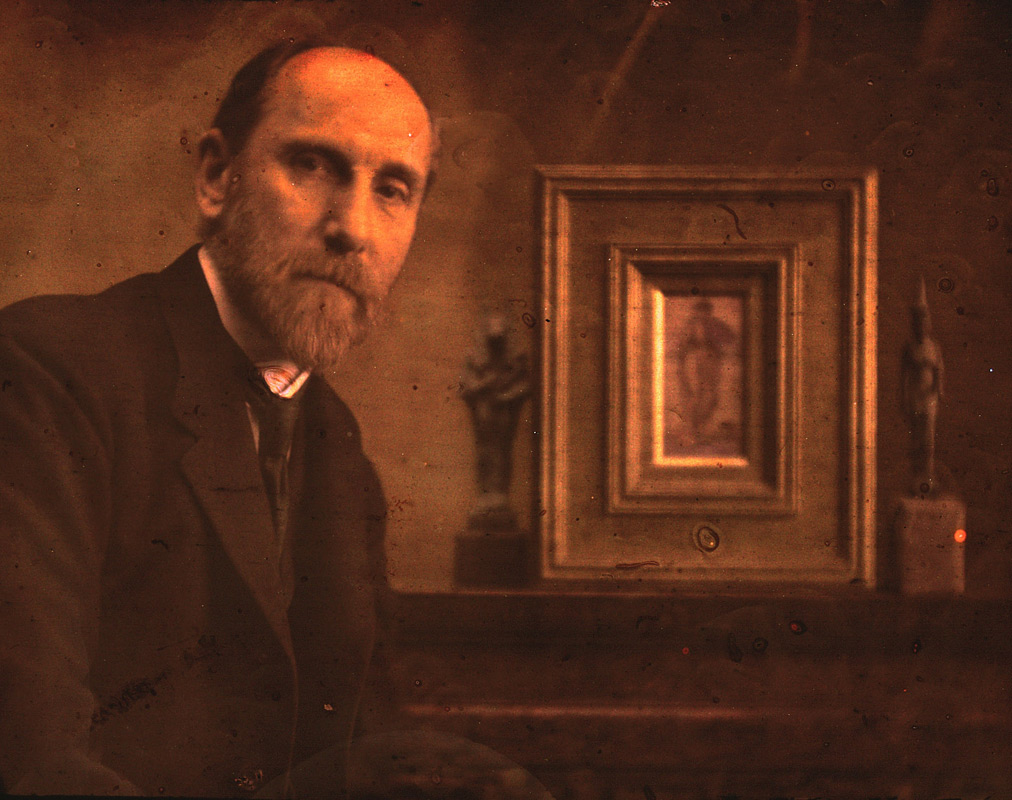
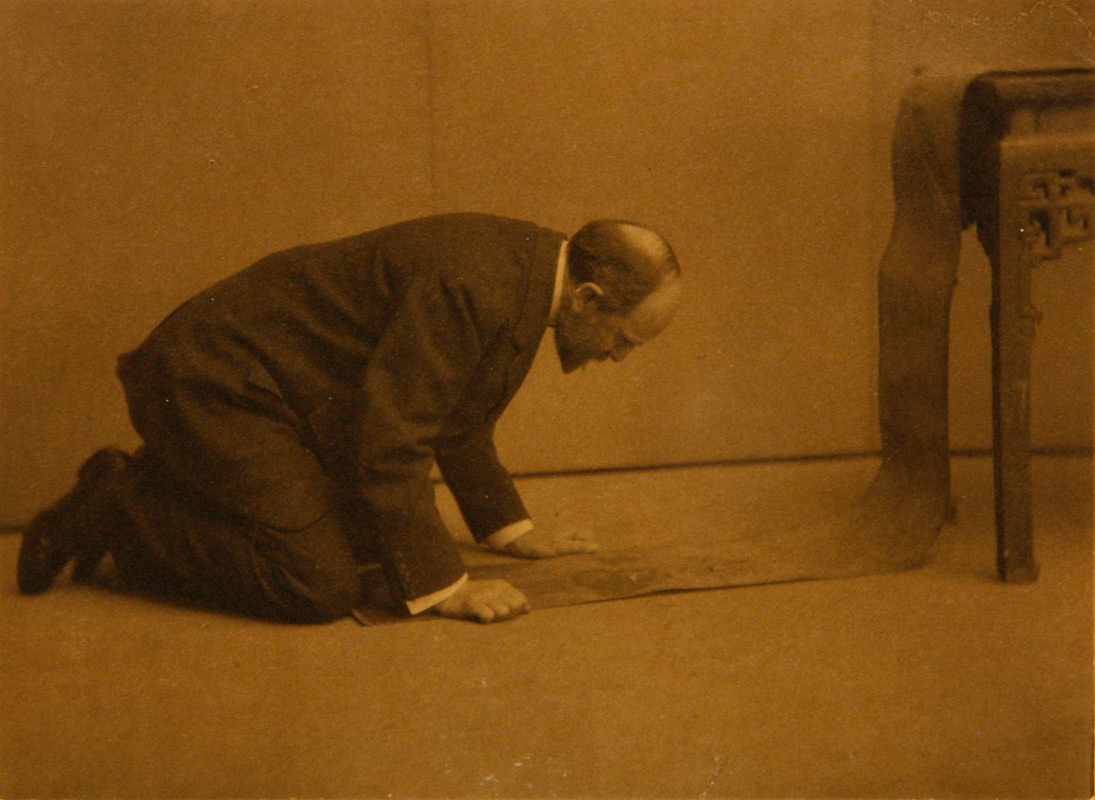
Charles Lang Freer with objects from his collection, 1909. Photographs by Alvin Langdon Coburn
Alvin Langdon Coburn visits Detroit and photographs Freer's collections, including the Peacock Room, using the autochrome process
Freer travels to China
Freer tours Europe to study the design of art museums
1909
First Lady Helen Taft plants first Japanese cherry trees along the Potomac River in Washington, D.C.
Ford Motor Company produces the first Model Ts from its Detroit factory
-
1910
Freer makes final trip to Asia, embarking from San Francisco; visits Buddhist caves at Longmen, Henan for study and acquisition
Kelekian publishes The Kelekian Collection of Persian and Analogous Potteries, 1884-1911
-
1911
Freer suffers stroke shortly after returning from China
Chinese revolution, led by Sun Yat-Sen, overthrows Qing dynasty
-
1912
Freer loans part of his collection for a preview exhibition to the Smithsonian's newly opened 'National Museum' building, now the National Museum of Natural History.
-
1913
Freer commissions architect Charles Adams Platt (1861-1933) to design museum in Washington
Armory Show in New York City introduces European modernism to American
-
1914
Freer meets Katharine Nash Rhoades (1885-1965), who will become his confidante and assistant
World War I begins in July; Panama Canal opens in August
-
1915
Freer settles in New York City
First long distance telephone service, between San Francisco and New York, is introduced
-
1916
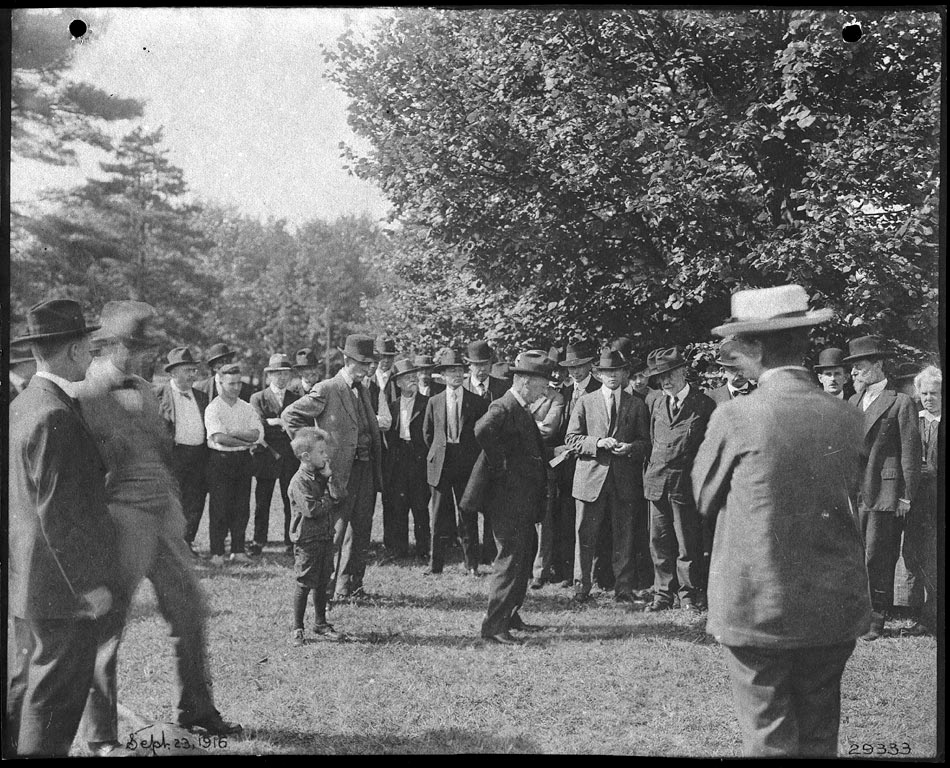
The groundbreaking of the Freer Gallery of Art on September 23, 1916, Smithsonian Institution Archives
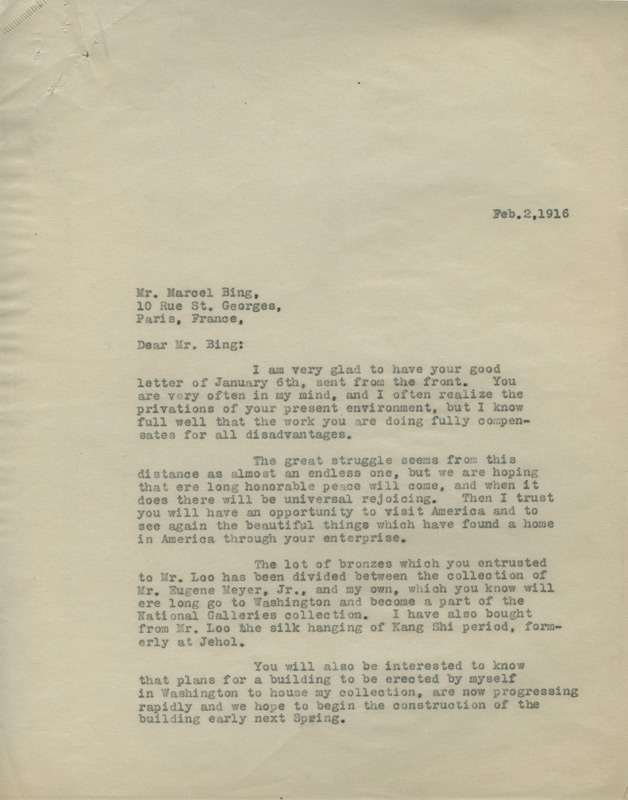
Marcel Bing to Charles Lang Freer, February 2, 1916
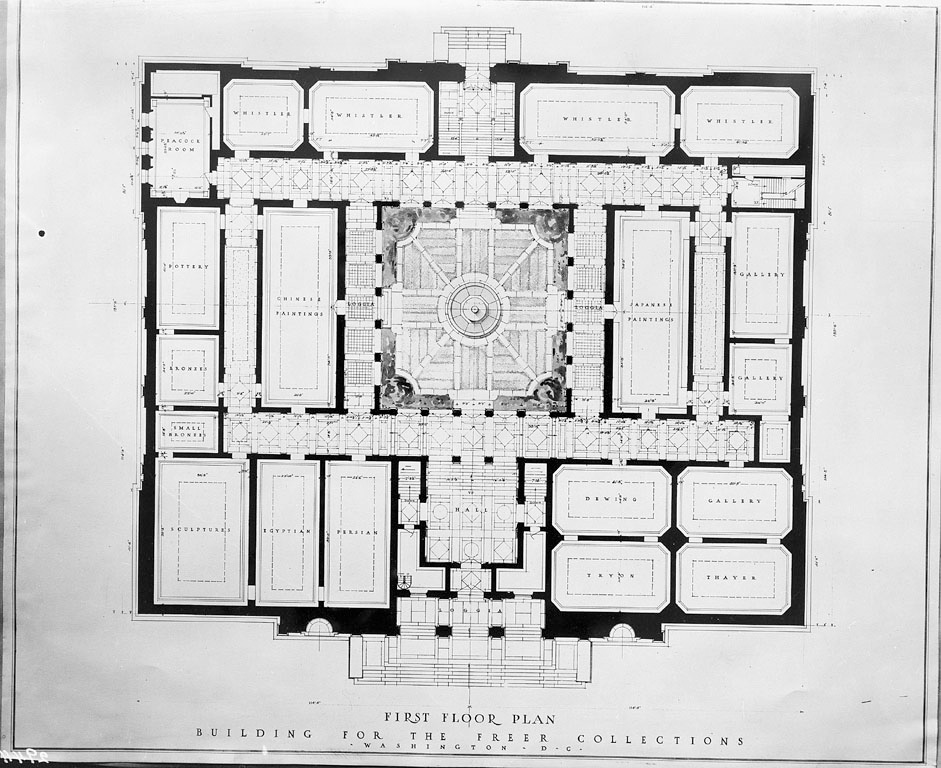
The first floor plan of the Freer Gallery of Art. Smithsonian Institution Archives.
Construction of the Freer Gallery begins on the National Mall
-
1917
U.S. enters World War I
-
1918
Construction of the Freer Gallery delayed by war
-
1919
Freer adds codicil to his will, allowing for future acquisitions to Asian collections after his death
Freer suffers final illness and dies in New York City on September 26
Construction of Freer Gallery completed
Treaty of Versailles ends World War I
-
1920
John Ellerton Lodge (1876-1942) of Boston becomes first director of the Freer Gallery
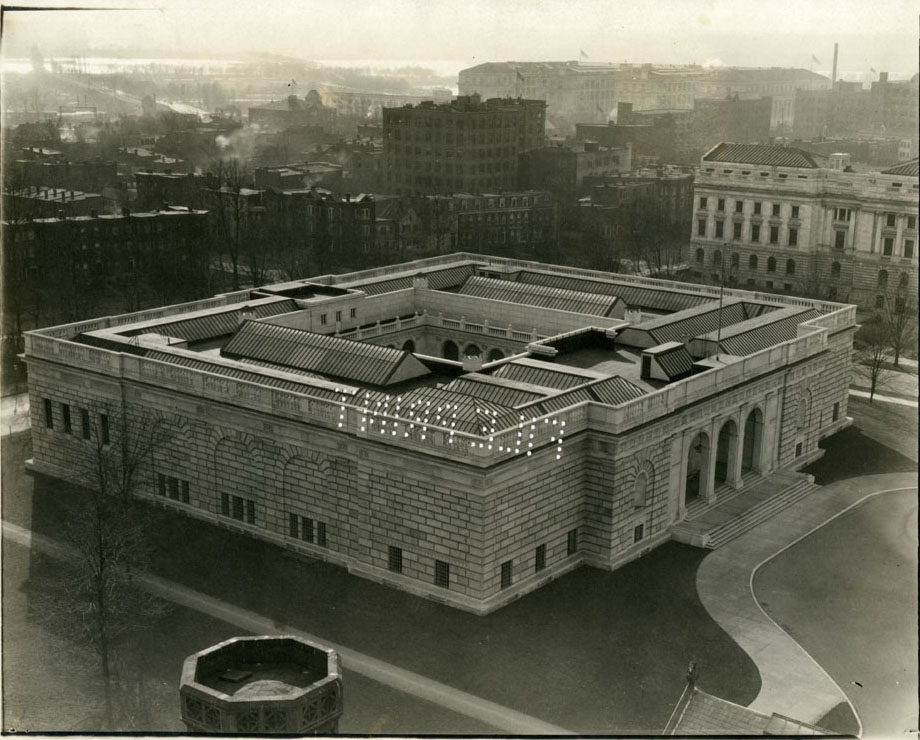
Aerial view of the Freer Gallery of Art, ca. 1923
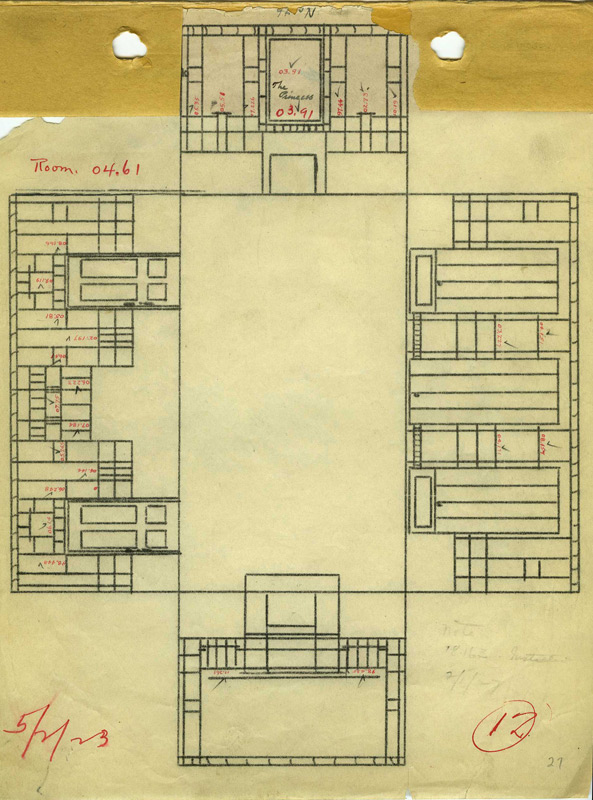
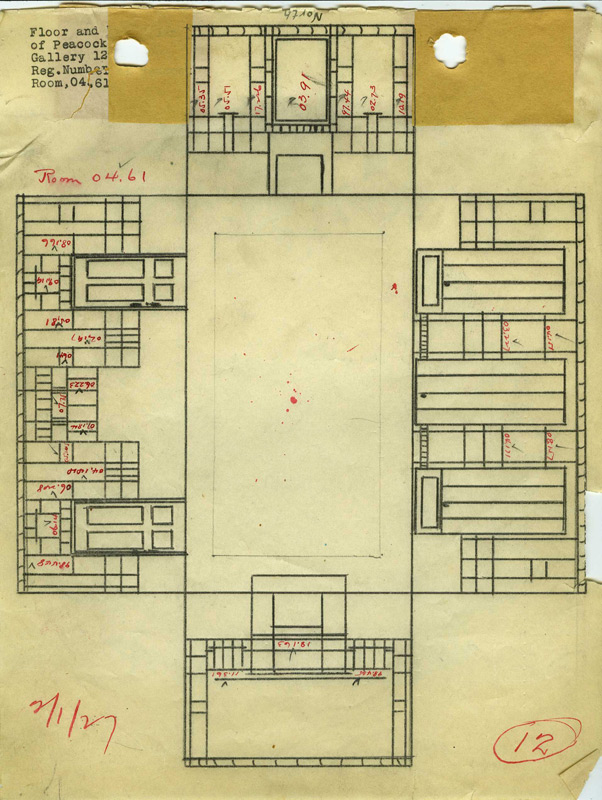
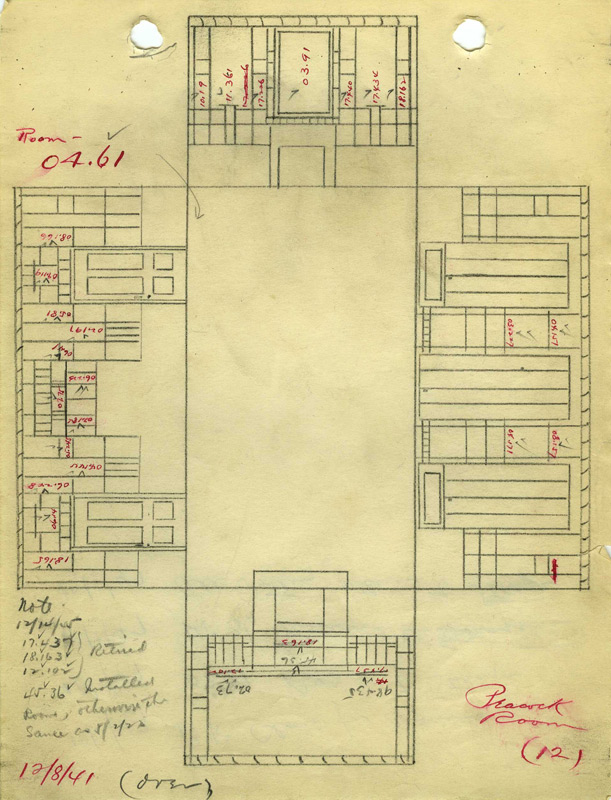
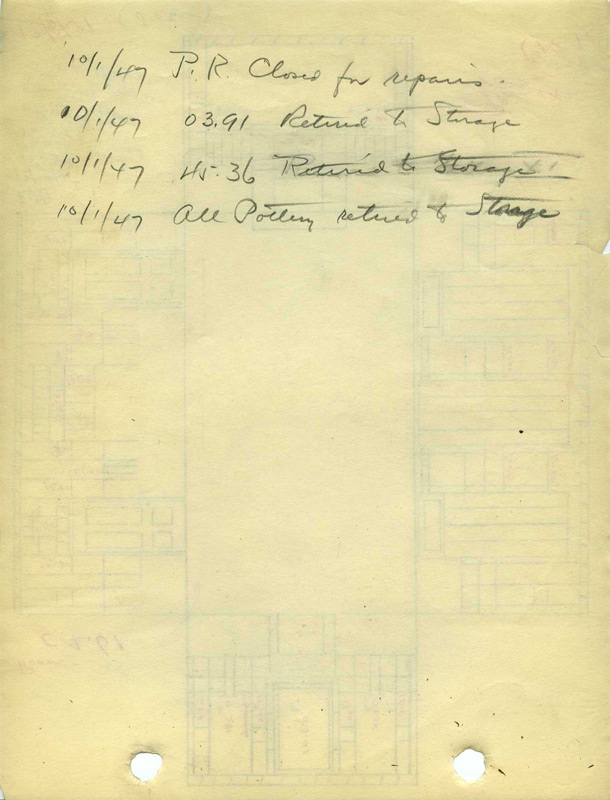
Plans describing the layout of the Peacock Room on May 2, 1923; February 1, 1927; and December 8, 1941 (with verso) in the Freer Gallery of Art
Freer Gallery opens to the public on May 2, with some 9,000 pieces of Asian and American art
-
1947
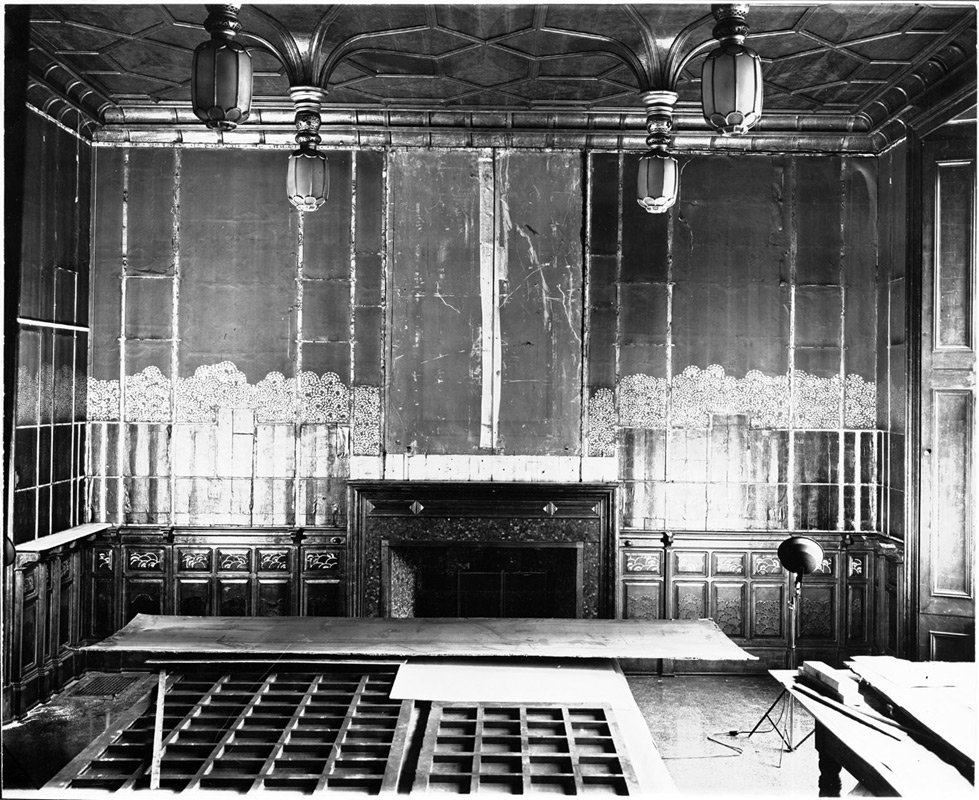
Art restorers John and Richard Finlayson repair sections of the Peacock Room between 1947 and 1950
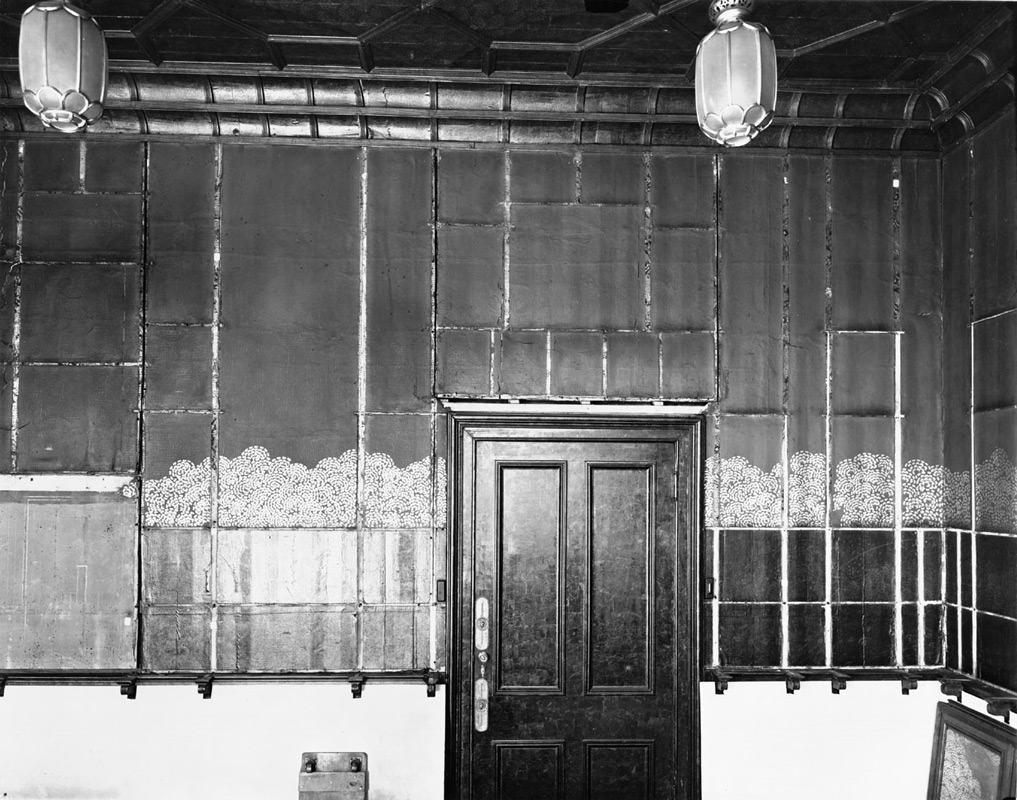
Finlayson renovation photos showing north wall (A0407) and west wall (A0408) with shelving removed
-
1989
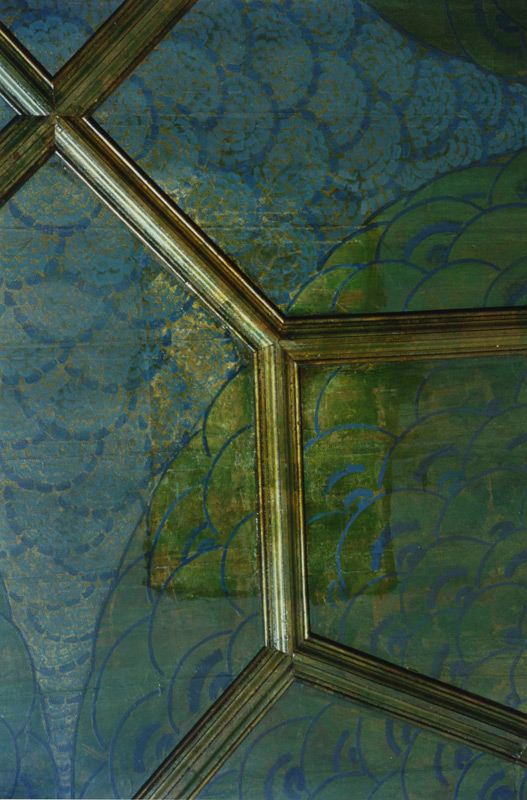
Detail of preliminary cleaning test on Peacock Room ceiling, 1989

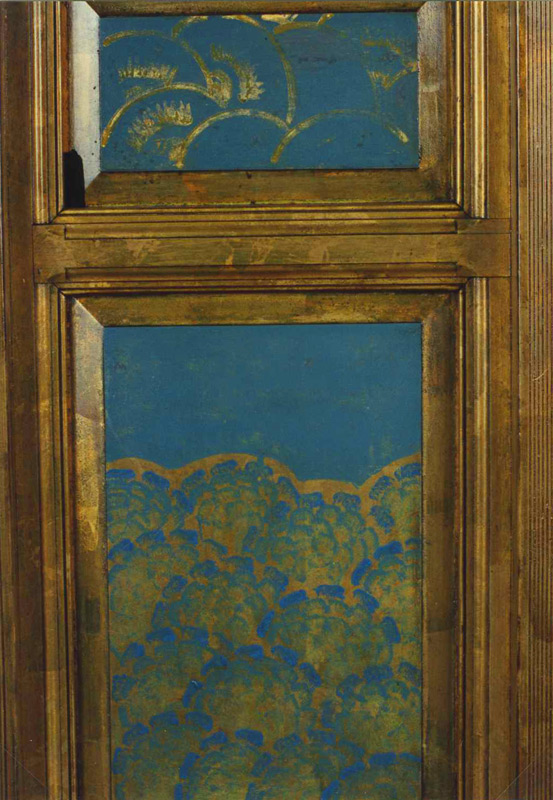
Detail of west wall of Peacock Room after cleaning and varnishing, showing panels before and after inpainting
Conservation photos; post-conservation photos
-
1993
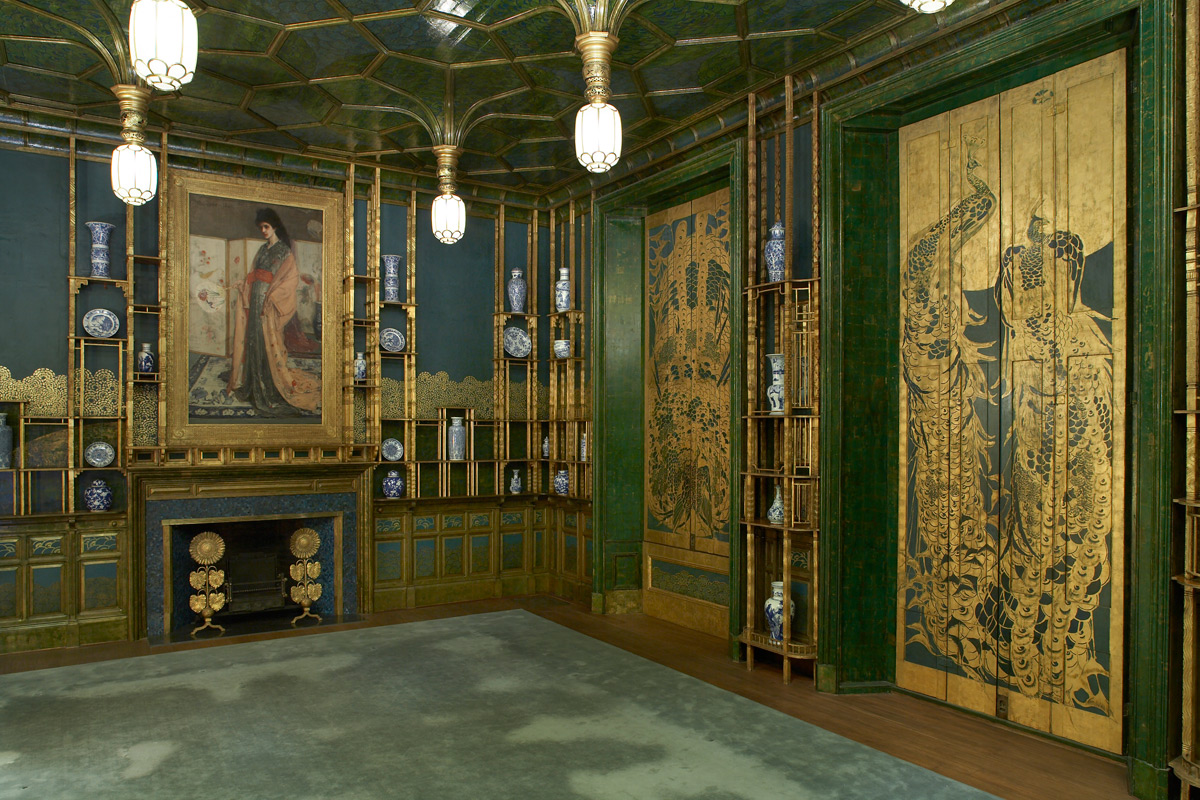
"Harmony in Blue and Gold: The Peacock Room" (F1904.61)
Freer gallery installs blue-and-white Kangxi porcelain to evoke the appearance of the Peacock Room at Prince's Gate
-
2011
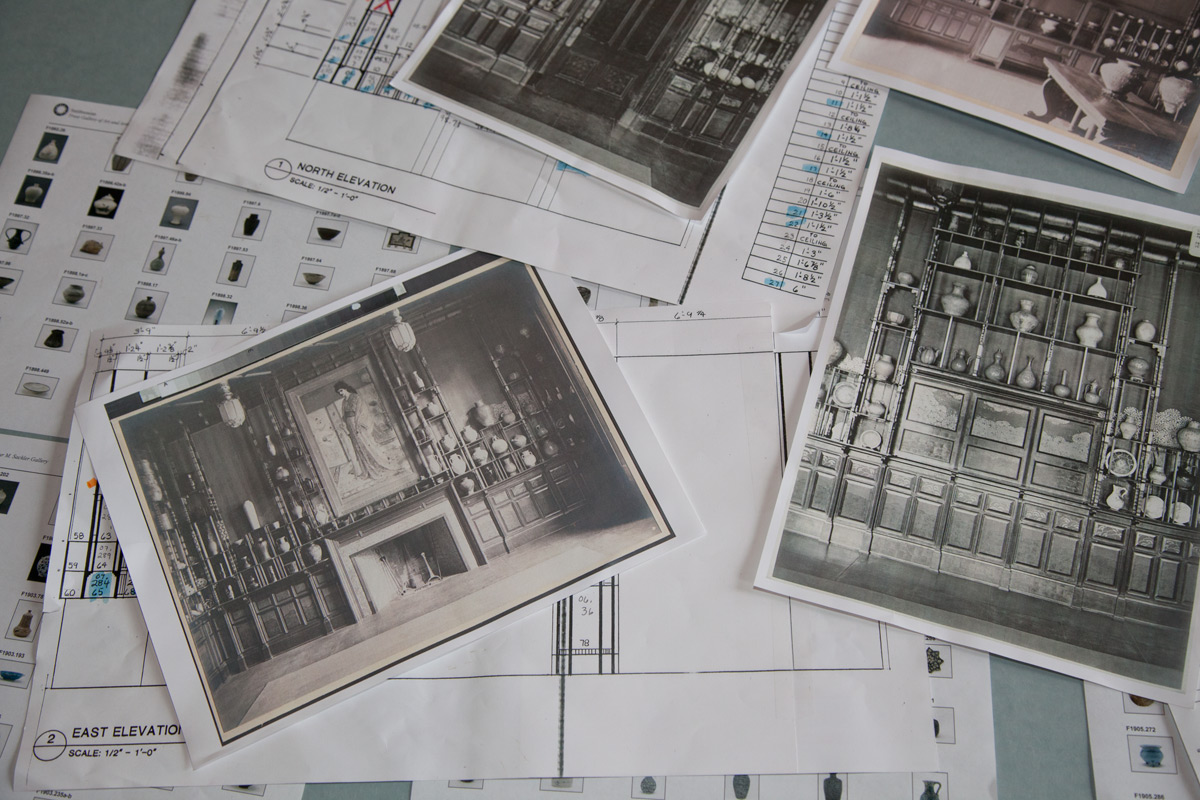
Archival photographs and elevations that guided the reinstallation

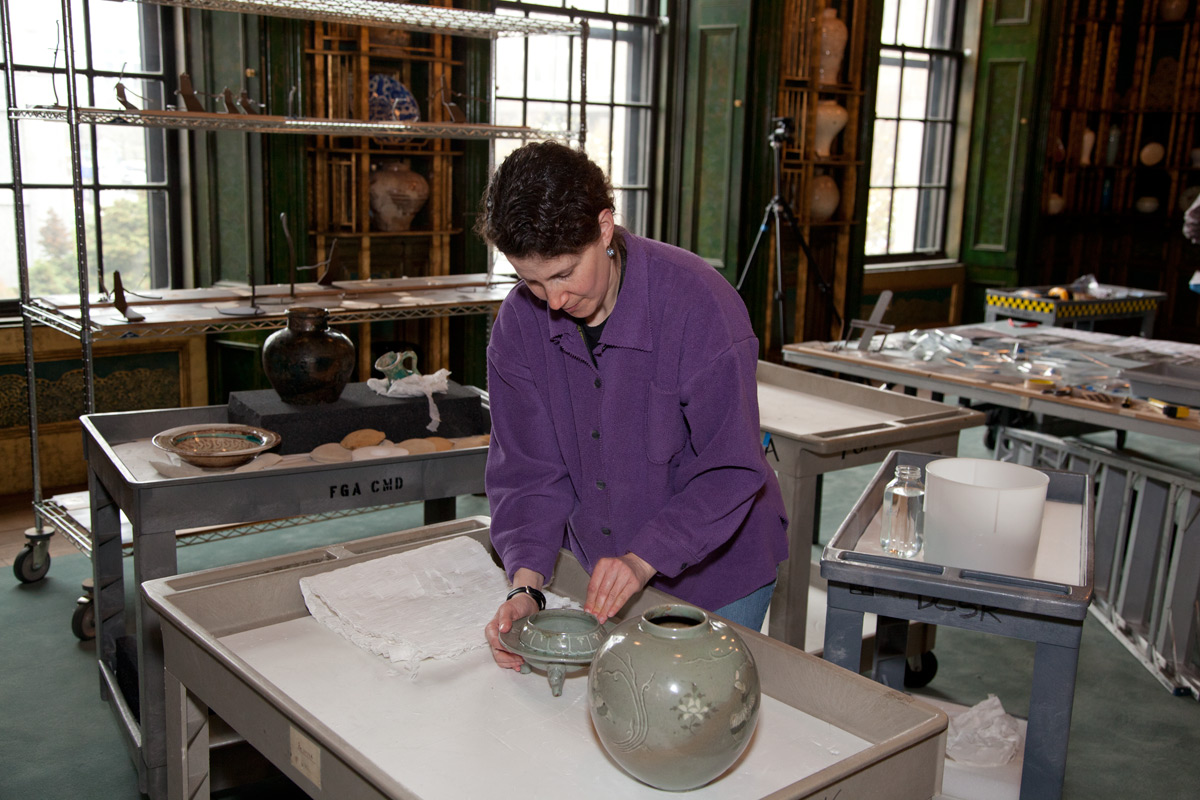
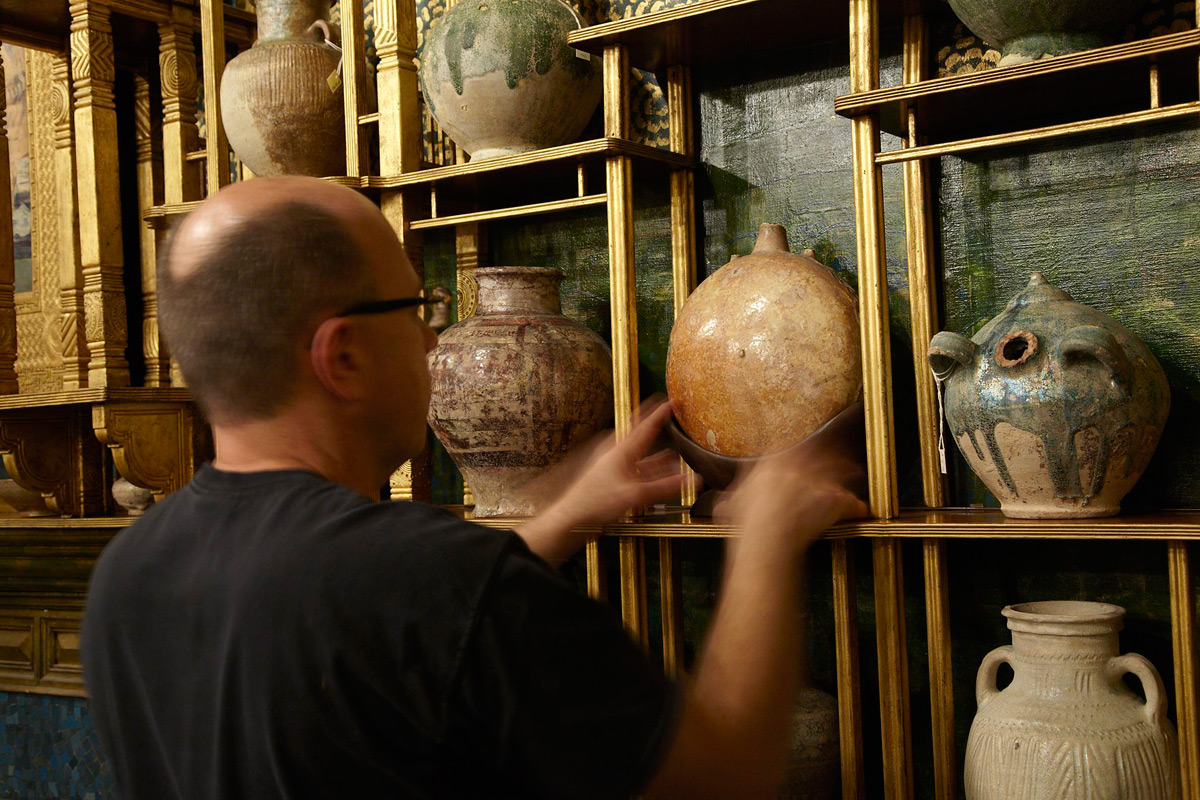
Freer staff installs 'The Peacock Room Comes to America,' March 2011
Peacock Room reinstalled as it was in Detroit in 1908 for The Peacock Room Comes to America
-
2012
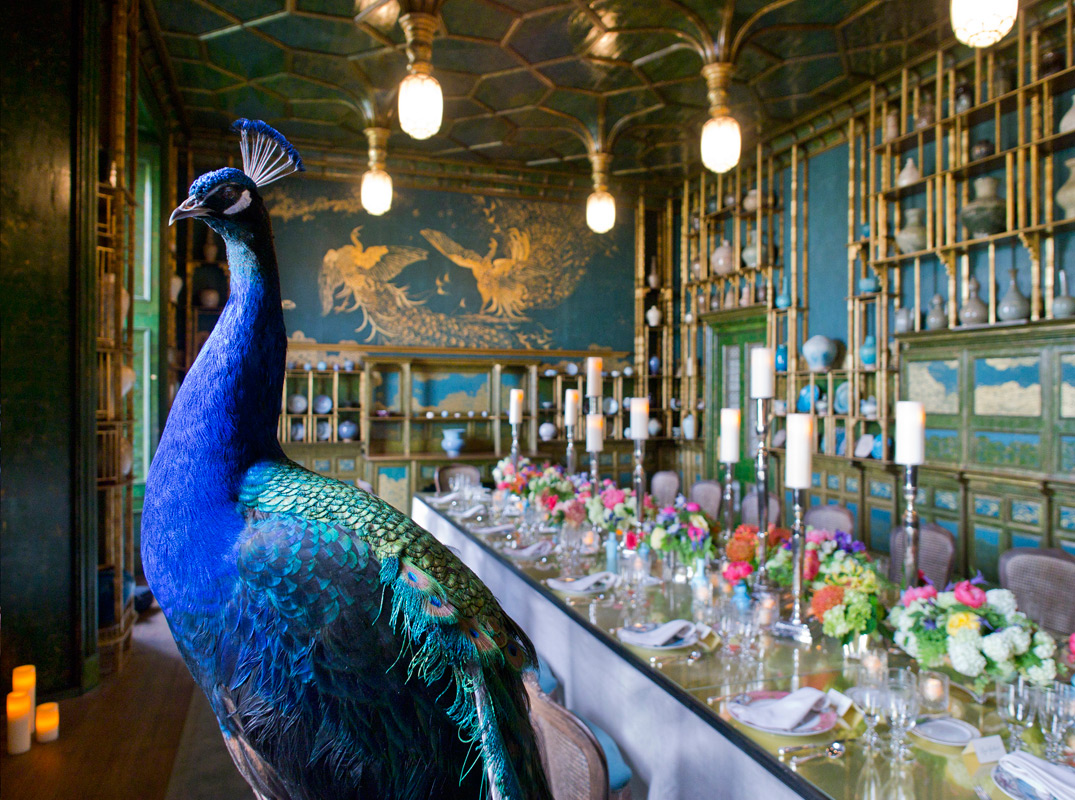
Dinner celebrating 'The Peacock Room Comes to America,' April 2012